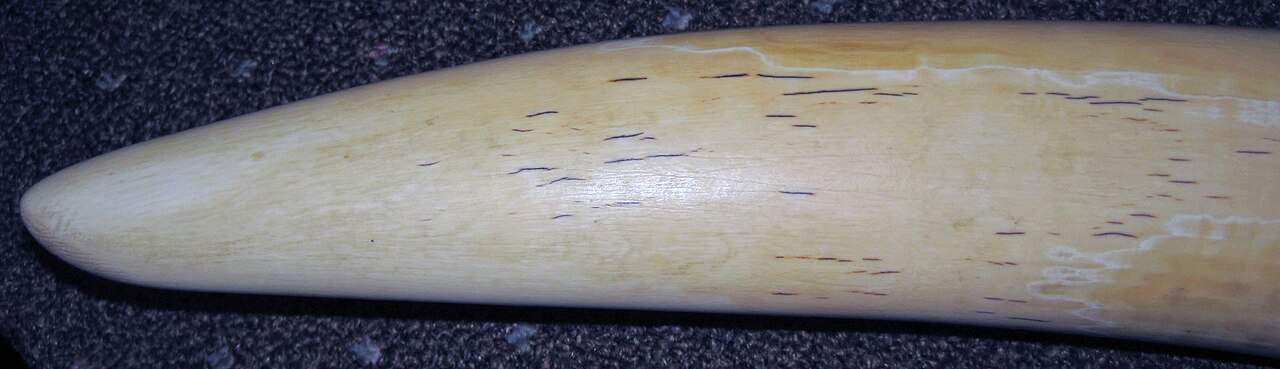
Woolly Mammoth Tusk
Zanna di Mammut
Ca₅(PO₄)₃F Properties
- Category
- Fossil
The woolly mammoth tusk is a fossil of ivory (fluorapatite, Ca₅(PO₄)₃F) preserved in permafrost for tens of thousands of years: a tangible testament to Pleistocene megafauna that went extinct approximately 4,000 years ago.
The woolly mammoth tusks (Mammuthus primigenius) represent one of the most fascinating fossils of the Quaternary. Chemically composed of fluorapatite (Ca₅(PO₄)₃F), with a residual organic matrix of collagen and other biopolymers, these remains have been preserved extraordinarily well thanks to the cryogenic conditions of Siberian, Canadian, and Alaskan permafrost. Tusks could reach 4–5 meters in length and weigh up to 90 kg, curving in a characteristic geometry that reflected the underlying hexagonal crystal structure of apatite.
From a paleontological perspective, each tusk tells a story of annual growth: growth rings (similar to those in trees) permit dating of the individual and reconstruction of climatic and dietary conditions. Color varies from creamy white to dark brown, depending on the degree of mineralization and exposure to environmental oxidants. Today, mammoth tusks are the subject of paleogenetic research (ancient DNA extraction) and represent invaluable scientific heritage for understanding late Pleistocene megafauna and extinction mechanisms.
Composition: Ca₅(PO₄)₃F (fluorapatite); traces of Ca₁₀(PO₄)₆(OH)₂ (hydroxyapatite), residual organic matrix (collagen ~5–15% dry weight).
Crystal system: Hexagonal, space group P63/m, lattice parameters a ≈ 9.37 Å, c ≈ 6.88 Å.
Hardness: 2.5–3 Mohs (lower than pure mineral due to organic degradation and residual porosity).
Density: 3.1–3.2 g/cm³ (lower than 3.2 of pure crystalline apatite, owing to organic component).
Refractive index: nω ≈ 1.633, nε ≈ 1.627 (negative birefringence).
Raman spectroscopy: characteristic PO₄³⁻ bands at 960 cm⁻¹ (symmetric stretching), 1070 cm⁻¹ (asymmetric stretching); organic signals at 1450 cm⁻¹ (C-H bending) and 1650 cm⁻¹ (collagen amide I).
FTIR spectroscopy: strong peaks at 1030–1090 cm⁻¹ (PO₄), 600 cm⁻¹ (P-O bending), 3300–3500 cm⁻¹ (O-H and N-H stretching from organic matrix).
Dating: ¹⁴C for samples < 50,000 years; ²⁶Al/¹⁰Be for older ages (up to 100,000+ years). Typical ages: 10,000–50,000 years before present.
Taphonomy: Exceptional preservation is due to rapid freezing in permafrost, which arrests bacterial degradation and reduces oxidation. Residual porosity (20–30%) reflects loss of water and organic matter over geological time.
Mining localities
- Siberia, Russia
- Alaska, Stati Uniti
- Yukon, Canada
- Groenlandia
- Scandinavia
Frequently Asked Questions
How much does an authentic woolly mammoth tusk cost?
The price of an authentic woolly mammoth tusk ranges from 500 to 50,000 euros depending on size, preservation condition, and certified provenance. Complete specimens well-preserved from Siberian permafrost command higher prices on the international market, while fragments or fossilized molars cost less. Authenticity must always be verified through paleontological certificates and radiometric analysis.
When did the woolly mammoth go extinct and where are tusks found today?
The woolly mammoth (Mammuthus primigenius) went extinct approximately 4,000 years ago, with the last populations disappearing on Arctic islands in eastern Siberia around 2000 BCE. Fossil tusks are primarily found in Siberian permafrost (Russia, Alaska, and Canada), extracted from glacial deposits 5 to 40 meters deep, where permanent freezing has preserved the ivory for tens of thousands of years. Thousands of tusks are discovered annually by professional and amateur fossil hunters in Arctic regions.
What is the microscopic structure of a mammoth tusk and how did it form?
A mammoth tusk is composed of fossilized dentin covered by enamel, with a crystalline structure of fluorapatite (Ca₅(PO₄)₃F) organized in concentric tubules characteristic of ivory. It formed from continuous tusk growth during the animal's lifetime, accumulating layers of mineral annually, visible as growth rings similar to tree rings. Fossilization occurred through permafrost freezing, which completely halted bacterial decomposition and preserved the original structure for 40,000-50,000 years.
Entry generated with Claude API (Anthropic) on data extracted from Mindat, RRUFF and Wikipedia. Not yet reviewed by a human expert. Verify data against original sources before citing in formal work.