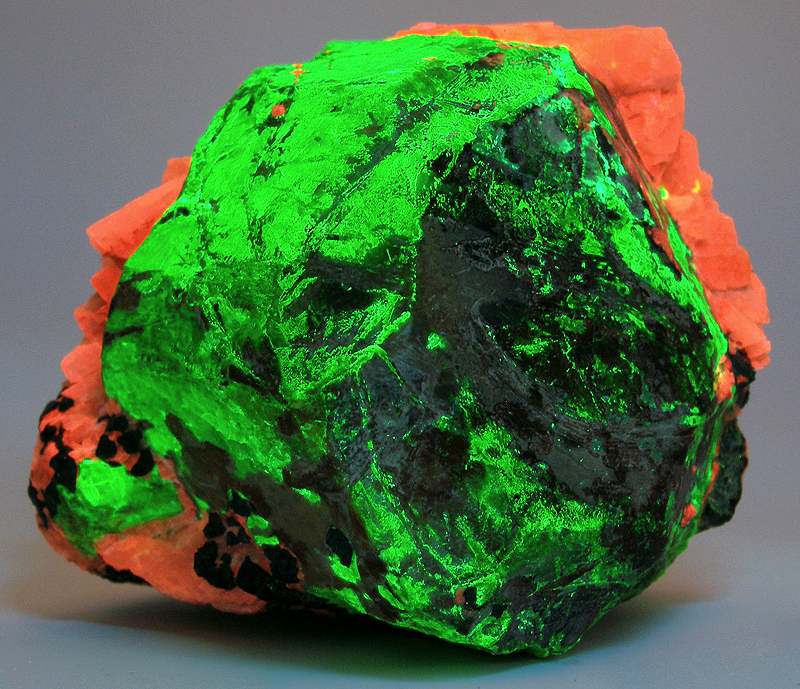
Willemite
Willemite
Zn₂SiO₄ Properties
- Category
- Mineral
Willemite is a zinc silicate (Zn₂SiO₄) that crystallizes in trigonal forms, famous above all for its intense green fluorescence under ultraviolet light, a property that makes it extraordinarily fascinating for mineral collectors.
Willemite is a zinc silicate named after Dutch King William I. It crystallizes in the trigonal system (space group R3̄) and forms typically in oxidation environments of zinc deposits, often associated with franklinite, zincite, and other metal oxides. Its hardness of 5.5 on the Mohs scale makes it relatively brittle, but its most fascinating characteristic is the brilliant green fluorescence under long-wave ultraviolet radiation (365 nm), caused by the presence of manganese traces as an activator. This phenomenon has made it a highly sought-after collector's gem, although it is rarely transparent in gem quality. The most beautiful and transparent crystals come from the famous Franklin mine in New Jersey, United States, where it was discovered in 1829 and where it remains today the most representative specimen.
Willemite (Zn₂SiO₄, space group R3̄, a = 13.98 Å, c = 9.30 Å) is an anhydrous silicate with a modified olivine-type structure. It exhibits a relative density of 4.0–4.2 g/cm³ and hardness of 5.5 Mohs. The refractive index ranges from nω = 1.691 to nε = 1.719 (negative birefringence), with birefringence Δn ≈ 0.028. Fluorescence is exceptional: under UV radiation at 254 nm (short-wave) it emits brilliant green, while at 365 nm (long-wave) the fluorescence is even more intense; the activator is Mn²⁺ substituting for Zn²⁺. Raman spectroscopy shows characteristic Si–O stretching bands around 900–950 cm⁻¹. Willemite forms in supergene oxidation zones of zinc deposits, often in association with franklinite (ZnFe₂O₄), zincite (ZnO), and other secondary minerals. Gem-quality specimens are extremely rare; the finest come from Franklin (New Jersey, USA), where willemite was the signature mineral of the mine. Composition may contain traces of Mn, Fe, and Cd. Under ordinary visible light it appears colorless, pale yellow-green or green, sometimes with orange tones due to franklinite inclusions.
Mining localities
- Franklin, New Jersey (USA) — giacimento classico e più importante per willemite gemmifera
- Ogdensburg, New York (USA) — miniera di zinco con willemite fluorescente
- Moresnet (Belgio/Germania) — giacimento storico di zinco con willemite secondaria
- Tsumeb, Namibia — minerali di ossidazione con willemite accessoria
- Laurion, Grecia — giacimenti polimetallici antichi con willemite
Frequently Asked Questions
Why does willemite glow bright green under ultraviolet light?
Willemite emits an intense green fluorescence under UV rays due to the presence of manganese ions (Mn²⁺) in its crystal structure, which absorb ultraviolet radiation and release it as visible green light. This property is so characteristic that willemite has become one of the most sought-after fluorescent minerals by collectors specifically for this spectacular and easily observable effect.
Where is willemite found and what are the main deposits worldwide?
Willemite is found primarily in oxidation zones of zinc deposits, with the most important occurrences located in Namibia (Tsumeb), Belgium (Moresnet), the United States (New Jersey), and Zambia. The finest specimens for fluorescence come from the Tsumeb mine in Namibia, which has historically been the most renowned source of gemological and collectible quality willemite.
How can you identify willemite from other zinc minerals?
Willemite is primarily identified by its characteristic green fluorescence under UV light and its moderate hardness (7.5 on the Mohs scale), along with a relatively high density (3.9-4.2 g/cm³). The chemical formula Zn₂SiO₄ and trigonal crystal structure are additional diagnostic parameters that, combined with its bright green fluorescence, clearly distinguish it from other zinc silicates like sphalerite.
What is the price of willemite and how does it vary based on quality?
Willemite prices vary significantly based on fluorescence quality, specimen size, and origin, ranging from a few euros for small fragments to several hundred euros for collector-grade examples with intense and well-defined fluorescence. Specimens from Tsumeb (Namibia) with vivid fluorescence and sizes larger than 5 cm tend to command the highest prices in the international collector market.
Entry generated with Claude API (Anthropic) on data extracted from Mindat, RRUFF and Wikipedia. Not yet reviewed by a human expert. Verify data against original sources before citing in formal work.