Unakite
Unakite
SiO₂+K(AlSi₃O₈)+Ca₂(Al,Fe)₃(SiO₄)₃(OH) Properties
- Category
- Rock
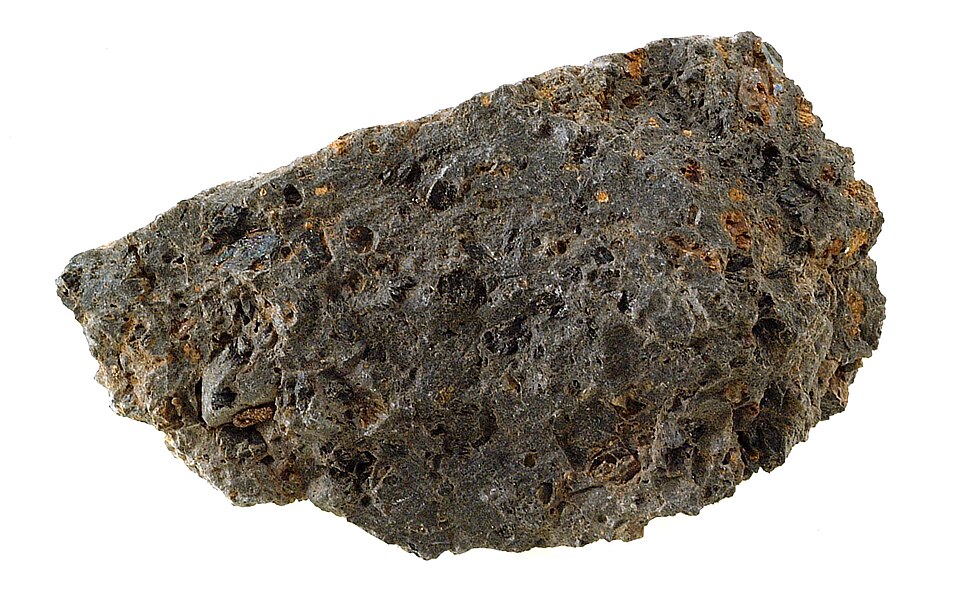
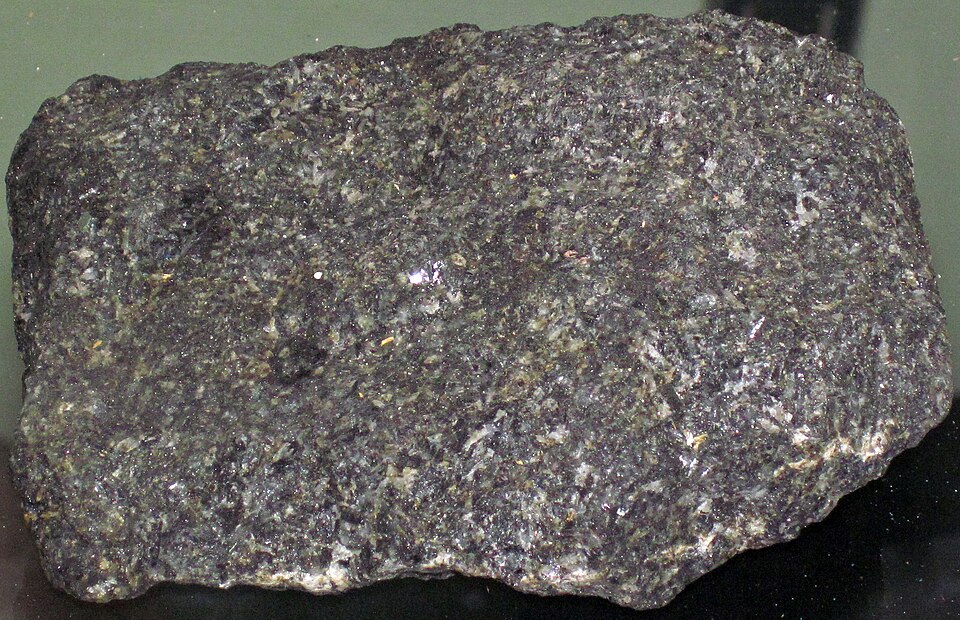
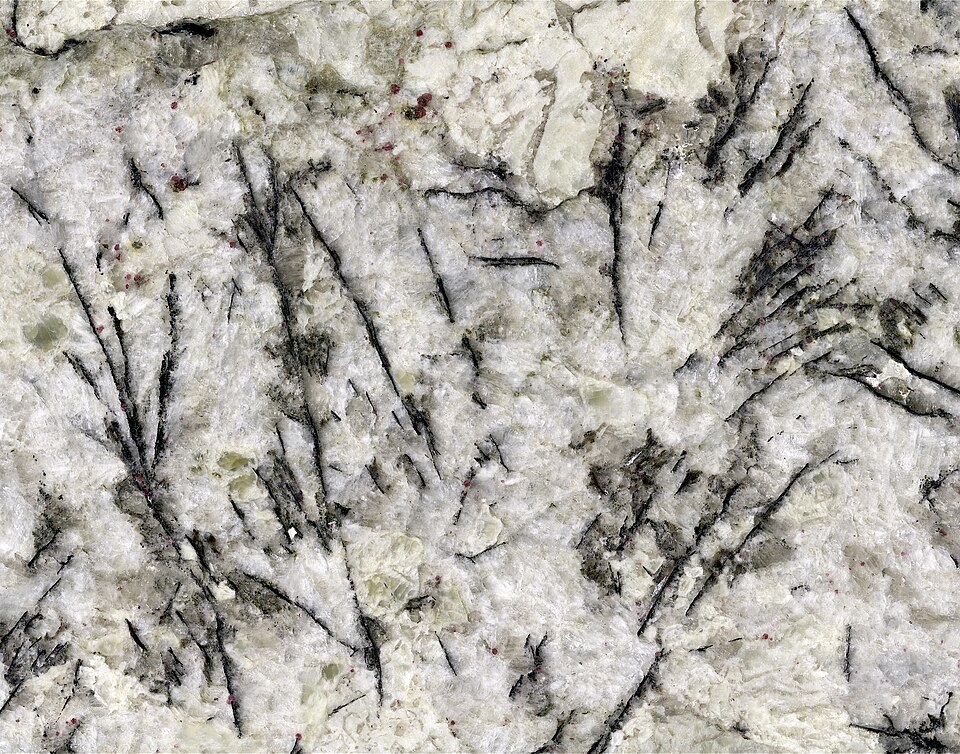
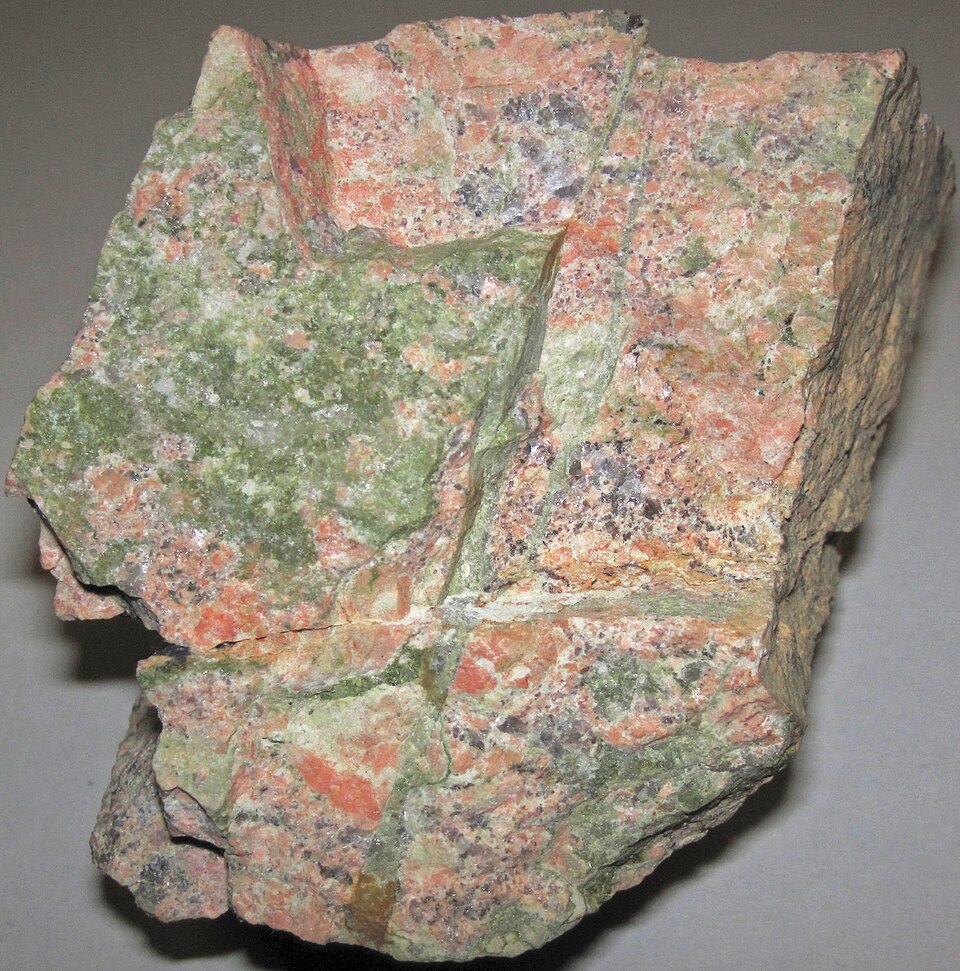
Unakite is a metamorphic rock composed of quartz, potassium feldspar, and epidote, characterized by a highly recognizable mottled pinkish-greenish appearance. It forms during the metamorphism of granitic rocks and takes its name from the Unaka mountain range, located on the border between Tennessee and North Carolina.
Unakite is an epidotic metamorphic rock that represents the result of the transformation of primary granites subjected to low- to medium-grade metamorphism in tectonically active environments. Its typical mineralogical composition includes quartz (SiO₂), potassium feldspar orthoclase (K(AlSi₃O₈)), and iron-rich epidote (Ca₂(Al,Fe)₃(SiO₄)₃(OH)), the latter being responsible for the characteristic pinkish coloration due to iron oxidation. The polymineral structure and granular texture confer upon the rock a hardness ranging between 6 and 7 on the Mohs scale.
Geologically, unakite forms predominantly in contexts of contact metamorphism or regional metamorphism, where granites and acidic igneous rocks undergo hydrothermal alteration and recrystallization under moderate pressure and temperature conditions. Typical mineralogical associations include other silicates such as biotite and amphibole. From a gemological perspective, unakite is appreciated by enthusiasts for cabochon cutting and decorative objects, although it is not considered a precious gemstone in the professional market. The most renowned extraction localities are the eastern Appalachians in the USA, particularly the region of origin in Tennessee and North Carolina, but significant deposits are also found in Brazil, South Africa, and China.
Unakite is classified as an epidotic metamorphic rock with granodioritic composition. The chemical formula represents the stoichiometric combination of the three principal minerals: quartz (SiO₂), potassium feldspar orthoclase (K(AlSi₃O₈)), and epidote (Ca₂(Al,Fe)₃(SiO₄)₃(OH)). The overall crystal system is amorphous at the macroscopic scale, although the constituent minerals maintain individual crystalline structures at the microscopic scale. Epidote imparts the characteristic salmon-pink coloration through isomorphal substitution Fe³⁺ ↔ Al³⁺ in the silicate crystal structure. The Mohs hardness of 6-7 reflects the mixed composition: quartz contributes hardness 7, feldspar 6-6.5, and epidote 6-7. The relative density ranges between 2.9 and 3.1 g/cm³ depending on the Fe/Al ratio in the epidote. UV-Vis spectroscopic analysis shows characteristic absorption bands of epidote in the 400-500 nm range. The rock exhibits hypidiomorphic granular texture with mineralogical granules typically ranging between 0.5 and 3 mm. X-ray diffractometric analysis confirms the presence of orthoclase (space group C2/m), quartz (space group P3₂21 or P3₁21), and epidote (space group P21/m). Porosity is generally low (< 2%), conferring compactness and chemical-physical stability.
Mining localities
- Unaka Mountains, Tennessee, USA
- Unaka Mountains, North Carolina, USA
- Minas Gerais, Brasile
- Western Cape, Sudafrica
- Guangdong, Cina
Frequently Asked Questions
How do you recognize unakite and what are its main characteristics?
Unakite is easily recognized by its mottled appearance with pink-red hues alternating with greenish-gray zones, due to the presence of potassium feldspar, epidote, and quartz. It is a metamorphic rock of medium hardness (6-6.5 on the Mohs scale) with visible grain to the naked eye, making it very distinctive and easily identifiable even by beginners.
Where is unakite found and in what geological context does it form?
Unakite takes its name from the Unaka mountain range on the border between Tennessee and North Carolina, where it was first discovered. It forms during the metamorphism of granitic rocks subjected to elevated pressure and temperature, through a process in which original potassium feldspar and quartz transform and recrystallize along with epidote.
What is the chemical formula of unakite and which minerals compose it?
Unakite is composed mainly of three minerals: quartz (SiO₂), potassium feldspar (K(AlSi₃O₈)), and epidote (Ca₂(Al,Fe)₃(SiO₄)₃(OH)). The variable proportion of these components determines the characteristic color hues: feldspar provides the pink-red, epidote the green, and quartz the transparent gray component.
What is unakite used for and what are its practical applications?
Unakite is primarily used in jewelry and crafts for the creation of pendants, beads, and decorative objects, thanks to its unique aesthetic appearance and distinctive color. It is also sought after by mineral and rock collectors, and occasionally used as ornamental stone in minor construction applications, although it has no significant industrial uses.
Entry generated with Claude API (Anthropic) on data extracted from Mindat, RRUFF and Wikipedia. Not yet reviewed by a human expert. Verify data against original sources before citing in formal work.