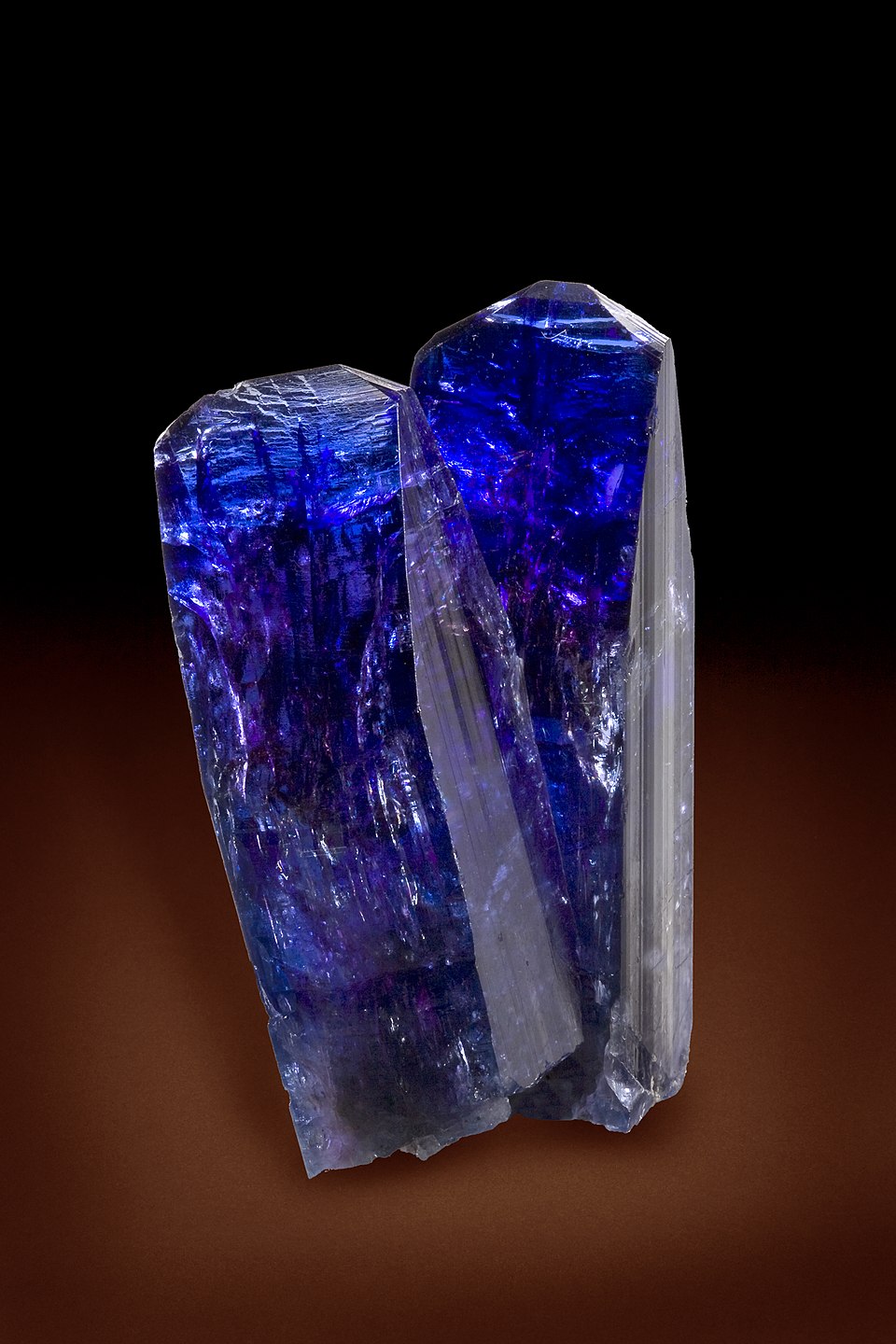
Tanzanite
Tanzanite
Ca₂Al₃(SiO₄)₃(OH) Properties
- Category
- Gem
Tanzanite is a blue-violet variety of zoisite, a calcium aluminum silicate discovered in Tanzania in 1967, which owes its fascinating color to the presence of vanadium and represents one of the youngest and most precious gems on the global market.
Tanzanite is a gem-quality variety of zoisite, a sorosilicate belonging to the epidote group. It was first discovered in 1967 near Merelani in the Arusha region of Tanzania by a local gemstone prospector. Its characteristic color, ranging from intense blue to blue-violet, is caused by the presence of vanadium ions (V³⁺) in the crystal structure. Unlike many ancient gemstones, tanzanite has a very recent commercial history: the name itself was coined by Tiffany & Co. in 1968, which recognized the gemological potential of this extraordinary stone.
Tanzanite crystallizes in the orthorhombic crystal system and exhibits a hardness of 6.5 on the Mohs scale, making it relatively fragile compared to diamond, sapphire, and ruby, requiring careful handling in jewelry applications. A fascinating characteristic is its tricolored pleochroism: when observing the crystal from different angles, one can distinguish shades of blue, violet, and red-brown. Many specimens undergo heat treatment to intensify the blue color and reduce unwanted brown tones, a standard practice in the industry. From a geological perspective, tanzanite forms in high-grade metamorphic environments, associated with feldspars, quartz, and other silicate minerals. Known reserves are concentrated almost exclusively in the Merelani deposits, making this gem particularly rare and sought after by collectors.
Chemical formula: Ca₂Al₃(SiO₄)₃(OH). Crystal system: orthorhombic, space group Pnma. Lattice parameters: a ≈ 16.2 Å, b ≈ 5.9 Å, c ≈ 10.0 Å. Mohs hardness: 6.5. Density: 3.35 g/cm³. Refractive index: nα ≈ 1.691, nβ ≈ 1.700, nγ ≈ 1.706 (positive birefringence). Birefringence: Δn ≈ 0.015. Tricolored pleochroism: blue, violet, red-brown (observable with polariscope). Absorption spectrum: characteristic bands around 585 nm and 610 nm due to V³⁺ ions. Luminescence: generally inert to ultraviolet light, occasionally weakly fluorescent. Fracture: conchoidal to irregular. Cleavage: perfect along (010) planes. Thermal stability: stable up to approximately 500 °C; controlled heating at 600–700 °C is commonly employed to improve color by reducing brown components. Typical inclusions: rutile needles, magnetite crystals, rarely fluid inclusions. Primary geographic origin: Merelani deposits, Tanzania (sole significant commercial source). Common treatments: heat treatment, occasionally surface coatings.
Mining localities
- Merelani, Arusha, Tanzania
- Merelani Hills, Tanzania
Frequently Asked Questions
Why is tanzanite so rare and precious?
Tanzanite is rare because it is found exclusively in Tanzania, in a small mountainous area of the Arusha region, discovered only in 1967. Its unique geographic location and limited geological formation in this zone make it one of the most sought-after gemstones in the world, with prices constantly increasing as known reserves are estimated to be depleted within 20-30 years.
How can you recognize authentic tanzanite from counterfeit?
Authentic tanzanite displays characteristic pleochroism, meaning it changes color from blue to violet to reddish-brown when viewed from different angles, a property that imitations cannot faithfully reproduce. Additionally, its hardness on the Mohs scale is 6-7, lower than sapphires and diamonds, so it is preferable to verify authenticity with a certified gemologist using spectroscopy and density tests.
What is the chemical formula of tanzanite and how does it form?
Tanzanite is a variety of zoisite with the chemical formula Ca₂Al₃(SiO₄)₃(OH), a calcium aluminum silicate whose blue-violet color is caused by traces of vanadium within the crystal structure. It forms under high pressure and temperature metamorphic conditions, during the transformation process of original sedimentary rocks, exclusively in Tanzania where unique geological conditions have allowed this rare crystallization.
What is the average price of tanzanite and what does it depend on?
Tanzanite prices vary considerably based on color, clarity, cut, and weight, ranging from $50 to over $3,000 per carat for high-quality specimens, while more common stones average between $100-$500 per carat. Determining factors include the intensity of blue-violet color (more saturated stones are more valuable), absence of visible inclusions, and authenticity certification from recognized gemological institutes such as AIGS.
Entry generated with Claude API (Anthropic) on data extracted from Mindat, RRUFF and Wikipedia. Not yet reviewed by a human expert. Verify data against original sources before citing in formal work.