Staurolite
Staurolite
Fe₂Al₉Si₄O₂₃(OH) Properties
- Category
- Mineral
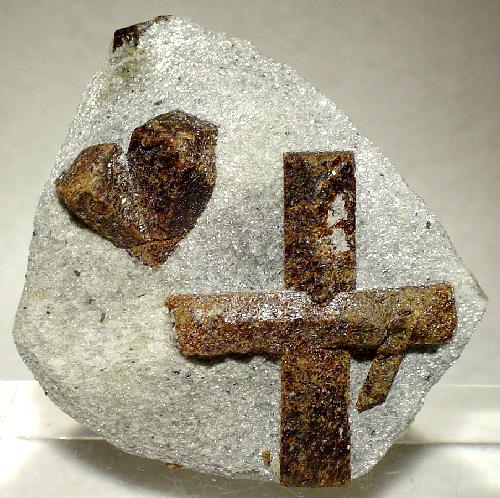
Staurolite is an iron and aluminum silicate that forms characteristic cross-shaped crystals, created by the interpenetration of two crystals at angles of 60° or 90°. It forms in aluminum-rich metamorphic rocks subjected to moderate pressures and temperatures, and is a reliable geological indicator of specific metamorphic conditions.
Staurolite (from Greek stauros, cross, and lithos, stone) is a complex hydrated silicate that crystallizes in the monoclinic system and represents one of the most important index minerals in metamorphic petrology. Its formation occurs during regional metamorphism of medium grade, typically at temperatures between 550–650 °C and pressures of 3–8 kbar, in micaceous schists and gneisses rich in potassium feldspar and quartz. The chemical composition Fe₂Al₉Si₄O₂₃(OH) can vary slightly with substitution of Mg for Fe and trace Zn. The characteristic cross-shaped crystals (called penetration twins) form when two crystal individuals interpenetrate along the c-axis, creating the famous 60° or 90° crosses that make it unmistakable. These forms, sometimes found in outcropping rocks, have been historically collected as natural curiosities. Staurolite frequently associates with garnet, white mica, biotite and kyanite, forming characteristic parageneses that allow geologists to reconstruct the thermal history of orogens. Its hardness of 7–7.5 on the Mohs scale makes it resistant to surface alteration, although residual hydration exposes it to fracturing along planes of structural weakness.
Crystal system: monoclinic, space group C2/m. Unit cell parameters (a, b, c): approximately 7.87 Å, 16.01 Å, 5.66 Å; β ≈ 90°. Density: 3.65–3.77 g/cm³. Mohs hardness: 7–7.5; irregular fracture, imperfect cleavage along ((100)). Refractive indices: nα ≈ 1.739, nβ ≈ 1.745, nγ ≈ 1.752; birefringence ≈ 0.013 (positive). Raman spectroscopy: characteristic bands at ~3630 cm⁻¹ (O–H stretching), ~1000–1200 cm⁻¹ (Si–O stretching), ~600–800 cm⁻¹ (Al–O bending). Chemical composition: Fe₂Al₉Si₄O₂₃(OH); possible substitutions: Mg²⁺ ↔ Fe²⁺ (up to 10% Mg), Zn²⁺ traces. Color: reddish-brown to dark brown, sometimes yellowish from surface alteration. Luminescence: weak, non-diagnostic. Characteristic mineral associations: garnet (almandine), white mica (muscovite), biotite, kyanite, potassium feldspar, quartz, magnetite. Twinning: frequent penetration twinning along (31) (60° crosses) or ((231)) (90° crosses), visible to the naked eye. Thermodynamic stability: the stability field narrows with increasing pressure; disappears beyond 700 °C due to partial melting or reaction with feldspar. Diagnostic applications: indicator of medium-grade metamorphism (upper greenschist–lower amphibolite facies); its absence in metamorphic rocks of appropriate composition suggests temperatures <500 °C or >700 °C.
Mining localities
- Bretagna, Francia (Ploumanac'h, Saint-Malo) — cristalli geminati eccezionali
- Alpi Orobie, Italia (Bergamo) — associazioni con granato e cianite
- Pirenei, Spagna — scisti metamorfici di grado medio
- Scozia, Regno Unito (Highlands) — gneiss e scisti micacei
- Monti Appalachiani, USA (Georgia, North Carolina) — cristalli a croce ben formati
- Massiccio Centrale, Francia — rocce metamorfiche regionali
- Alpi Bavaresi, Germania — associazioni mineralogiche caratteristiche
Frequently Asked Questions
How do you recognize staurolite by its characteristic shape?
Staurolite is unmistakable for its cross-shaped crystals, generated by the interpenetration of two crystals at angles of 60° or 90°. This unique geometry, known as cross twinning, is so distinctive that the crystals are often called "fairy stones" and is virtually impossible to confuse with other minerals. This characteristic makes it easily identifiable even at an amateur level.
In which rocks and geological conditions does staurolite form?
Staurolite forms exclusively in aluminum-rich metamorphic rocks subjected to moderate pressures and temperatures (medium-grade regional metamorphism). It is a fundamental indicator mineral in petrology, as its presence signals specific metamorphic conditions and represents a distinctive evolutionary stage of metamorphosed pelitic rocks, such as mica schists and gneisses.
What are the main physical properties of staurolite?
Staurolite (Fe₂Al₉Si₄O₂₃(OH)) is a hard silicate with hardness 7-7.5 on the Mohs scale, typically reddish-brown or black color, and transparency ranging from transparent to opaque. It has a density of approximately 3.7 g/cm³ and crystallizes in the monoclinic system, with a subconchoidal fracture and irregular breaks. These properties make it relatively resistant to weathering and easily found in metamorphic rock outcrops.
Where are the main staurolite deposits found in the world?
The most important staurolite deposits are found in regions with medium-grade metamorphic rocks, such as Scotland (particularly northern Scotland), France (Brittany), the USA (New England, Georgia, and North Carolina), Austria, and northern Italy. In Italy it is common in the Alps, especially in Piedmont and Lombardy, where it is found in mica schists and gneisses of the Alpine orogen and is sought after by collectors for its characteristically perfect crosses.
Entry generated with Claude API (Anthropic) on data extracted from Mindat, RRUFF and Wikipedia. Not yet reviewed by a human expert. Verify data against original sources before citing in formal work.