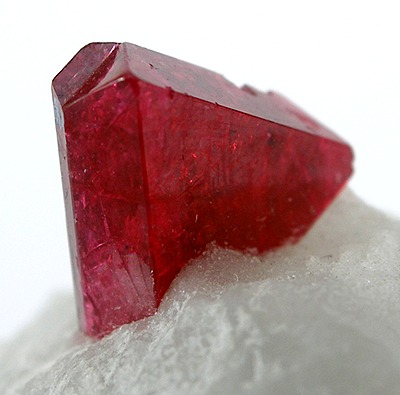
Spinel
Spinello
MgAl₂O₄ Properties
- Category
- Gem
Spinel is a magnesium and aluminum oxide that forms transparent cubic crystals, prized as a gem for its hardness (8 Mohs) and vivid colors ranging from red to blue, green to black. Historically confused with ruby until the 18th century, it is today a precious gemstone in its own right.
Spinel (MgAl₂O₄) is a crystalline oxide belonging to the *spinel* group, a family of minerals with cubic structure characterized by magnesium ions in octahedral coordination and aluminum ions in tetrahedral coordination. Its hardness of 8 on the Mohs scale makes it ideal for jewelry, inferior only to diamond (10) and corundum (9). The most prized red variety, *red spinel* or *balas ruby*, was long confused with ruby until modern crystallography clarified the chemical and structural differences. Color depends on trace elements such as chromium (red), iron and cobalt (blue), and vanadium (green). The most important deposits are found in Burma (Myanmar), Sri Lanka, Tanzania, and Madagascar, with Burmese crystals historically considered the finest. The contemporary gemological market particularly appreciates saturated red and blue spinels, which command high prices when pure and well-cut.
Crystal system: *cubic*, space group Fd-3m, lattice parameter a = 8.08 Å. Density: 3.58–3.61 g/cm³. Refractive index: nω = 1.712–1.735 (isotropic, uniaxial negative in stressed varieties). Birefringence: absent (pure crystals); may manifest in samples with compositional zonation. Chromatic dispersion (fire): 0.020. Hardness: 8 Mohs; conchoidal fracture. Cleavage: none (fracture). UV-Vis spectroscopy: characteristic absorption in the blue (Fe²⁺–Fe³⁺ charge transfer) and in the red (d-d transitions of Cr³⁺). Raman spectroscopy: main band at ~680 cm⁻¹ (Mg–O vibration). Fluorescence: variable; red spinels often inert under UV, blue spinels may show weak red fluorescence. Composition: pure MgAl₂O₄; common ionic substitutions include Fe²⁺, Zn²⁺ (replacing Mg), Fe³⁺, Cr³⁺, V³⁺ (replacing Al). Formation: typically in high-grade metamorphic rocks (granulites, eclogites), dolomitic marbles, granitic pegmatites, and in association with corundum, feldspars, olivine. Treatments: occasionally heating to improve color; rarely oiling. Distinction from ruby: lower density (3.6 vs 3.99 g/cm³), lower refractive index (1.71–1.73 vs 1.76–1.77), absence of birefringence, distinct absorption spectrum.
Mining localities
- Myanmar (Birmania) — Mogok Valley: spinelli rossi e blu di qualità gemmologica eccezionale
- Sri Lanka — depositi alluvionali e pegmatiti: spinelli di varie tonalità
- Tanzania — Mahenge e altre località: spinelli rosa e blu intenso
- Madagascar — spinelli rossi e blu di buona qualità
- Tajikistan — Pamir: spinelli rossi pregiati
- Vietnam — spinelli blu e rossi di qualità gemmologica
- Italie — Val d'Aosta, Piemonte: spinelli in marmi metamorfici (campioni da collezione)
Frequently Asked Questions
How does spinel differ from ruby?
Spinel (MgAl₂O₄) and ruby (Al₂O₃) are completely different minerals: ruby is harder (9 Mohs) than spinel (8 Mohs) and has a trigonal crystal structure instead of cubic. They were historically confused until the 18th century because red spinel can appear similar to ruby, but optical and X-ray diffraction analysis easily distinguishes them.
What are the most common spinel colors and what causes them?
Spinel displays a wide range of colors due to trace element impurities: red and pink derive from chromium (Cr³⁺), blue from iron (Fe²⁺) and titanium (Ti), green from a combination of elements, while black contains iron and other transition metals. The cubic crystal structure allows uniform distribution of these elements, producing particularly vivid and saturated colors.
Where are the most important spinel deposits located?
The main deposits of gemological-quality spinel are found in Myanmar (Burma), Sri Lanka, Tanzania, and Thailand, with Myanmar representing the most prestigious historical source of red and blue spinels. These deposits form in metamorphic rocks and alluvial deposits from the erosion of granitic pegmatites rich in magnesium and aluminum.
What is the price of spinel compared to other precious stones?
Spinel is generally more affordable than ruby and sapphire, with prices ranging from €50 to €500 per carat for good-quality specimens, while exceptional spinels can reach €1000+ per carat. Cost depends on saturated color, transparency, size, and origin, with Burmese reds commanding the highest market prices.
Entry generated with Claude API (Anthropic) on data extracted from Mindat, RRUFF and Wikipedia. Not yet reviewed by a human expert. Verify data against original sources before citing in formal work.