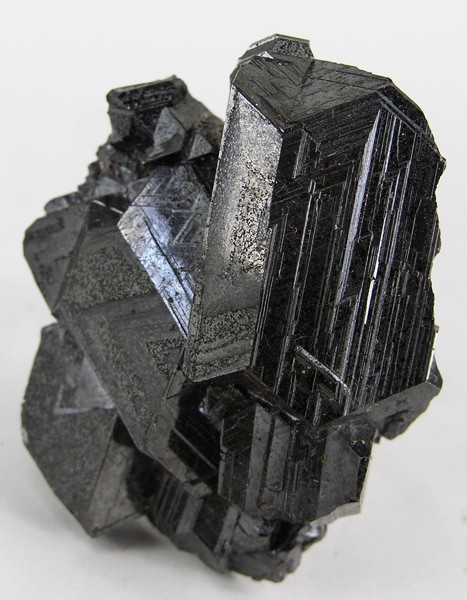
Sphalerite
Sfalerite
ZnS Properties
- Category
- Mineral
Sphalerite is the principal ore mineral of zinc, a cubic sulfide with color ranging from yellow to black, and a hardness of 3.5–4 on the Mohs scale. It is the most important mineral for zinc extraction on a global scale.
Sphalerite (ZnS) is a cubic sulfide belonging to the *blende* group, with a crystal structure analogous to diamond but containing two distinct elements. Color varies considerably depending on impurities: iron imparts dark tints up to opaque black, while pure specimens may be colorless or yellow. Sphalerite exhibits a characteristic *resinous luster* that is highly recognizable and perfect cleavage along octahedral planes ((111)). Geologically, it forms in moderate to high-temperature hydrothermal environments, often associated with galena (PbS), pyrite, and chalcopyrite in volcanogenic massive sulfide (VMS) deposits or epithermal veins. Its economic importance is enormous: it supplies approximately 95% of globally extracted zinc. Historically, the name derives from the Greek *sphaleros* (deceptive), as medieval miners confused it with galena despite its lack of lead content.
Sphalerite (ZnS, *blende*) — Cubic system, space group F-43m, *a* = 5.406 Å. Density: 3.9–4.1 g/cm³. Hardness: 3.5–4 Mohs. Perfect cleavage along ((111)) (octahedral). Resinous luster; transparency ranges from transparent to opaque. Refractive index: 2.35–2.42 (anomalous birefringence due to strain effects). Color: colorless, yellow, brown, black (dependent on Fe²⁺ and Cd²⁺ isomorphous substitution). UV Spectroscopy: blue-violet fluorescence under long-wave UV radiation (due to Mn²⁺ trace impurities). Typical chemical analysis: Zn 67%, S 33% (theoretical); common impurities: Fe (up to 26% in marmatite variety), Cd, In, Ga. Transition temperature: sphalerite undergoes a cubic to tetragonal transition (*wurtzite*) at ~1020 °C. Mineral associations: galena, pyrite, chalcopyrite, grey copper ore, calcite, fluorite. Formation: syngenetic SEDEX and VMS deposits, epithermal veins, zinc-bearing pegmatites. Genesis: crystallization from hydrothermal fluids with moderate sulfur fugacity (*fS₂*); common in reducing environments.
Mining localities
- Raibl (Friuli-Venezia Giulia, Italia) — sfalerite nera di eccellente qualità con cristalli ottaedrici
- Bleiberg (Carinzia, Austria) — deposito classico con sfalerite gialla e marrone
- Tri-State District (Missouri-Kansas-Oklahoma, USA) — uno dei maggiori distretti storici di estrazione
- Trepča (Kosovo) — deposito VMS con sfalerite massiccia ad alto tenore
- Broken Hill (New South Wales, Australia) — sfalerite in associazione con galena in metamorfiti
- Hunan (Cina) — principali riserve mondiali di sfalerite
- Peru (Perù) — depositi epitermali ricchi di sfalerite
- Zambia (Africa) — sfalerite in associazioni cuprifere
Frequently Asked Questions
How do you identify sphalerite in nature?
Sphalerite is recognized by its variable color (yellow, brown, black) and its brilliant luster, combined with relatively low hardness of 3.5-4 on the Mohs scale. It often displays perfect cleavage along the cubic system, a feature that distinguishes it from other zinc minerals. The streak test produces a white to yellowish powder, which is useful for definitive identification.
Where is sphalerite found and what are the main deposits?
Sphalerite forms primarily in hydrothermal sulfide deposits associated with galena, pyrite, and other base metal minerals. The world's major deposits are found in China, Canada, Australia, Mexico, and Peru, where it is extracted alongside other sulfides in polymetallic mines. Sphalerite is often concentrated in hydrothermal alteration zones around igneous intrusions or metamorphosed sediments.
What is the commercial value of sphalerite and how much does it cost?
Sphalerite has no significant collector value, as its worth lies in the zinc content extracted, not in the raw crystal. Prices depend on the international zinc market, which fluctuates between 1,500 and 3,000 USD per ton of pure metal. High-quality gem-grade specimens are extremely rare and may have value for specialized collectors, but remain far less valuable than rare minerals.
Why is sphalerite the primary zinc mineral and how is it extracted?
Sphalerite (ZnS) is the primary zinc mineral because it contains approximately 67% zinc by weight and is available in enormous quantities in global polymetallic deposits. Extraction occurs through mining, roasting to convert the sulfide to oxide (ZnO), and subsequent carbothermic or electrolytic reduction to obtain pure metallic zinc. The process is economically viable due to the large volumes available and the relative ease of processing.
Entry generated with Claude API (Anthropic) on data extracted from Mindat, RRUFF and Wikipedia. Not yet reviewed by a human expert. Verify data against original sources before citing in formal work.