Schorl
Schorl
NaFe²⁺₃Al₆(BO₃)₃Si₆O₁₈(OH)₄ Properties
- Color
- Black
- Luster
- Vitreous to sub-resinous
- Density
- 3.18–3.22 g/cm³
- Category
- Mineral
Schorl is black tourmaline, the most abundant species of the tourmaline supergroup — estimated to account for over 95% of all tourmaline in Earth's crust. Its black color results from high ferrous iron (Fe²⁺) content at the Y site of the crystal lattice.
Despite its limited gemological appeal, schorl is one of the most common silicates in existence. It forms in pegmatitic environments, high-grade metamorphic rocks, and sandstones. Its resistance to weathering makes it common in alluvial deposits and beach sands.
The name "schorl" is of medieval German origin, attested as early as the 15th century in the tin mines of Saxony, where it referred to a black waste mineral in tin-tungsten veins. It is one of the very few minerals that still carries a pre-Linnaean mining name.
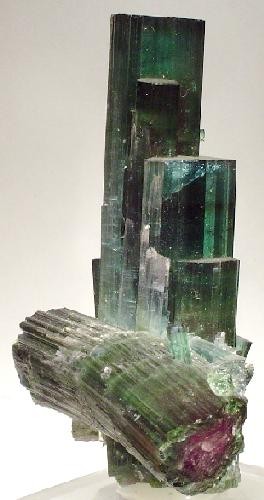
Erongo (Namibia) specimens — brilliant black prisms on white feldspar matrix — are highly prized by collectors for their chromatic contrast.
Formula: NaFe²⁺₃Al₆(BO₃)₃Si₆O₁₈(OH)₄. Trigonal system, space group R3m. The Y site is dominated by Fe²⁺, responsible for total optical absorption across the visible spectrum and thus the black color. Refractive index 1.635–1.675, birefringence 0.025–0.040 — among the highest in the group. Density 3.18–3.22 g/cm³, higher than elbaite due to the greater atomic weight of iron vs. lithium. UV fluorescence generally inert.
Mining localities
- Erongo, Namibia
- Minas Gerais, Brazil
- Habachtal, Austria
- Elba, Italy
- Cornwall, United Kingdom
Frequently Asked Questions
Are schorl and black tourmaline the same thing?
Yes. "Black tourmaline" is the trade name; schorl is the mineralogical species name. Almost all black tourmaline sold on the market is schorl, though other tourmaline species can occasionally appear black in rare cases.
Where does the name "schorl" come from?
From medieval German, attested in the 15th century in the tin mines of Saxony. Miners called the black worthless mineral in metallic veins "Schorl." It is one of the very few minerals with a name predating modern scientific nomenclature.
Why is schorl so much more common than other tourmalines?
Iron is one of the most abundant elements in Earth's crust, while lithium (needed for elbaite) is relatively rare. In common granitic pegmatites, iron is almost always available in large quantities, making schorl by far the most widespread tourmaline.
Entry generated with Claude API (Anthropic) on data extracted from Mindat, RRUFF and Wikipedia. Not yet reviewed by a human expert. Verify data against original sources before citing in formal work.