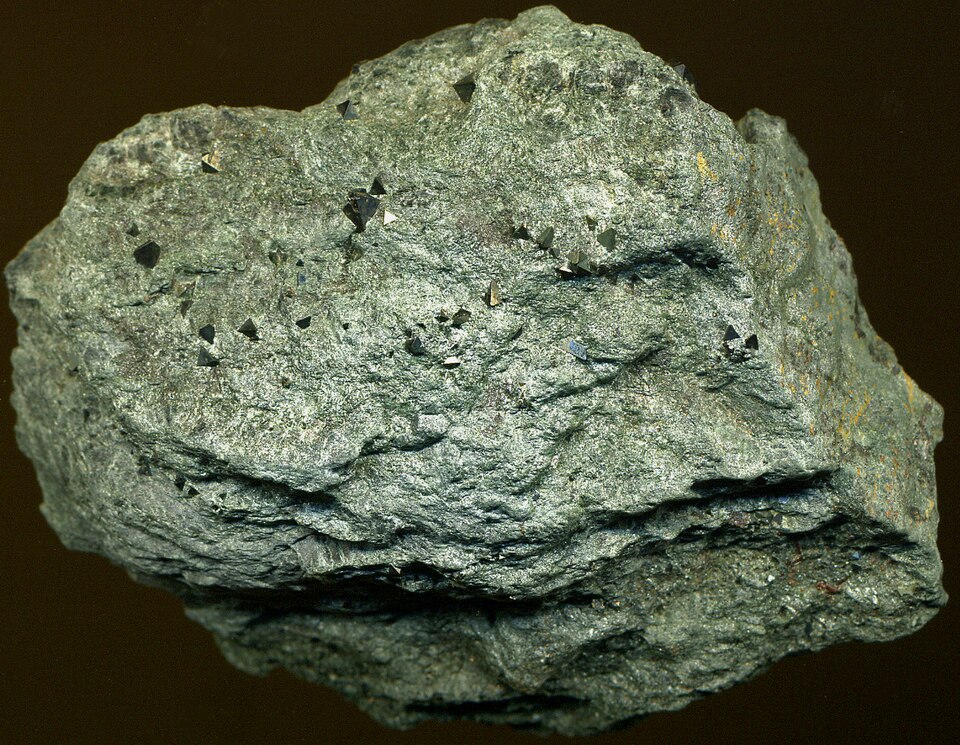
Schist
Scisto
SiO₂ + Al₂O₃ + mica Properties
- Category
- Rock
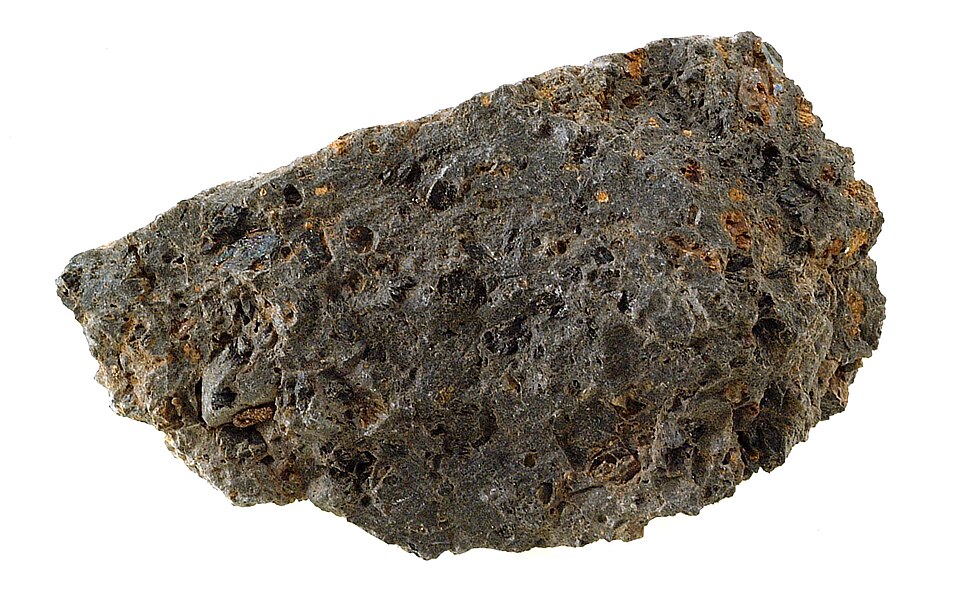
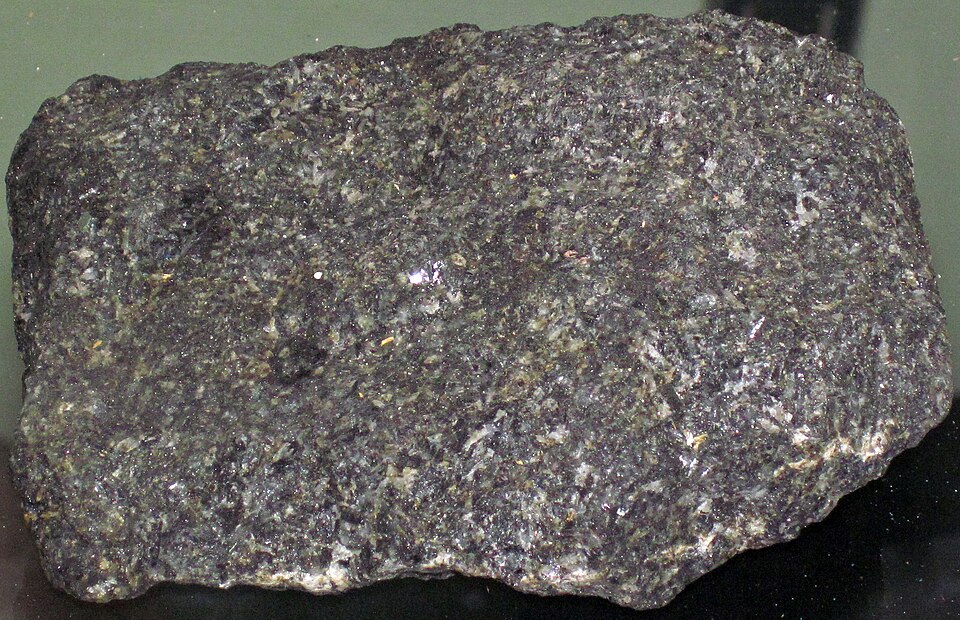
Schist is a metamorphic rock characterized by pronounced foliation, that is, thin and parallel layers visible to the naked eye, composed primarily of quartz, feldspar, and micaceous minerals such as muscovite and biotite. Its lamellar structure makes it easily divisible into thin sheets, a property that has made it valuable since antiquity for roof coverings and flooring.
Schist represents an intermediate stage of regional metamorphism, formed by the heating and pressure of sedimentary rocks (predominantly clays and marls) at depths between 10 and 30 km in the Earth's crust. During this process, the original minerals recrystallize and preferentially orient along the direction of maximum pressure, generating the characteristic schistosity—the ability to split along nearly perfect parallel planes. This property is not random: micaceous minerals (muscovite KAl₂(AlSi₃O₁₀)(OH)₂ and biotite K(Mg,Fe)₃(AlSi₃O₁₀)(OH)₂) arrange with their atomic planes parallel, creating a structural weakness that can be exploited.
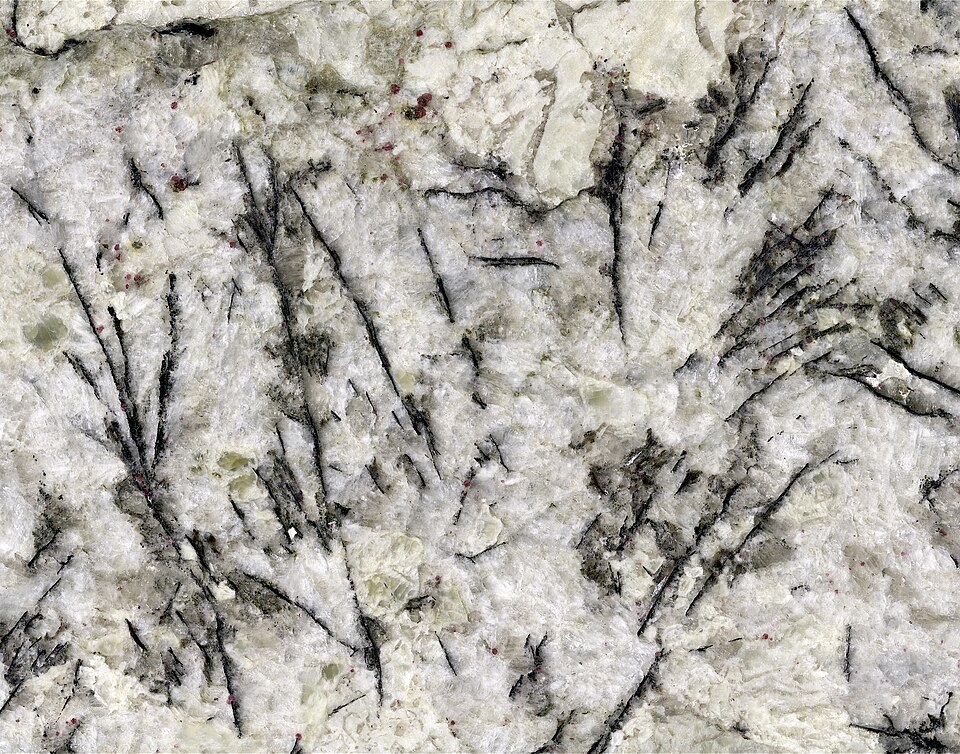
The nomenclature of schist is often enriched by the name of the most abundant mineral besides mica: garnet schist, chlorite schist, talc schist indicate specific compositions and different metamorphic grades. Garnet schists, for example, form at higher temperatures and pressures compared to chlorite schists, providing geologists with valuable information about the thermal history of the rock. From an economic perspective, schists have provided building material for millennia—the roofs of many European houses are covered with schist—and today remain important in the search for economically significant minerals, as they often host deposits of gold, copper, and other metals.
Schist is a medium-grade metamorphic rock belonging to the greenschist facies (300–500 °C, 2–8 kbar) up to the blueschist facies (200–700 °C, 8–12 kbar) in subduction contexts. The chemical formula is variable and depends on protolithic composition and metamorphic grade; an average composition can be approximated as (SiO₂)₆₀(Al₂O₃)₁₅(K₂O,Na₂O)₈(MgO,FeO)₁₀(H₂O)₇, reflecting the content of quartz, feldspar, mica, and amphiboles.
The crystal structure is complex and non-uniform: the constituent minerals maintain their own crystal systems (quartz trigonal, feldspar monoclinic/triclinic, mica monoclinic), but their spatial arrangement is controlled by metamorphic foliation. The refractive index ranges between 1.52 and 1.62 depending on composition; birefringence is moderate (δ ≈ 0.01–0.04). Density ranges between 2.7 and 2.9 g/cm³.
Hardness is 3–4 Mohs along the foliation (due to easy slipping along micaceous planes), but can reach 6–7 Mohs perpendicular to the foliation, where quartz is the dominant mineral in resistance. Schist is not homogeneous: optical microscopy and X-ray diffraction (XRD) reveal characteristic mineralogical assemblages. Raman spectroscopy identifies vibrational bands of quartz (127, 206, 264 cm⁻¹), mica (700–1100 cm⁻¹), and other silicates. Differential thermal analysis (DTA) shows structural water loss between 600 and 900 °C, confirming the presence of hydrated minerals.
The typical mineralogical association includes quartz (SiO₂), potassium feldspar (KAlSi₃O₈), muscovite (KAl₂(AlSi₃O₁₀)(OH)₂), biotite (K(Mg,Fe)₃(AlSi₃O₁₀)(OH)₂), chlorite ((Mg,Fe)₅Al(AlSi₃O₁₀)(OH)₈), amphiboles such as actinolite (Ca₂(Mg,Fe)₅Si₈O₂₂(OH)₂), and often almandine garnet (Fe₃Al₂(SiO₄)₃). Accessory minerals include rutile (TiO₂), ilmenite (FeTiO₃), magnetite (Fe₃O₄), and apatite (Ca₅(PO₄)₃(F,Cl,OH)).
Mining localities
- Alpi Pennine, Svizzera e Italia
- Massiccio centrale, Francia
- Monti Appalachi, Stati Uniti
- Pirenei, Spagna e Francia
- Highlands, Scozia
- Carpazi, Romania
- Catena del Caucaso, Russia
- Himalaya, Nepal e Tibet
- Bacino del Reno, Germania
- Cornovaglia, Regno Unito
Frequently Asked Questions
How is schist formed and what is the difference with other metamorphic rocks?
Schist forms from the metamorphism of sedimentary rocks (clays, marls) subjected to elevated pressure and temperature at depth in the Earth's crust. Unlike other metamorphic rocks such as marble or gneiss, schist displays a highly pronounced foliation that is easily divisible into thin parallel laminae, thanks to the realignment of mica minerals (muscovite and biotite) during deformation.
How do you identify schist and what are its visible characteristics?
Schist is recognized by its obvious lamellate structure visible to the naked eye, with thin and parallel layers that easily split along the foliation plane. Its main composition includes quartz, feldspar, and mica minerals that give the rock a brilliant appearance and variable coloration ranging from gray to brown, depending on the minerals present and the degree of metamorphism.
Where is schist found and what are its practical uses?
Schist is found in many mountainous regions worldwide, particularly in the Apennines, Alps, and mountain chains of regional metamorphism. Thanks to its ease of division into slabs, it has historically been used for roof coverings, slate, paving, and decorative elements, although today it has more limited uses compared to other modern materials.
What is the economic value of schist and how much does it cost?
The value of schist varies considerably based on quality, color, thickness, and origin, with prices generally ranging between 5 and 50 euros per square meter for raw or semi-finished material. Demand has declined in recent decades due to competition from synthetic and laminated materials, keeping schist mainly as a niche product for restoration and quality interior design.
Entry generated with Claude API (Anthropic) on data extracted from Mindat, RRUFF and Wikipedia. Not yet reviewed by a human expert. Verify data against original sources before citing in formal work.