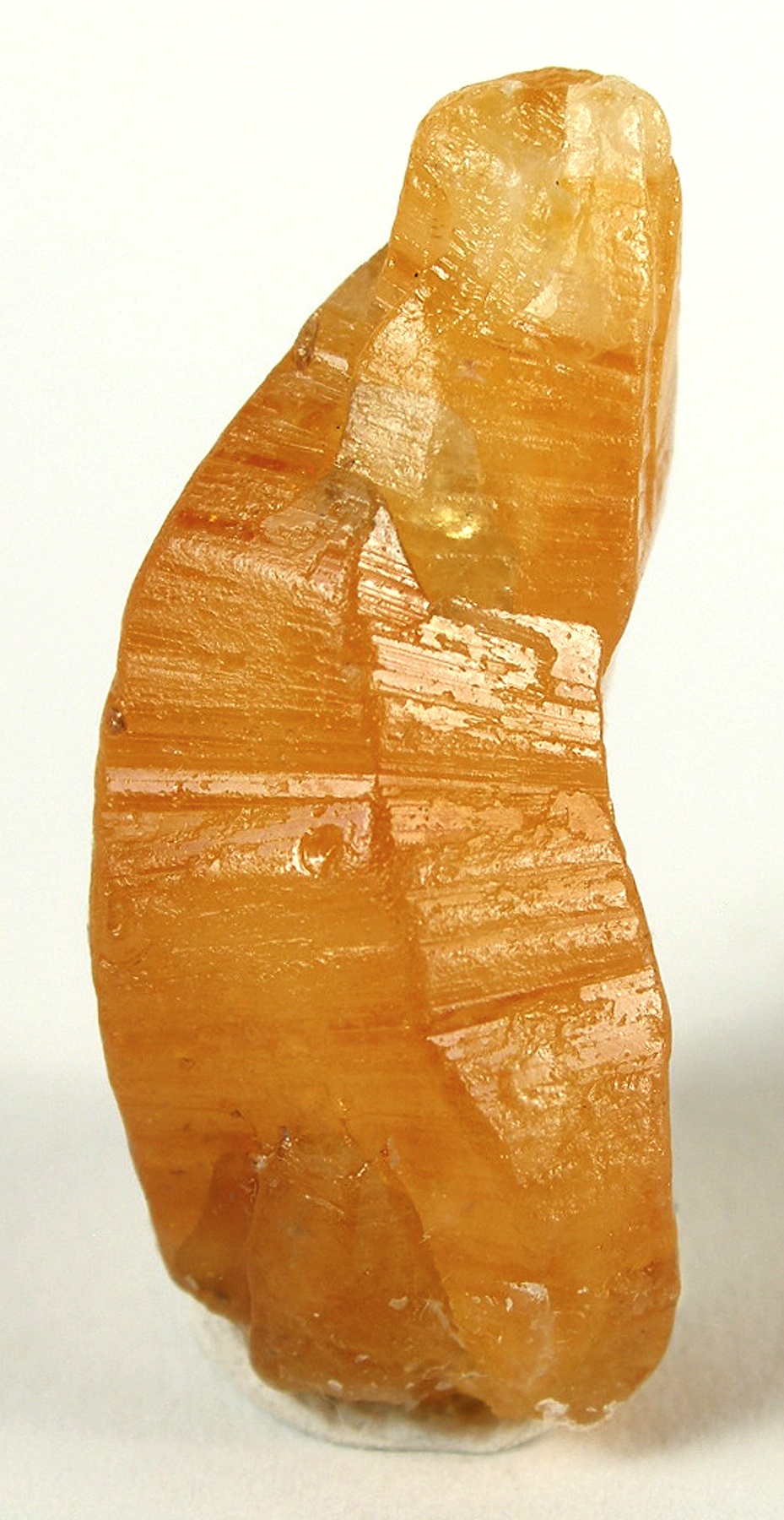
Sapphire
Zaffiro
Al₂O₃ Properties
- Category
- Gem
Sapphire is a precious gemstone composed of aluminum oxide (Al₂O₃) that owes its characteristic blue color to the presence of trace amounts of iron and titanium; with a hardness of 9 on the Mohs scale, it is the second hardest mineral in nature after diamond.
Sapphire is the blue variety of corundum (Al₂O₃), an oxide that crystallizes in the trigonal system, forming prismatic crystals that are often tabular. The intense blue color derives from isomorphic substitution of Fe²⁺ and Ti⁴⁺ ions within the crystal structure, while other hues (pink, yellow, orange) are caused by different chromophoric elements. Gem-quality sapphires form primarily in metamorphic rocks, particularly in aluminum-silicate schists and corundum-rich marbles, or in alkaline igneous rocks such as basalts. The most prestigious deposits are found in Myanmar (Burma), Sri Lanka, Kashmir, and Thailand, where extractive traditions date back centuries. Kashmir sapphires are celebrated for their saturated "velvety blue" color and exceptional transparency, while Thai sapphires tend toward darker tones. In the gemological market, valuation depends on color (saturation and tone), transparency, carat weight, and the absence of heat treatments.
Sapphire — Al₂O₃, trigonal system, space group R3̄c. Lattice parameters: a = 4.758 Å, c = 12.991 Å. Mohs hardness 9; density 3.99–4.10 g/cm³ (variable with inclusion content). Ordinary refractive index (nω) ≈ 1.768, extraordinary (nε) ≈ 1.760; birefringence δ ≈ 0.008. Marked pleochroism: deep blue in ordinary direction, paler blue in extraordinary direction. UV-Vis spectroscopy: characteristic absorption bands at 450 nm (Fe²⁺-Ti⁴⁺ charge transfer), 550 nm and 600 nm (Fe²⁺). Fluorescence under long-wave UV: generally inert; under short-wave UV: occasionally weakly fluorescent (red-orange). Typical inclusions: rutile needles (silk effect), feldspar crystals, mica, magnetite. Unheated natural sapphires often display gas and fluid inclusions in negative cavities; thermal treatment (1200–1800 °C) dissolves inclusions and improves transparency, shifting color toward more saturated tones. Gemological analysis: Raman spectroscopy for crystal structure identification; X-ray fluorescence for elemental determination; reflected and transmitted light microscopy for inclusion evaluation and treatment assessment.
Mining localities
- Myanmar (Birmania) — Mogok Valley, Mong Hsu (giacimenti alluvionali e primari in marmi)
- Sri Lanka — Ratnapura, Elahera (depositi alluvionali in gneiss e scisti)
- Kashmir — Paddar Valley (marmi metamorfici, produzione storica limitata)
- Tailandia — Chanthaburi, Trat (alluvioni in basalti alcalini)
- Madagascar — Ilakaka, Andranondambo (marmi e rocce pegmatitiche)
- Australia — Queensland, New South Wales (basalti e rocce vulcaniche)
- Tanzania — Umba Valley (alluvioni in rocce metamorfiche)
- Vietnam — Luc Yen (depositi alluvionali e primari)
Frequently Asked Questions
Why is sapphire blue and how does this color form?
Sapphire owes its characteristic blue color to the presence of trace amounts of iron and titanium within the crystal structure of aluminum oxide (Al₂O₃). These elements substitute some aluminum ions during crystal formation, absorbing specific wavelengths of visible light and reflecting blue hues. The color intensity depends on the concentration of these elements: sapphires with higher amounts of iron and titanium display deeper and more vivid blue colorations.
How hard is sapphire and why is it so resistant?
Sapphire has a hardness of 9 on the Mohs scale, making it the second hardest mineral in nature after diamond (hardness 10). This extraordinary hardness derives from the strong crystalline structure of aluminum oxide (Al₂O₃), where aluminum and oxygen ions are bonded by strong ionic forces. Thanks to this property, sapphire is extremely scratch-resistant and is used in industrial applications as well as in jewelry.
How can I recognize an authentic sapphire from a fake one?
An authentic sapphire can be recognized by first checking its hardness: being 9 on the Mohs scale, it should not scratch with common objects like steel, and only diamond should be able to mark it. It's important to verify the color purity and the presence of characteristic mineral inclusions: natural sapphires often show microscopic traces of iron and titanium visible under specific lighting. For certain authentication, it's advisable to request a gemological certificate from recognized international laboratories.
Where in the world are the finest sapphires found?
The finest blue sapphires are extracted primarily from Burma (Myanmar), Kashmir, and Sri Lanka, with Kashmir historically considered the producer of the most prized sapphires for their intense and pure blue color. Burma is currently the world's largest producer of gem-quality sapphires, followed by Sri Lanka and Thailand. These minerals form in metamorphic and igneous rocks, often in areas with specific geological conditions of high temperature and pressure where aluminum oxide can crystallize in the presence of iron and titanium.
Entry generated with Claude API (Anthropic) on data extracted from Mindat, RRUFF and Wikipedia. Not yet reviewed by a human expert. Verify data against original sources before citing in formal work.