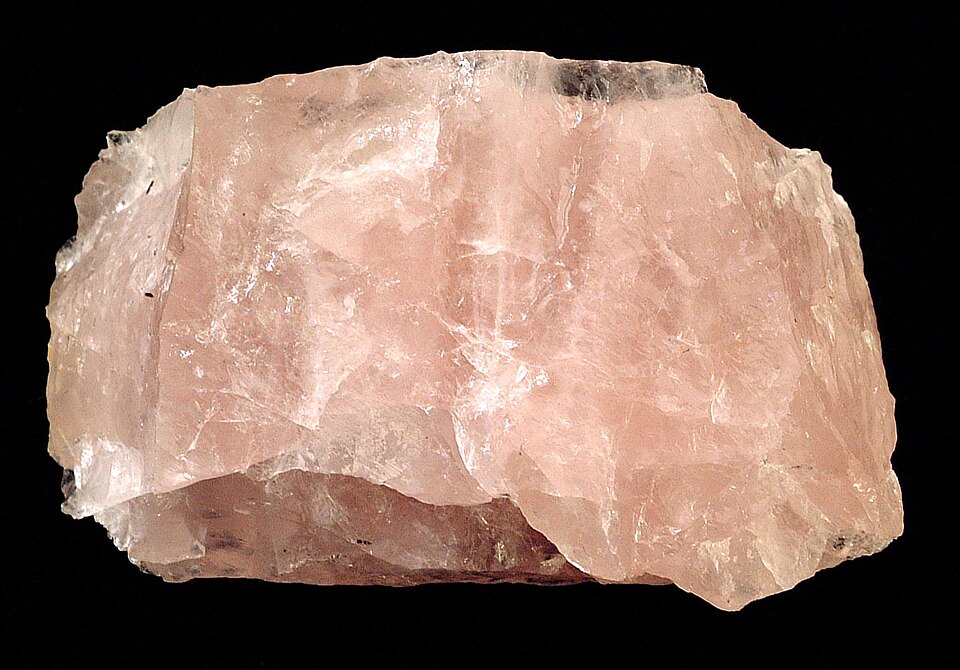
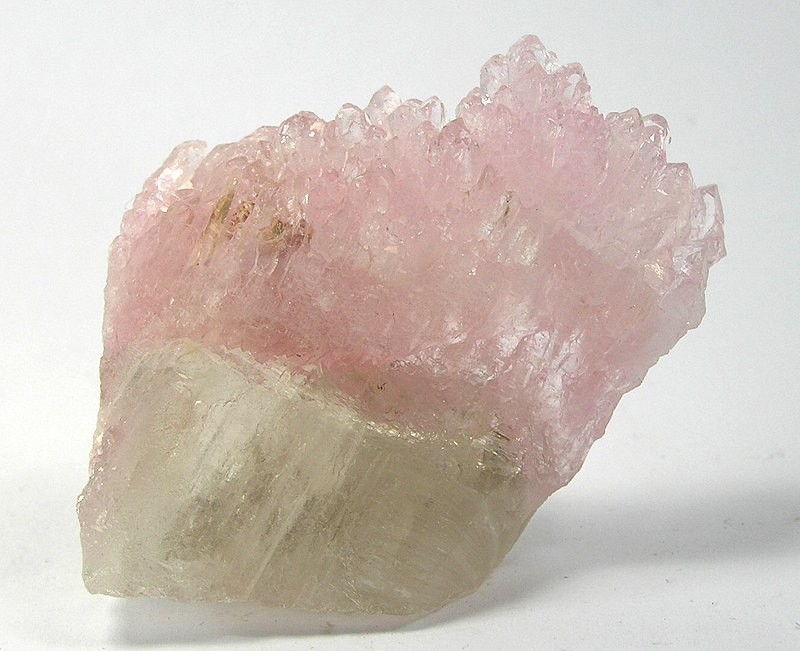
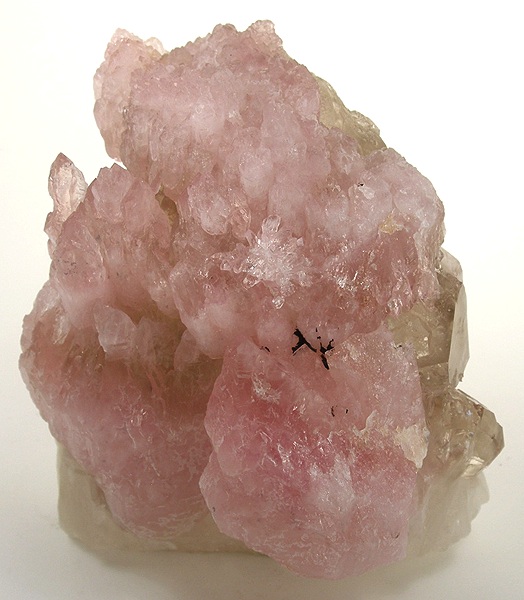
Rose Quartz
Quarzo Rosa
SiO₂ Properties
- Category
- Gem
Rose quartz is a translucent variety of quartz (SiO₂) colored by traces of titanium, iron, and phosphorus, making it one of the most prized quartzes in gemology and lapidary work. Its delicate hue, ranging from pale pink to intense rose, makes it ideal for cabochons, spheres, and decorative objects.
Rose quartz belongs to the trigonal crystal system and exhibits a hardness of 7 on the Mohs scale, making it sufficiently durable for everyday jewelry wear. Contrary to common belief, the color is not due to iron oxide inclusions, but rather to traces of titanium, iron, and phosphorus that integrate into the crystal structure. This mineral typically forms in granitic pegmatites and hydrothermal environments, often in association with feldspar, mica, and tourmaline. From a gemological perspective, high-quality rose quartz originates primarily from Brazil (particularly Minas Gerais state), Madagascar, and Namibia; the clearest and most intensely colored crystals command significant prices in the collector market. A fascinating characteristic is the asterism (star effect) that occasionally manifests in specimens rich in rutile inclusions, creating the rare "star rose quartz." The mineral is sensitive to prolonged sunlight exposure, which can fade its color over time.
Rose quartz — SiO₂, trigonal system (space group P3₁21 or P3₂21), a = 4.913 Å, c = 5.405 Å. Hardness 7 Mohs, density 2.65 g/cm³. Ordinary refractive index (no) ≈ 1.544; extraordinary (ne) ≈ 1.553; birefringence δ ≈ 0.009. Pleochroism absent or very weak. UV spectroscopy: red-orange fluorescence under long-wave UV (365 nm) due to Fe³⁺ and Ti⁴⁺ impurities. Visible light absorption concentrated in the blue region (450–500 nm), responsible for pink light transmission. Chemical analysis: SiO₂ > 99.5%; traces of Ti, Fe, P (0.01–0.1% by weight). Common inclusions: rutile (causes asterism), hematite, limonite. Conchoidal fracture, no cleavage. Cathodoluminescence: weak, blue-green. Solubility: insoluble in common acids; soluble in HF. Thermal stability: stable up to ~573 °C (α→β transition); heating may alter color. Gemological origin: granitic pegmatites, hydrothermal veins. Principal deposits: Brazil (Minas Gerais, Bahia), Madagascar, Namibia, USA (South Dakota), Pakistan (Hunza Valley).
Mining localities
- Brasile — Minas Gerais (Araçuaí, Teófilo Otoni): cristalli di qualità gemmologica superiore, colore rosa intenso
- Madagascar — Fianarantsoa: esemplari translucidi, spesso di grandi dimensioni
- Namibia — regione del Kunene: quarzo rosa con buona limpidezza e tonalità delicata
- Pakistan — Hunza Valley (Gilgit-Baltistan): cristalli stellati con rutilo visibile
- USA — South Dakota (Keystone): quarzo rosa in pegmatiti granitiche, giacimento storico
- Germania — Baviera (Waldeck): quarzo rosa in pegmatiti associate a feldspato
Frequently Asked Questions
What causes the pink color in rose quartz?
The pink color of rose quartz (SiO₂) is caused by trace amounts of titanium, iron, and phosphorus within the crystal structure. These elements partially substitute silicon atoms, creating color centers that absorb light in the blue-green wavelengths. The color intensity varies depending on the concentration of these elements, producing shades from pale pink to deep rose.
How can you identify authentic rose quartz from a fake?
Authentic rose quartz exhibits translucent to semi-transparent clarity with homogeneous but never perfectly uniform color, and has a hardness of 7 on the Mohs scale. Microscopic observation reveals natural crystal structure, while synthetic imitations often show air bubbles or artificially uniform coloring. Density testing (2.65 g/cm³) and spectroscopic analysis can confirm authenticity.
Where is rose quartz found in nature and what are the main deposits?
Rose quartz forms primarily in pegmatitic environments and occurs as large crystals in natural deposits. Major deposits are found in Brazil (especially Minas Gerais state), Madagascar, Namibia, and South Africa, where geological conditions favor the formation of this colored quartz. Namibia is currently the world's largest producer of gemstone-quality rose quartz.
How much does rose quartz cost and what factors influence the price?
Rose quartz prices vary significantly based on quality, size, and shape, ranging from just a few euros for rough specimens to several hundred euros for high-quality faceted cabochons. Determining factors include color intensity and uniformity, transparency, absence of visible inclusions, and craftsmanship. Rose quartz is not as rare as other gemstones, so it remains relatively affordable even in gemological quality.
Entry generated with Claude API (Anthropic) on data extracted from Mindat, RRUFF and Wikipedia. Not yet reviewed by a human expert. Verify data against original sources before citing in formal work.