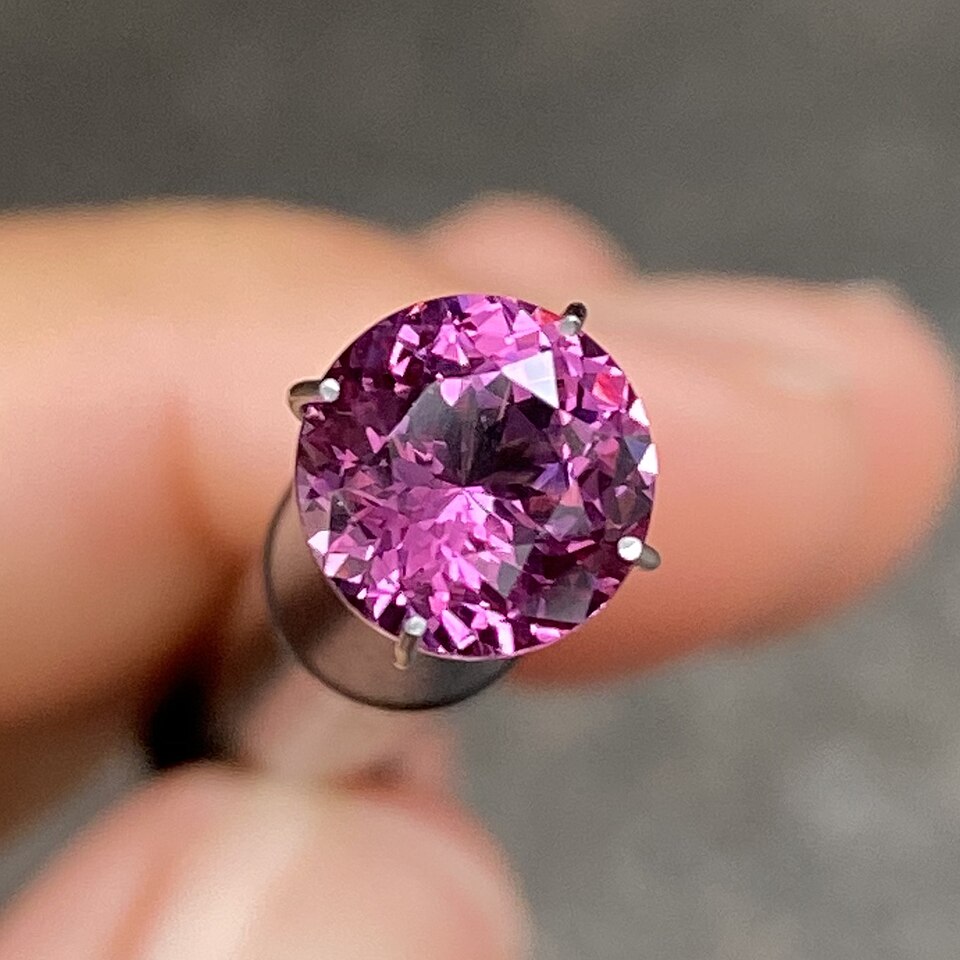
Rhodolite
Rodolite
(Mg,Fe)₃Al₂(SiO₄)₃ Properties
- Category
- Gem
Rhodolite is a variety of garnet characterized by an intense red-violet color, valued as a gemstone for jewelry. It belongs to the pyralspite garnets group, with formula (Mg,Fe)₃Al₂(SiO₄)₃, and forms in aluminum-rich metamorphic rocks.
Rhodolite represents one of the most fascinating gemmological varieties of the garnet group, distinguished by its characteristic color ranging from crimson red to violet-pink. Chemically, it is a solid solution between almandine (Fe₃Al₂(SiO₄)₃) and pyrope (Mg₃Al₂(SiO₄)₃), with an Fe:Mg ratio that confers the distinctive red-violet tonality. The term "rhodolite" was coined in 1882 by George Frederick Kunz, deriving from the Greek "rhodon" (rose), referring to its characteristic color. It crystallizes in the cubic system, generally in trapezohedric crystals, with hardness 7–7.5 on the Mohs scale, making it suitable for all types of jewelry.
Geologically, rhodolite forms in high-grade metamorphic environments, particularly in gneiss and aluminum-rich schists, often associated with feldspars, quartz, and biotite. The most renowned deposits are found in Sri Lanka (Ceylon), where gemmological-quality rhodolite is extracted from alluvial and metamorphic deposits; other significant sources include Mozambique, Tanzania, and North Carolina in the United States. In the gemmological market, rhodolite with saturated color and high clarity commands significant prices, lower only than fine rubies but higher than common red garnets, with museum-quality specimens reaching 1,000–2,000 USD per carat.
Rhodolite crystallizes in the cubic system, point group 4/m3̄2/m (Ia3̄d), with lattice parameter a ≈ 11.52 Å. Relative density: 3.74–3.84 g/cm³. Refractive index: 1.740–1.760 (isotropic). Hardness: 7–7.5 Mohs; no cleavage, conchoidal fracture. Chemical composition varies as a function of the Fe:Mg ratio; gemmological rhodolites typically present 40–70% almandine component and 30–60% pyrope, with traces of spessartine (Mn₃Al₂(SiO₄)₃). The UV-Vis absorption spectrum shows characteristic bands around 573 nm (Fe²⁺ d-d transition) and 680 nm, with possible weak red fluorescence under 254 nm UV. Optical microscopy reveals typical inclusions: rutile needles, magnetite dots, and occasional three-phase fluid inclusions. Raman spectroscopy: main band at 859 cm⁻¹ (Si-O stretching of the SiO₄ tetrahedron). FTIR spectroscopy: characteristic absorptions in the 400–1200 cm⁻¹ region. No significant X-ray fluorescence. Rhodolite does not exhibit detectable pleochroism in thin section. Thermal treatments can shift color toward more reddish tones; no significant commercial irradiation treatments are known.
Mining localities
- Sri Lanka (Ceylon)
- Mozambico
- Tanzania
- Carolina del Nord, Stati Uniti
- Madagascar
- Zambia
Frequently Asked Questions
What is the difference between rhodolite and other red garnets?
Rhodolite is distinguished by its unique red-violet color, caused by the mixture of magnesium and iron in the formula (Mg,Fe)₃Al₂(SiO₄)₃, while other red garnets like almandine tend toward darker red or brownish tones. It belongs to the pyralsalite garnet group and is considered the most precious variety among garnets for its vivid color and superior transparency.
How is rhodolite formed and where is it found?
Rhodolite forms in aluminum-rich metamorphic rocks, such as schists and gneisses, during regional metamorphism at high temperatures and pressures. The main deposits are located in Sri Lanka, Mozambique, Madagascar, and Tanzania, where geological conditions favor the crystallization of this garnet variety.
How much does a rhodolite cost and how do you recognize an authentic one?
A gemstone-quality rhodolite typically costs between 100 and 500 euros per carat, depending on purity and origin, with exceptional specimens reaching higher prices. To identify it, check for the characteristic red-violet color (not pure red), hardness of 7-7.5 on the Mohs scale, and request a gemological certificate from accredited laboratories.
What are the physical properties of rhodolite and how do you clean it?
Rhodolite has a hardness of 7-7.5 on the Mohs scale, density of 3.8-3.9 g/cm³, and displays a characteristic vitreous luster, making it suitable for everyday jewelry as it is resistant to scratching. It cleans easily with warm water and neutral soap using a soft brush, while avoiding harsh chemicals and ultrasonic cleaning that could damage the stone.
Entry generated with Claude API (Anthropic) on data extracted from Mindat, RRUFF and Wikipedia. Not yet reviewed by a human expert. Verify data against original sources before citing in formal work.