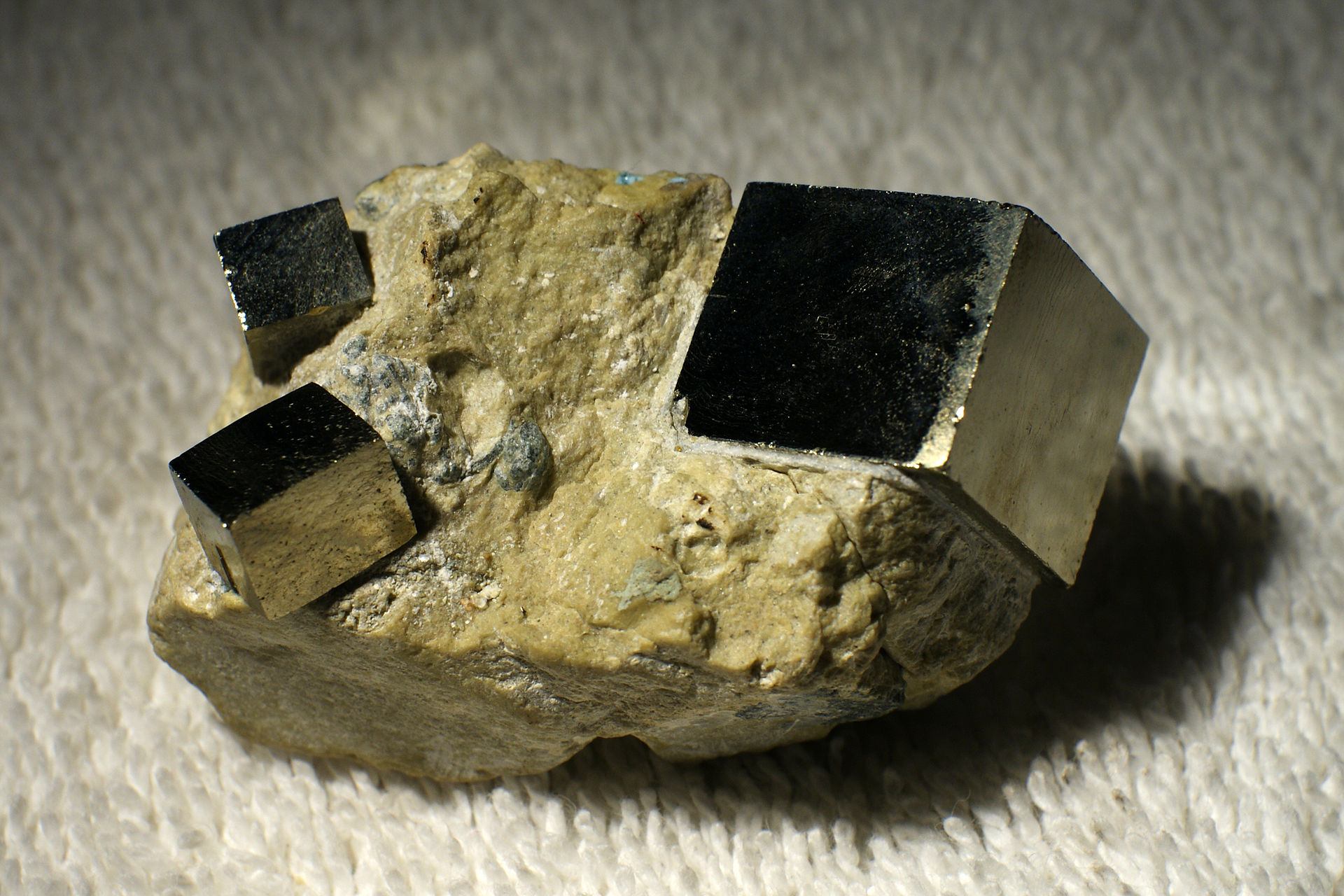
Pyrite
Pirite
FeS₂ Properties
- Color
- Brass yellow, golden
- Luster
- Metallic
- Density
- 5.01 g/cm³
- Category
- Mineral
Pyrite is the most common sulfide on Earth, renowned for its yellow-golden color that earned it the nickname fool's gold. Its perfect cubic crystals are among the most recognizable geometric forms in mineralogy.
The name derives from the Greek pyr (fire), because pyrite produces sparks when struck against steel. This property made it essential in wheel-lock firearms of the 16th and 17th centuries. The deposits of Navajún in Spain produce the most perfect cubic crystals in the world.
Despite visual similarity to gold, pyrite is easily distinguished by its superior hardness, lower specific gravity, and black streak rather than yellow.
It belongs to the pyrite group, cubic crystal system with space group Pa3̄. The structure is analogous to sodium chloride, with Fe²⁺ and persulfide units S₂²⁻. It conducts electricity as an n-type semiconductor. Some pyrites can contain up to 0.25 wt% Au.
Mining localities
- Navajún, La Rioja, Spagna (cubi perfetti)
- Huanzala, Perù
- Elba, Italia
- Illinois, USA
- Kazakhstan
Frequently Asked Questions
How can I distinguish pyrite from real gold?
Pyrite is much more brittle than gold and crumbles easily with a hammer, while gold is malleable and deforms without breaking. Additionally, pyrite shows black streaks when scratched, has a pale and unnatural yellow color, and always crystallizes in perfect cubic forms, unlike gold which is found in irregular nuggets. This is why it earned the nickname 'fool's gold' and caused disappointments during gold rushes.
Where is pyrite found and how much does it cost?
Pyrite is found worldwide, particularly in Spain, Peru, Russia, and the United States, often associated with copper, gold, and coal deposits. The price is very economical, generally between €0.50 and €5 per kilogram for raw specimens, while perfect cubic crystals and well-formed examples can reach €10-50 for museum-quality collection specimens.
What are the physical and chemical properties of pyrite?
Pyrite (FeS₂) is an iron sulfide with hardness 6-6.5 on the Mohs scale, density of 5.02 g/cm³, and cubic crystal structure. It is an electrical conductor, non-magnetic, with metallic luster and opaque appearance, and develops a reddish-brown oxidation patina if exposed to moisture and air. Its chemical formula contains sulfur that, when heated, produces the characteristic smell of burning sulfur.
How does pyrite form in nature and which rocks contain it?
Pyrite forms through hydrothermal, sedimentary, and metamorphic processes, precipitating from solutions rich in iron and sulfur at high temperatures. It is commonly found in igneous rocks, metamorphic rocks, bituminous shales, coal deposits, and gold-bearing quartz veins, where it often acts as the host mineral for gold. Its abundance in the Earth's crust makes it the most economically important metallic sulfide for sulfur and iron extraction.
Entry generated with Claude API (Anthropic) on data extracted from Mindat, RRUFF and Wikipedia. Not yet reviewed by a human expert. Verify data against original sources before citing in formal work.