Prehnite
Prehnite
Ca₂Al(Si₃Al)O₁₀(OH)₂ Properties
- Category
- Mineral
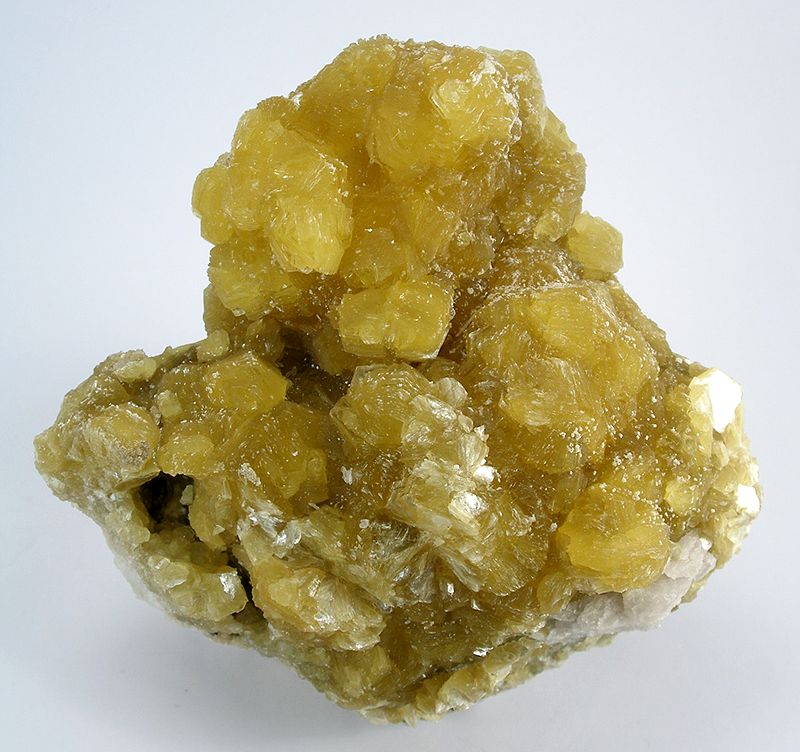
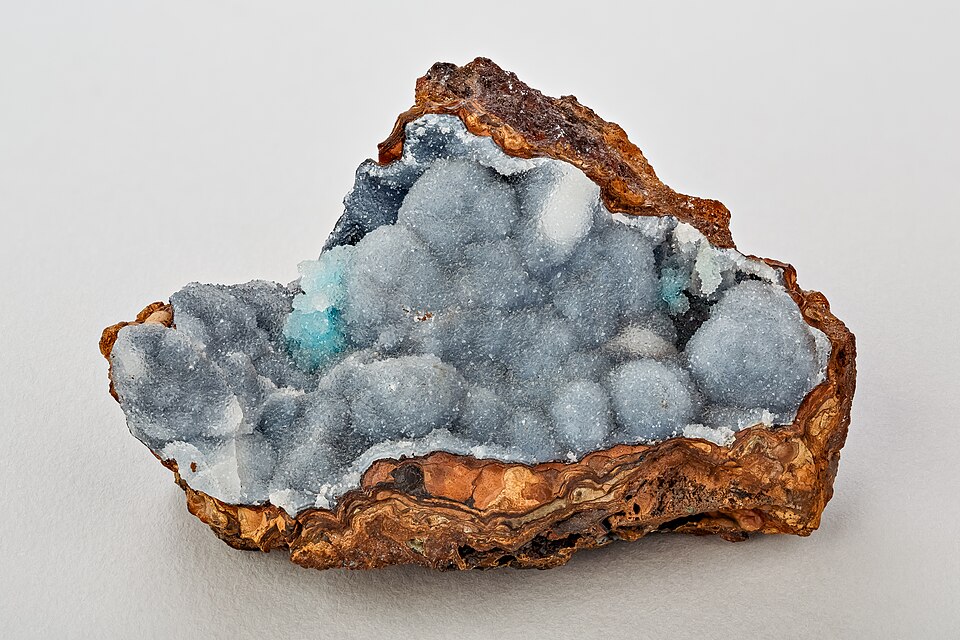
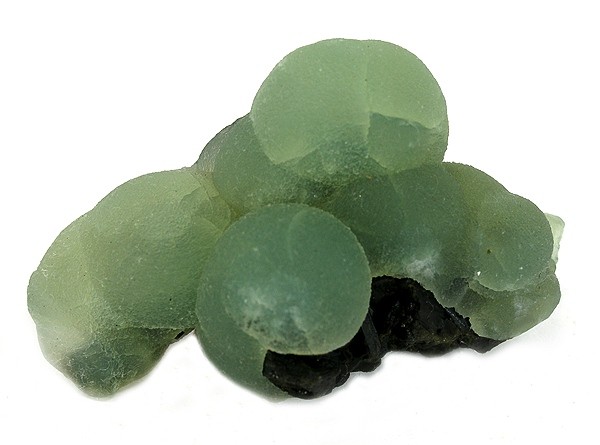
Prehnite is a hydrated calcium and aluminum silicate that crystallizes in tabular or botryoidal forms, characterized by a color ranging from pale green to yellow-green and a transparency that makes it appreciated by collectors. It typically forms in low-temperature metamorphic and volcanic rocks, where it represents an important geological indicator of early metamorphic conditions.
Prehnite (Ca₂Al(Si₃Al)O₁₀(OH)₂) is an inosilicate that belongs to the zeolite group and represents one of the most significant minerals for understanding diagenesis and very-low-temperature metamorphism. First discovered in 1788 in South Africa by Dutch mineralogist Hendrik von Prehn, from whom it takes its name, prehnite forms preferentially in environments where volcanic or sedimentary rocks undergo moderate heating in the presence of fluids rich in calcium and aluminum. Its orthorhombic crystal structure features interconnected chains of silicon tetrahedra, which confer on the mineral good hardness (6-6.5 on the Mohs scale) and a characteristic subconchoidal fracture.
Geologically, prehnite is a reliable indicator of the prehnite-pumpellyite facies, a fundamental pressure-temperature interval in metamorphic classification. It appears frequently in association with other minerals such as calcite, epidote, laumontite, and zeolites, often filling cavities and fractures in altered basalts or metamorphic schists. From a gemological perspective, transparent specimens with intense green coloration are sought by collectors, although prehnite remains a relatively little-known mineral to the general public compared to other gemstones. The most prized varieties come from Australia (Tasmania), Scotland, and South Africa, where they reach remarkable dimensions and transparency.
Prehnite crystallizes in the orthorhombic system, space group Pnma, with lattice parameters a ≈ 4.64 Å, b ≈ 5.47 Å, c ≈ 18.48 Å (variable as a function of composition). The ideal formula Ca₂Al(Si₃Al)O₁₀(OH)₂ exhibits minor substitutions of Fe²⁺ for Ca²⁺ and variability in the Si/Al ratio. Density ranges between 2.80 and 2.95 g/cm³, while the refractive index varies from nα = 1.611 to nγ = 1.669, with birefringence Δn ≈ 0.024. The hardness of 6-6.5 Mohs, combined with subconchoidal fracture and imperfect cleavage along the (001) plane, characterizes the mechanical behavior of the mineral.
Spectroscopically, prehnite shows absorption in the near-infrared (NIR) attributable to O-H vibrations, with a characteristic band around 3100 cm⁻¹ in Raman spectroscopy. Green colorations result from traces of Fe²⁺ and Fe³⁺ substituting aluminum in the structure. Differential thermal analysis (DTA) reveals structural water loss around 600-700 °C. Prehnite is thermodynamically stable in the P-T field between 150 and 300 °C and pressures of 1 to 3 kbar, making it a marker for the prehnite-pumpellyite facies according to Coombs classification. Microscopically, it often exhibits tabular habit along the (001) plane with acute terminations, or botryoidal forms in fibrous aggregates. UV fluorescence is generally absent or very weak.
Mining localities
- Tasmania, Australia
- Scozia, Regno Unito
- Sudafrica
- Nuova Zelanda
- Giappone (Hokkaido)
- Francia (Alpi)
- Svizzera
- Austria
Frequently Asked Questions
What is prehnite and how does it form?
Prehnite is a hydrated calcium aluminum silicate with the chemical formula Ca₂Al(Si₃Al)O₁₀(OH)₂ that forms primarily in low-grade metamorphic rocks and basaltic amygdules. Its genesis is linked to hydrothermal alteration of feldspars and aluminum-rich minerals in the presence of aqueous fluids at temperatures between 200 and 350°C.
How do you identify prehnite from other green minerals?
Prehnite is distinguished by its characteristic pale green to yellow-green color, a hardness of 6-6.5 on the Mohs scale, and vitreous transparency that makes it translucent. Unlike chlorite or serpentine, it displays well-defined tabular or botryoidal crystal forms and a particularly bright luster.
Where is prehnite found and what does it cost?
Prehnite is extracted mainly from deposits in South Africa, Australia, China, and Italy, with the finest specimens coming from the Aosta Valley. Prices vary considerably: small raw mineral samples cost €10-30, while faceted gemmological-quality stones can reach €50-150 per carat.
What are the physical and chemical properties of prehnite?
Prehnite has a hardness of 6-6.5, density of 2.85-2.95 g/cm³ and belongs to the orthorhombic crystal system with tabular or botryoidal habit. It is birefringent with a refractive index of 1.61-1.65 and contains hydroxyls in its structure (OH)₂, which give it transparency and its characteristic green color due to iron traces.
Entry generated with Claude API (Anthropic) on data extracted from Mindat, RRUFF and Wikipedia. Not yet reviewed by a human expert. Verify data against original sources before citing in formal work.