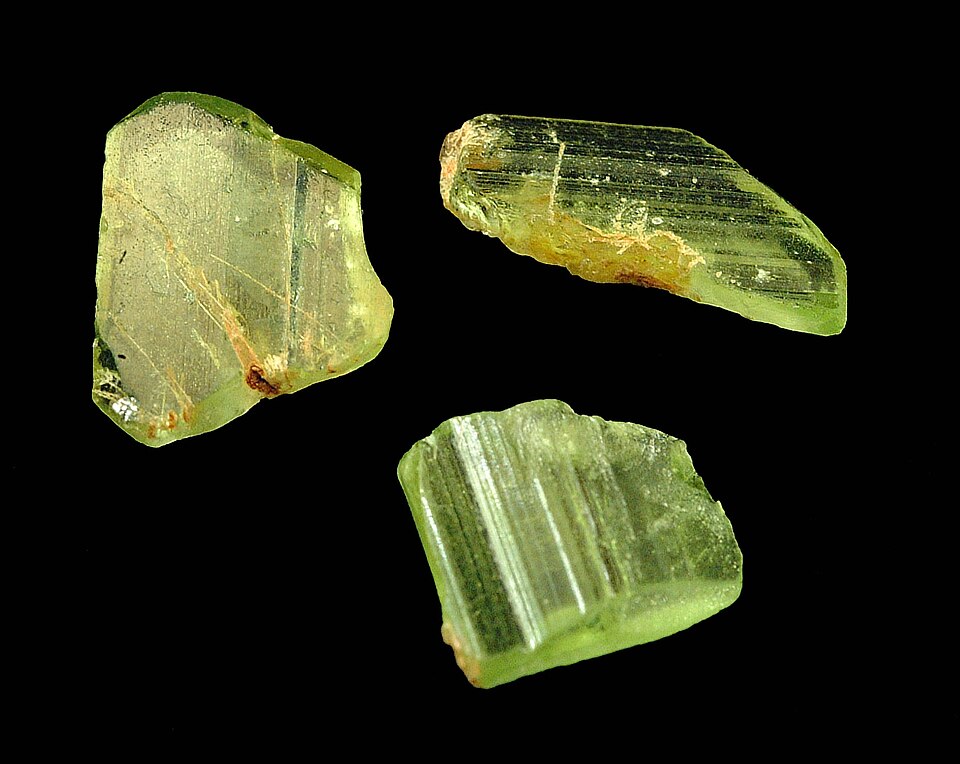
Peridot
Peridoto
Mg₂SiO₄ Properties
- Category
- Gem
Peridot is a magnesium silicate with a characteristic yellowish-green color, known as a precious gemstone since antiquity and valued for its transparency and natural brilliance.
Peridot, chemically olivine (Mg₂SiO₄), is an orthorhombic silicate that crystallizes in magnesium-rich environments, typically in basic and ultrabasic igneous rocks. Its characteristic green coloration derives from the presence of divalent iron (Fe²⁺) that partially substitutes magnesium in the crystal structure. Unlike many gemstones, peridot is not a product of deep metamorphism: it instead forms during the cooling of silica-poor magmas, or in exceptional cases is brought to the surface by volcanic eruptions involving the Earth's mantle. Its hardness of 6.5–7 on the Mohs scale makes it suitable for jewelry but requires caution in daily wear. Historically, peridot was extracted on the Egyptian island of Zabargad (Topaz) in the Red Sea as early as 1500 BCE, and the ancients frequently confused it with emerald. The most prized deposits today are found in Myanmar, Pakistan (Himalayas), and Arizona, where gemstone-quality peridot commands significant prices in the international market.
Peridot (olivine): Mg₂SiO₄ with possible isomorphous substitution Fe²⁺ ↔ Mg²⁺. Orthorhombic crystal system, space group Pbnm. Lattice parameters: a = 4.76 Å, b = 10.20 Å, c = 5.98 Å. Hardness 6.5–7 Mohs; density 3.27–3.37 g/cm³ (increases with iron content). Refractive index: nα = 1.635–1.680, nβ = 1.651–1.705, nγ = 1.670–1.723; birefringence Δn ≈ 0.035–0.043. Moderate optical dispersion (0.020). Weak pleochroism: yellowish-green to bluish-green tones. Spectroscopy: characteristic absorption at 1050 nm and band at 450 nm (Fe²⁺); Raman spectrum with dominant peaks at 820 cm⁻¹ and 970 cm⁻¹. UV fluorescence generally absent or very weak. Formation in ultramafic rocks (dunites, lherzolites) and olivine basalts; mineralogical associations include enstatite, diopside, magnetite. Gem deposits: Myanmar (Mogok Valley), Pakistan (Hunza Valley), Arizona (San Carlos), Egypt (Zabargad), Brazil, China. Treatments: rare; occasionally light heating to improve color. Moderate thermal stability; avoid thermal shock.
Mining localities
- Myanmar — Mogok Valley (qualità superiore, colore intenso)
- Pakistan — Hunza Valley, Karakoram (peridoto di alta qualità)
- Arizona, USA — San Carlos (principale produttore mondiale)
- Egitto — Isola di Zabargad, Mar Rosso (giaciture storiche)
- Brasile — Minas Gerais (peridoto di qualità gemmologica)
- Cina — Hunan (produzioni recenti)
Frequently Asked Questions
What is the chemical formula of peridot and how does it form?
Peridot has the chemical formula Mg₂SiO₄, a magnesium silicate that forms primarily in Earth's mantle at depths exceeding 400 km. It reaches the surface through volcanic eruptions or is brought to the crust by geological processes, making it common in basaltic and ultramafic rocks.
How can you identify authentic peridot from counterfeit stones?
Authentic peridot displays a characteristic yellowish-green color and crystalline transparency, with a hardness of 6.5-7 on the Mohs scale. You can distinguish it from imitations by observing birefringence (double refraction) under magnification and verifying its density, which for natural peridot ranges around 3.3-3.4 g/cm³.
What are the main peridot deposits in the world?
The most important peridot deposits are found in Egypt (Zabarget Island in the Red Sea), Myanmar, China, Kenya, and the United States. Egypt is historically the primary producer, known since ancient Pharaonic times for mining this precious gem.
What is the average price of peridot per carat and what factors affect it?
Peridot prices typically range from 50 to 400 euros per carat depending on quality, size, and origin. The value depends primarily on color saturation of the green hue, transparency, absence of inclusions, and cutting quality, with high-quality Egyptian specimens commanding the highest prices.
Entry generated with Claude API (Anthropic) on data extracted from Mindat, RRUFF and Wikipedia. Not yet reviewed by a human expert. Verify data against original sources before citing in formal work.