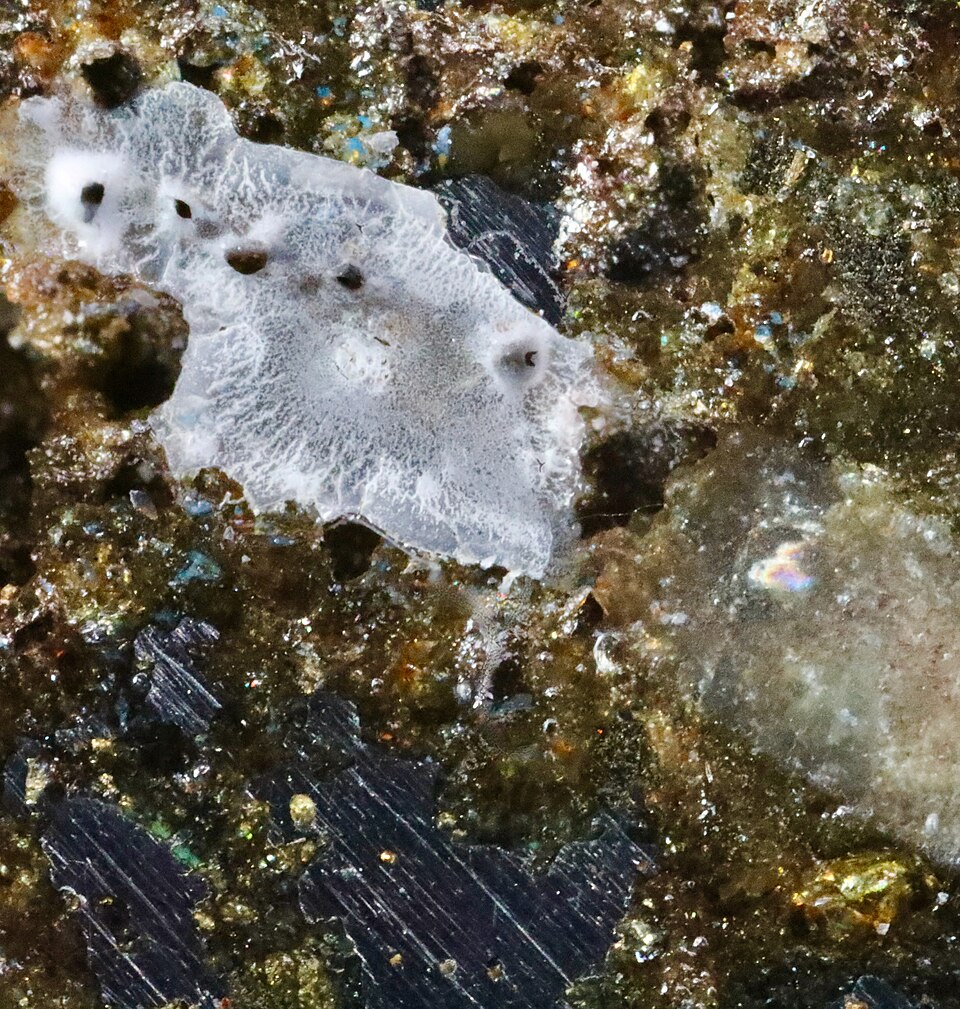
Pallasite
Pallasite
Fe-Ni + Mg₂SiO₄ Properties
- Category
- Meteorite
Pallasite is a rare stony-iron meteorite composed of an iron-nickel metallic matrix that encloses transparent crystals of olivine (Mg₂SiO₄), creating a fascinating appearance resembling a cosmic window when polished and illuminated.
Pallasites represent one of the most fascinating types of stony-iron meteorites, constituting approximately 8% of meteorites that reach Earth. Their unique structure—a matrix of kamacite and taenite (iron-nickel alloys) hosting yellow-green olivine nodules—suggests an origin in the outer core of a differentiated planetesimal, likely formed in the first few million years of the Solar System. When a section is polished and treated with dilute nitric acid, the celebrated Widmanstätten pattern emerges, a banded crystalline structure revealing extremely slow cooling in space.
The name derives from Count Ernst Friedrich von Chladni, who classified meteorites in 1794, while the term "pallasite" was coined in honor of Peter Simon Pallas, a Russian naturalist who studied the Krasnojarsk meteorite (Siberia) in 1772. Notable specimens come from Atacama (Chile), Imilac, and Seymchan (Russia), where desert conditions preserve these cosmic fragments for millennia. The variable hardness (4-7 on the Mohs scale) reflects the composite nature: olivine is harder (6.5-7), while the metallic matrix is softer (4-5).
Pallasite is classified as a stony-iron meteorite, subtype PAL according to international meteorite nomenclature. The chemical composition is dominated by metallic Fe-Ni (60-90% by weight) with olivine (Mg₂SiO₄) constituting 10-40% by volume. The metallic matrix exhibits a characteristic microstructure composed of kamacite (cubic Fe,Ni, 5-8% Ni) and taenite (cubic Fe,Ni, 25-35% Ni), with occasional minor phases such as troilite (FeS) and schreibersite ((Fe,Ni)₃P).
The crystal system of the olivine component is orthorhombic (not cubic as previously noted for the metallic matrix), with lattice parameters a ≈ 4.76 Å, b ≈ 10.20 Å, c ≈ 5.98 Å. Olivine hardness is 6.5-7 Mohs; the metallic matrix is 4-4.5 Mohs. Total density ranges from 5.0 to 5.5 g/cm³. Olivine exhibits weak pleochroism and moderate birefringence; refractive indices are nα ≈ 1.635, nβ ≈ 1.651, nγ ≈ 1.670. The Widmanstätten pattern, visible in polished section after acid etching, reveals the lamellar structure resulting from extremely slow cooling (approximately 1-10 °C per million years) in the planetesimal core. Oxygen isotope analysis (δ¹⁸O vs δ¹⁷O) places pallasites in a distinct group, consistent with origin from a single parent body or a few similar bodies. Radiometric dating (Pb-Pb, Ar-Ar) indicates a crystallization age of 4.5-4.56 billion years.
Mining localities
- Atacama, Cile
- Imilac, Cile
- Seymchan, Russia (Siberia orientale)
- Krasnojarsk, Russia
- Springwater, Canada
- Marjalahti, Finlandia
- Sericho, Kenya
- Pallasite (località eponima, Russia)
Frequently Asked Questions
How much does a pallasite cost and where can I buy one?
The price of a pallasite varies significantly based on size, olivine quality, and origin, ranging from €50 to €5000+ for significant specimens. Authentic pallasites are purchased from specialized meteorite dealers, scientific auctions, and mineral museums, where authenticity certification is guaranteed, as they are highly sought by collectors.
How does a pallasite form and where does it come from?
A pallasite forms in the core of planetesimals during the early stages of the solar system, when molten iron-nickel crystallizes around olivine crystals under extreme pressure. These meteorites reach Earth only when the parent planetesimal fractures due to collisions, allowing fragments to fall as authentic meteorites from space.
How do I recognize a true pallasite and what are its distinctive characteristics?
A true pallasite features a gray metallic matrix of iron-nickel (Fe-Ni) enclosing translucent olivine crystals (Mg₂SiO₄), creating a "cosmic window" effect when polished and illuminated. The presence of Widmanstätten lines (chevron patterns visible under microscope) on the metal surface is a distinctive characteristic confirming authentic meteorite origin.
What is the exact chemical composition of pallasite and why is it so rare?
Pallasite is composed primarily of an iron-nickel matrix (Fe-Ni) at approximately 90% with inclusions of olivine crystals (Mg₂SiO₄), coming from the cores of destroyed planetesimals. It is extraordinarily rare because it represents less than 1% of all meteorites that have fallen to Earth, since most planetesimals never fractured in a way that allowed their core fragments to reach our planet.
Entry generated with Claude API (Anthropic) on data extracted from Mindat, RRUFF and Wikipedia. Not yet reviewed by a human expert. Verify data against original sources before citing in formal work.