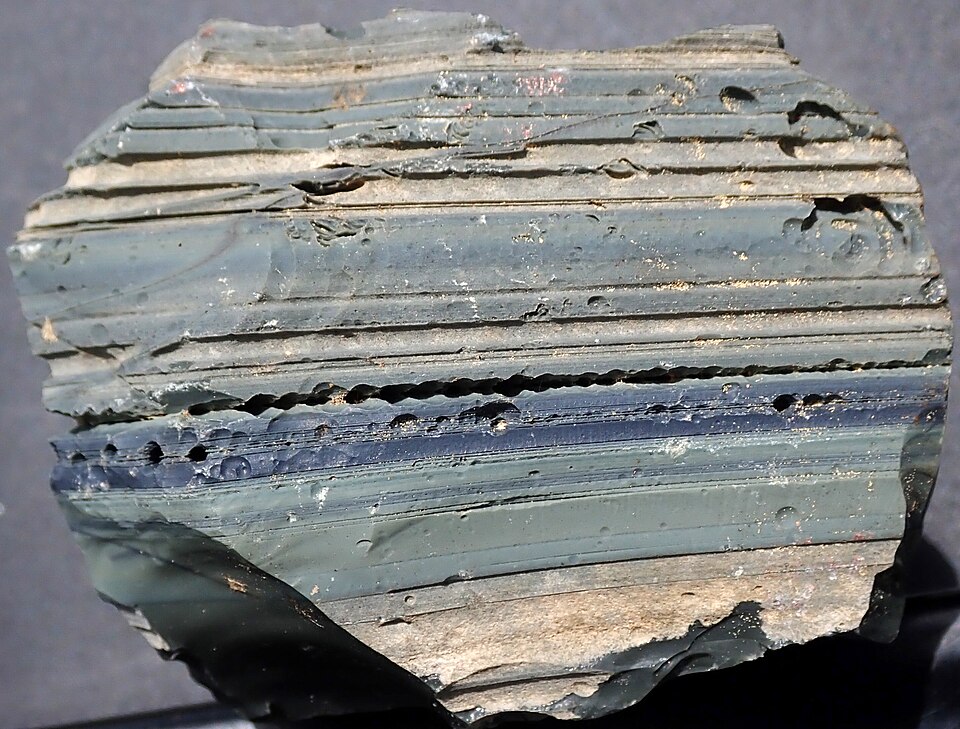
Obsidian
Ossidiana
SiO₂ + Al₂O₃ Properties
- Category
- Rock
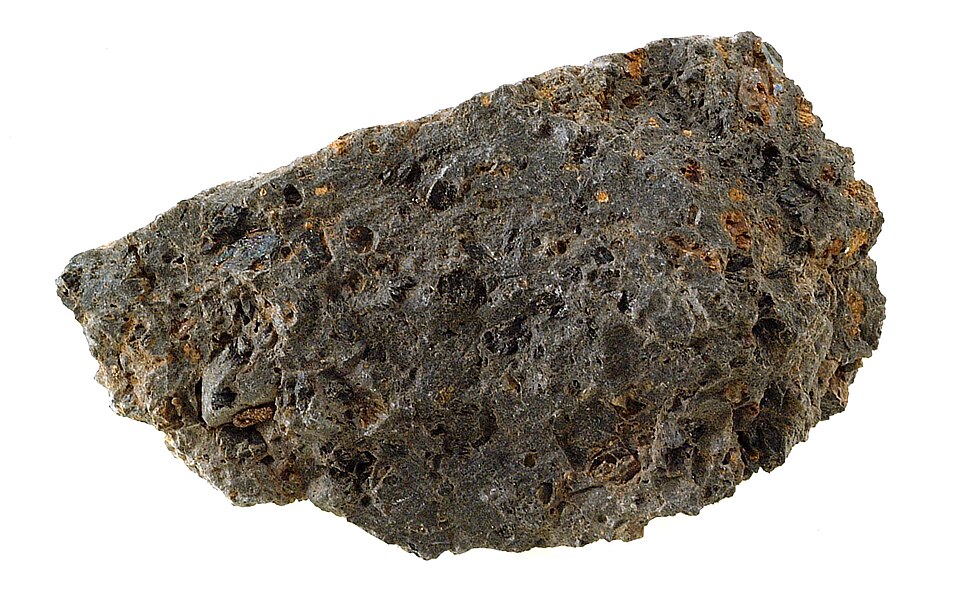
Obsidian is a natural volcanic glass formed by the rapid cooling of silica-rich lava, creating an amorphous rock typically black or dark brown in color with a characteristic glassy luster and a conchoidal fracture as sharp as glass.
Obsidian is an amorphous volcanic rock that forms when felsic lava (rich in silica and aluminum) cools so rapidly that mineral crystallization cannot occur. This process, which takes place over days or weeks, locks atoms into the disordered structure typical of glasses, giving obsidian its characteristic transparency or translucency and brilliant glassy luster. Chemical composition varies slightly depending on the magmatic source, but is always dominated by SiO₂ (70–75%) with significant quantities of Al₂O₃, FeO, and other minor oxides.
From a geological perspective, obsidian forms predominantly in active or recent volcanic environments, often associated with rhyolites and dacites. Its conchoidal fracture (curved and smooth) makes it extremely sharp: natural edges can reach a keenness superior to surgical steel, a property that made it valuable for tools and weapons since the Paleolithic. Colored varieties exist such as snowflake obsidian (with white crystallites of cristobalite), rainbow obsidian (with iridescence due to lamellar inclusions), and mahogany obsidian (with red and brown tones). In the contemporary gemological market, obsidian is prized for jewelry and decorative objects, with the most important deposits in Mexico, Turkey, Japan, and the western United States.
Obsidian — Amorphous volcanic rock, SiO₂ 70–75% + Al₂O₃, FeO, CaO, and traces of other oxides.
Crystal system: Amorphous (natural glass, no ordered crystalline structure). Mohs hardness: 5–5.5 (brittle, unsuitable for ring jewelry). Density: 2.35–2.60 g/cm³ (varies with composition and inclusions). Luster: Glassy, sometimes greasy. Fracture: Characteristic conchoidal, very sharp. Transparency: Opaque to translucent (rarely transparent). Refractive index: 1.48–1.51 (typical of silicate glasses). Dispersion: Absent (amorphous).
Spectroscopic characteristics: Near-infrared absorption due to H₂O and OH⁻ trapped in the glassy structure. Raman spectroscopy shows characteristic bands of amorphous silica around 800 cm⁻¹. UV fluorescence: generally inert, sometimes weak red luminescence in iron-bearing varieties.
Geological origin: Felsic lava effusion in continental or submarine volcanic environments with rapid cooling (rate > 10⁶ K/s). Often associated with pumice, perlitic obsidian (perlite), and crystalline rhyolite. Radiometric dating possible via K-Ar on feldspar inclusions.
Varieties and inclusions: Snowflake obsidian contains cristobalite crystallites (SiO₂). Rainbow obsidian exhibits iridescence from oriented laminae of magnetite or hematite. Mahogany obsidian: dispersed hematite imparts red-brown color. Sheen obsidian: reflections due to parallel lamellar inclusions.
Principal producers: Mexico (Pachuca, Hidalgo), Turkey (Cappadocia), Japan (Izu), USA (Oregon, California, Yellowstone), Peru, Ecuador. Important archaeological deposits in Anatolia (Çatalhöyük, 7500 BCE) and Mesoamerica.
Mining localities
- Pachuca, Hidalgo, Messico
- Cappadocia, Turchia
- Izu, Giappone
- Oregon, USA
- California, USA
- Yellowstone, Wyoming, USA
- Perù
- Ecuador
- Çatalhöyük, Anatolia, Turchia
Frequently Asked Questions
How is obsidian formed and why is it so sharp?
Obsidian forms from the extremely rapid cooling of silica-rich lava (SiO₂ + Al₂O₃), which prevents crystallization and creates an amorphous glassy structure. Its conchoidal fracture, identical to artificial glass, produces microscopically sharp edges because molecules break along natural planes of weakness, creating smooth and cutting edges.
How to recognize real obsidian and how much does it cost?
Real obsidian has a glossy glassy appearance, is opaque black or dark brown, and shows a characteristic conchoidal fracture when broken; you can test it by scratching it on a white ceramic tile to verify if it leaves a gray-black streak. Prices range from 5-15 euros for small raw samples to 50-200 euros for polished quality pieces, depending on size, variety (snowflake, mahogany, rainbow), and origin.
Where is obsidian found and what are the main deposits in the world?
Obsidian forms exclusively in volcanically active areas where silica-rich lava cools rapidly; major deposits are found in Mexico (Pachuca), Peru (Ayacucho), United States (Oregon, Idaho, Yellowstone), Iceland, Turkey, and Indonesia. Italy has small deposits in Sardinia and the Lazio volcanic region, but in limited quantities compared to major world suppliers.
What is the difference between obsidian and volcanic glass? Are they the same thing?
Yes, obsidian is technically a natural volcanic glass: the term 'volcanic glass' is the general category describing any amorphous rock formed by rapid lava cooling, while 'obsidian' is the specific name for silica-rich volcanic glass with that characteristic composition (SiO₂ + Al₂O₃) and black or brown appearance. So all obsidian is volcanic glass, but not all volcanic glass is obsidian.
Entry generated with Claude API (Anthropic) on data extracted from Mindat, RRUFF and Wikipedia. Not yet reviewed by a human expert. Verify data against original sources before citing in formal work.