Megalodon Tooth
Dente di Megalodonte
Ca₅(PO₄)₃F Properties
- Category
- Fossil
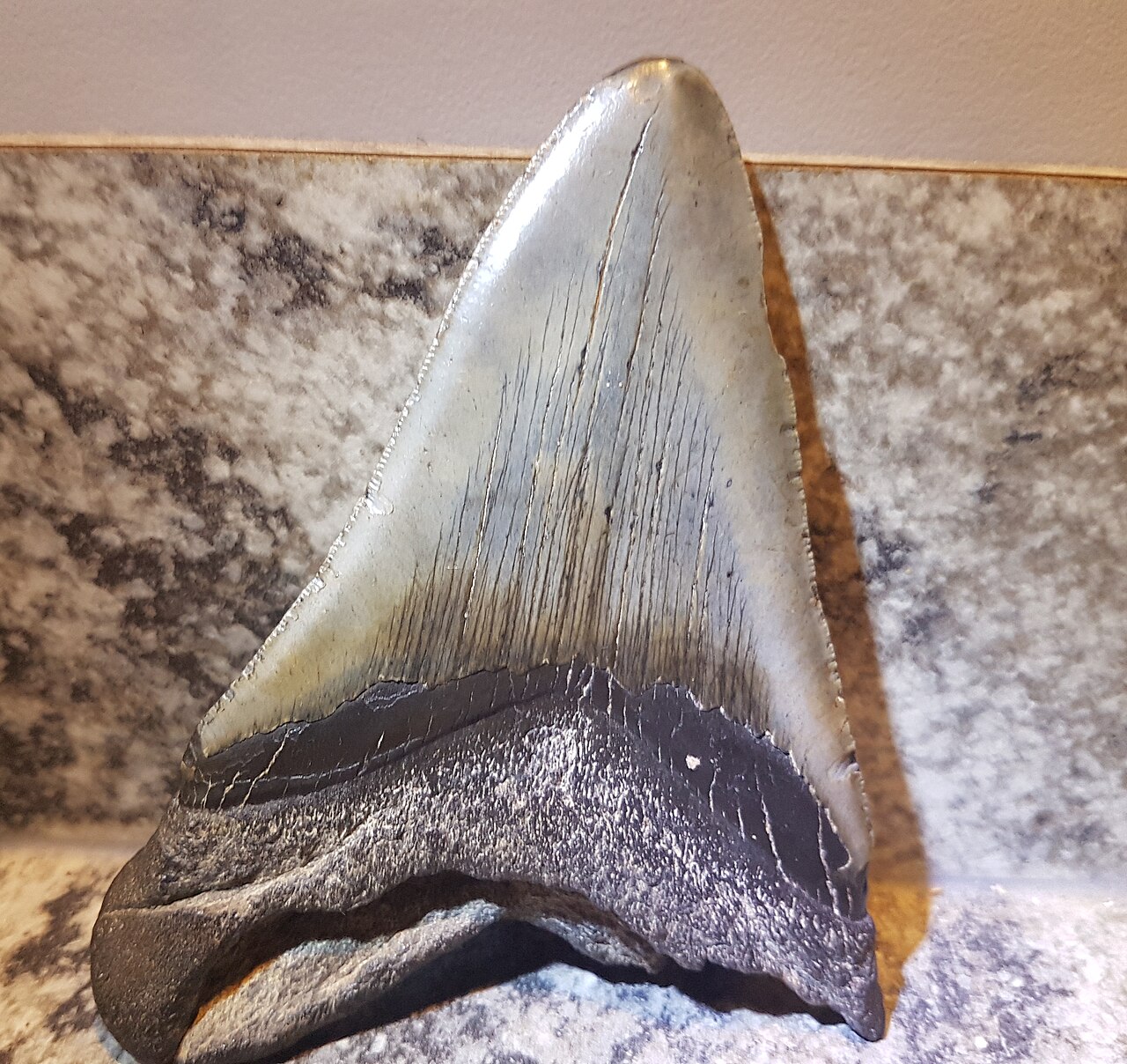
A megalodon tooth is the fossil of a large extinct shark (Carcharocles megalodon) that lived between 23 and 3.6 million years ago, composed primarily of apatite (fluorated calcium phosphate) and dentin, which can reach 18 centimeters in length and is one of the most sought-after fossil specimens among collectors.
The megalodon tooth represents one of the most fascinating paleontological specimens from the Cenozoic Era. Carcharocles megalodon was the dominant marine predator during the Miocene and Pliocene epochs, with an estimated body length between 16 and 18 meters. The fossil teeth are composed primarily of fluorated apatite (Ca₅(PO₄)₃F), the same mineral that forms dental enamel, along with dentin and cementum. The hexagonal crystal structure of apatite confers hardness and wear resistance, essential properties for a predator that fed on whales and other large cetaceans.
Megalodon teeth vary considerably in size and morphology depending on their position in the jaw: anterior teeth are more pointed and curved, while lateral teeth display tighter edges and flatter cross-sections. Coloration ranges from black to blue-gray, brown to off-white, depending on the sediment type and diagenetic processes affecting the fossil. The most important discovery sites concentrate in marine strata from the Miocene and Pliocene, particularly in California, Florida, North Africa, and Mediterranean basins. In gemological and paleontological collections, megalodon teeth rank among the most valued fossils for their scientific and collecting significance.
Mineralogical composition: fluorated apatite Ca₅(PO₄)₃F (principal component), dentin (amorphous calcium phosphate), cementum (mineral-organic). Crystal system: hexagonal, space group P63/m. Typical apatite lattice parameters: a ≈ 9.37 Å, c ≈ 6.88 Å. Mohs hardness: 5 (pure apatite); fossil teeth exhibit variability due to fossilization processes and mineralogical replacement. Density: 3.15–3.25 g/cm³. Refractive index: nω ≈ 1.633, nε ≈ 1.629 (negative birefringence). Raman spectroscopy: characteristic phosphate peaks at 960 cm⁻¹ (symmetric PO₄³⁻ stretching), 1040 cm⁻¹ (asymmetric stretching). XRD analysis frequently reveals the presence of francolite (apatite with carbonate ions substituting phosphate) in fossilized teeth. UV fluorescence ranges from inert to weakly fluorescent (blue-violet) due to trace rare elements and organic inclusions. Geological age: Late Miocene–Pliocene (23–3.6 Ma). Mineralogical associations in host sediments: quartz, feldspar, glauconite, secondary phosphates (vivianite, wavelite). Megalodon teeth frequently undergo permineralization and isomorphous substitution with pyrite, marcasite, and iron oxides.
Mining localities
- Charleston, South Carolina, USA
- Venice, Florida, USA
- Bakersfield, California, USA
- Atacama, Chile
- Marocco settentrionale
- Bacino del Mediterraneo, Italia
- Belgio, Paesi Bassi
- Perù, costa del Pacifico
- Giappone, bacini fossili marini
Frequently Asked Questions
How can I identify a genuine megalodon tooth from a fake?
An authentic megalodon tooth consists primarily of apatite (Ca₅(PO₄)₃F) and dentin, with coloration ranging from black to gray-brown depending on fossilization conditions. A genuine fossil has sharp and well-defined edges, uniformly aged surface patina, and weight consistent with its size; counterfeits often show artificial colors, overly perfect edges, or suspicious cracks.
What is the average price of a megalodon tooth on the market?
Prices vary enormously based on size, preservation conditions, and origin: small teeth (5-8 cm) start from €50-150, while large well-preserved specimens (15-18 cm) can reach €500-2000 or more. Rarest teeth with perfect edges and no cracks, and those with authenticity certificates, command significantly higher prices in the collector market.
How did a megalodon tooth form over millions of years?
The tooth originally formed in the jaw of the Carcharocles megalodon shark (23-3.6 million years ago) as a biological structure composed of apatite and dentin for chewing. After the shark's death, the tooth was buried in marine sediments and underwent fossilization processes, where the original elements remained substantially chemically stable thanks to apatite's crystalline nature, creating a time-resistant fossil.
Where can I find and buy authentic megalodon teeth?
Authentic megalodon teeth are found primarily in coastal fossil deposits in South Africa, Florida, Morocco, and Belgium, and can be purchased from specialized fossil dealers, online auctions, museums with commercial sections, and certified collectors. It is essential to verify provenance documentation and request authenticity certificates to avoid purchasing modern replicas or fraudulent fossils.
Entry generated with Claude API (Anthropic) on data extracted from Mindat, RRUFF and Wikipedia. Not yet reviewed by a human expert. Verify data against original sources before citing in formal work.