Magnetite
Magnetite
Fe₃O₄ Properties
- Category
- Mineral
Magnetite is an iron oxide (Fe₃O₄) that constitutes one of the most magnetic minerals in nature: it is so strongly attracted to magnets that it can be collected with a simple magnet, and for this reason it has been used since antiquity as a natural compass.
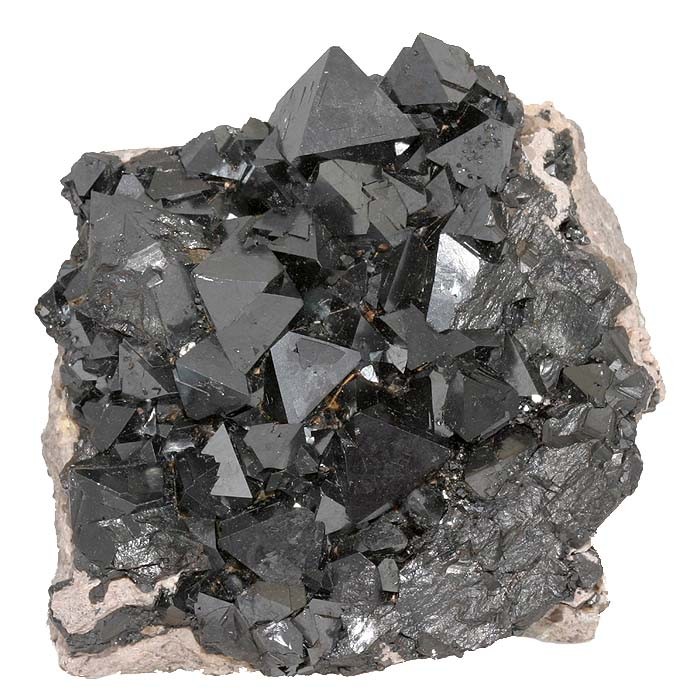
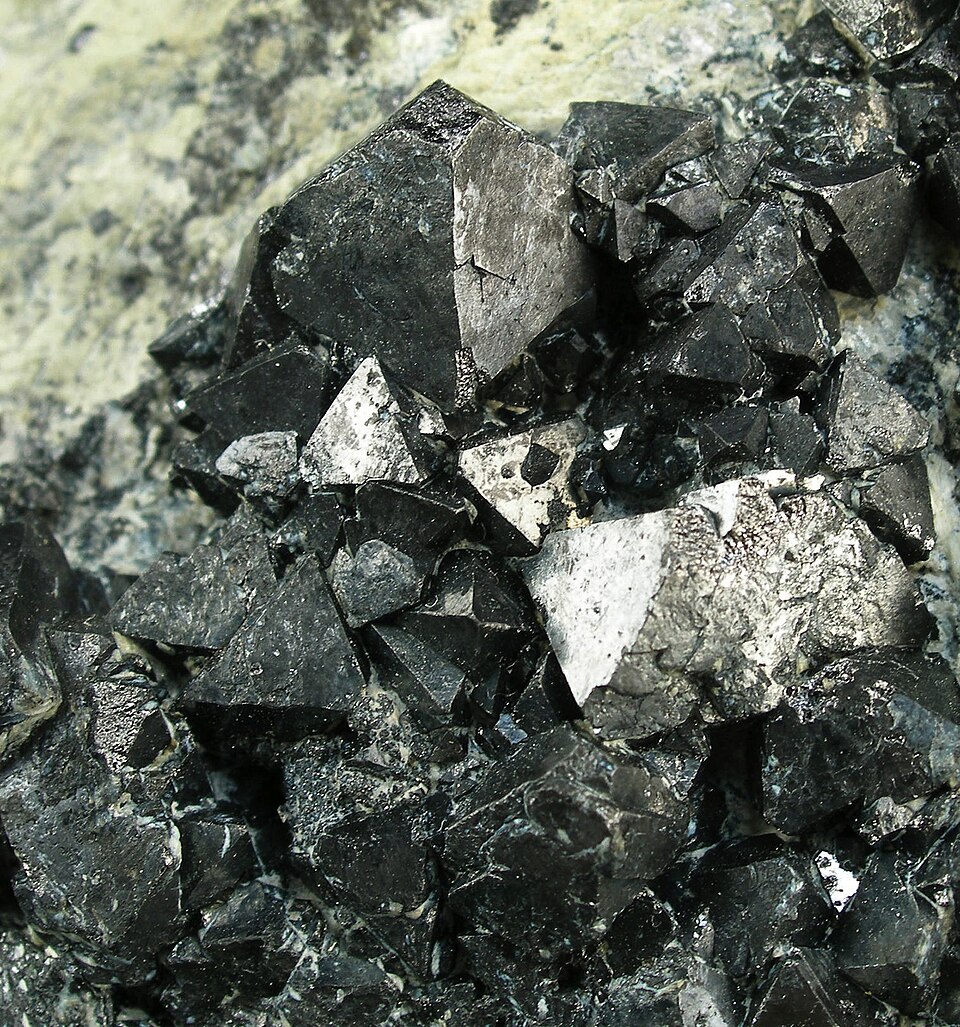
Magnetite is an iron oxide crystallized in the cubic system, characterized by spontaneous magnetization (*ferromagnetism*) due to the alignment of magnetic moments in iron ions. Its formula Fe₃O₄ actually represents a mixture of FeO and Fe₂O₃, and the *spinel* crystal structure allows a particular distribution of these cations that generates a macroscopic magnetic field. It forms predominantly in magmatic environments (as segregations in basic igneous rocks), in high-temperature metamorphic rocks, and in sediments of detrital origin. The finest and most magnetically intense crystals come from hydrothermal deposits. Historically, magnetite (*lodestone* or magnetic stone) was known to the Greeks and Chinese, who used it as a primitive compass. Today it remains essential as the primary iron mineral for the iron and steel industry, as well as a subject of study in paleomagnetism and archaeomagnetism.
Magnetite, Fe₃O₄, cubic system (space group Fd-3m), inverse spinel structure. Lattice parameter: a = 8.396 Å. Hardness 5.5–6.5 Mohs; density 5.17–5.18 g/cm³. Metallic luster; black color; black streak; opaque. Spontaneous magnetism with saturation magnetic moment ~92 emu/g (at room temperature). Volumetric magnetic susceptibility κ ≈ 0.1 SI (among the highest values for natural minerals). Curie temperature Tc ≈ 858 K. High electrical conductivity (p-type semiconductor). Mössbauer spectroscopy: reveals two octahedral and one tetrahedral sites for Fe²⁺ and Fe³⁺ ions. XRD analysis reveals spinel structure with characteristic reflections (111), (220), (311). Typical mineralogical associations: ilmenite, hematite, titanian magnetite (with Fe²⁺ ↔ Ti⁴⁺ substitution). Formation: magmatic segregation in basalts and gabbros; contact metamorphism in carbonate rocks; oxidation of iron sulfides in supergene environments. Stable isotopes: ⁵⁶Fe (91.75%), ⁵⁷Fe (2.12%), ⁵⁸Fe (0.28%).
Mining localities
- Kiruna, Svezia (giacimenti di magnetite massiva di origine magmatica)
- Mineville, New York, USA (depositi di magnetite metamorfica)
- Isola d'Elba, Italia (magnetite in rocce ignee e metamorfiche)
- Minas Gerais, Brasile (Quadrilátero Ferrífero, magnetite in itabiriti)
- Krivoy Rog, Ucraina (giacimenti di magnetite in formazioni ferrifere)
- Taberg, Svezia (magnetite in rocce alcaline)
- Bor, Serbia (magnetite in depositi di rame porfidico)
Frequently Asked Questions
How do you identify magnetite from other iron minerals?
Magnetite is easily recognized because it is strongly magnetic: it attracts a common magnet without any rubbing, something that other iron oxides do not do. It also has an opaque black metallic color, a metallic luster, and leaves a black streak when rubbed on white ceramic (streak test).
Where is magnetite found in nature and how does it form?
Magnetite (Fe₃O₄) forms mainly in igneous rocks during the cooling of iron-rich magma, and in high-temperature metamorphic rocks. The world's major deposits are found in Sweden, Australia, Brazil, and China, often associated with sedimentary iron formations.
What is the price of magnetite as a collector's mineral?
Raw magnetite prices range from 5 to 30 euros per kilogram depending on quality and crystal size. Well-formed collection specimens, especially those with visible octahedral crystals, can reach 50-100 euros for superior quality examples.
Why has magnetite been used as a natural compass since ancient times?
Magnetite possesses a permanent natural magnetic field due to the alignment of its iron atoms (Fe₃O₄), making it magnetic without artificial magnetization. This makes it sensitive to Earth's magnetic field, so a suspended or floating magnetite spontaneously aligns toward Earth's magnetic poles, functioning as a compass.
Entry generated with Claude API (Anthropic) on data extracted from Mindat, RRUFF and Wikipedia. Not yet reviewed by a human expert. Verify data against original sources before citing in formal work.