Liddicoatite
Liddicoatite
Ca(Li₂Al)Al₆(BO₃)₃Si₆O₁₈(OH)₃F Properties
- Color
- Green, pink, colorless, zoned
- Luster
- Vitreous
- Density
- 3.00–3.12 g/cm³
- Category
- Mineral
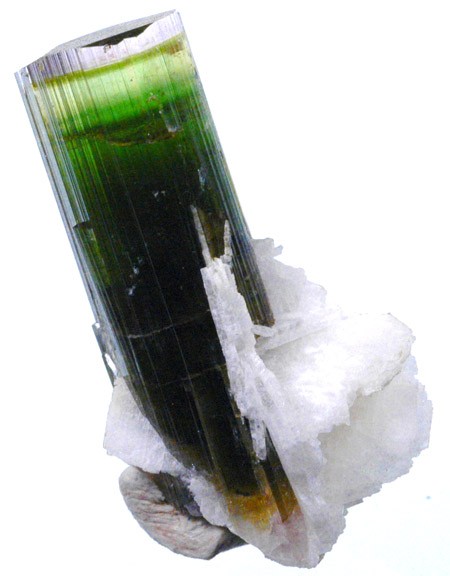
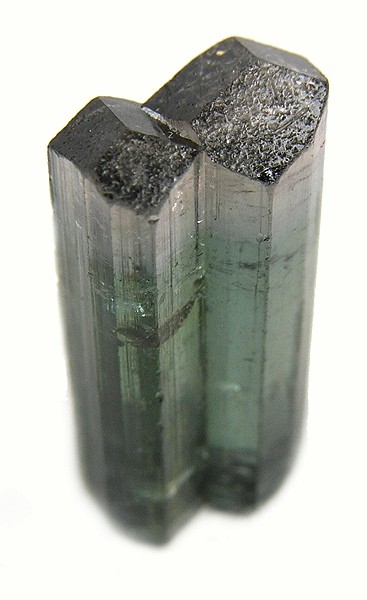
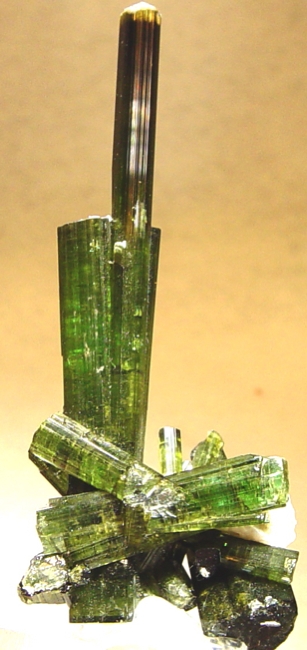
Liddicoatite is a mineral species of the tourmaline supergroup, distinguished from elbaite by the presence of calcium at the X site instead of sodium. It is famous for the spectacular concentric triangular zoning in Madagascar crystals — green on the outside, pink or colorless at the core.
Liddicoatite was recognized as an independent species only in 1977, described by Dunn, Appleman, and Nelen from Anjanabonoina, Madagascar. Before that, it was classified as calcic elbaite or simply sold as green or pink tourmaline without distinction — and much of the gem trade still doesn't distinguish them today.
Anjanabonoina crystals show concentric triangular zoning in cross-section — green on the outside, shading to pink or colorless at the center — recording millions of years of crystal growth in a single polished slice. These sections are highly sought-after collector pieces.
In practice, distinguishing liddicoatite from elbaite requires chemical analysis: optical and physical properties overlap almost completely.
Formula: Ca(Li₂Al)Al₆(BO₃)₃Si₆O₁₈(OH)₃F. Trigonal system, space group R3m. The X site is occupied by Ca (vs. Na in elbaite), with F at the W site instead of OH. Refractive index 1.621–1.659, birefringence 0.018–0.038. Pleochroism weak to moderate. Optical distinction from elbaite is practically impossible without quantitative chemical analysis.
Mining localities
- Anjanabonoina, Madagascar
- Antsirabe, Madagascar
- Minas Gerais, Brazil
Frequently Asked Questions
What is the difference between liddicoatite and elbaite?
The only difference is chemical: liddicoatite has calcium at the X site of the crystal lattice, while elbaite has sodium. Color, luster, and hardness are virtually identical — telling them apart requires laboratory chemical analysis.
Why are liddicoatite cross-sections from Madagascar so famous?
Anjanabonoina crystals show a unique triangular concentric zoning in cross-section: green on the outside, with rings shading to pink or colorless at the center. Each slice is a geological "painting" recording the changing chemistry of the hydrothermal fluid during crystal growth.
Entry reviewed by a mineralogist or gemologist. Key data has been verified against primary sources. Minor inaccuracies may remain in secondary data.