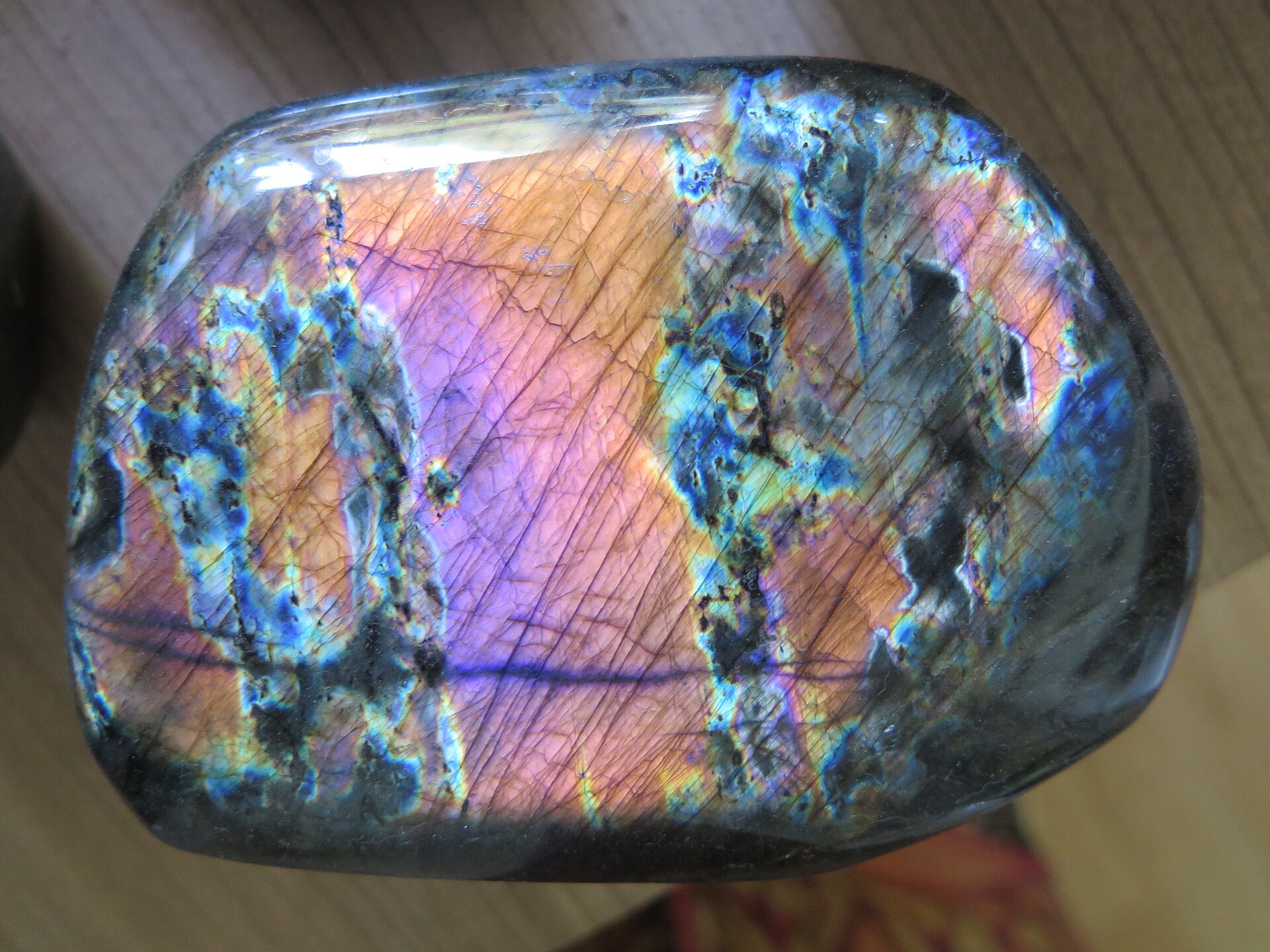
Labradorite
Labradorite
(Ca,Na)(Al,Si)₄O₈ Properties
- Color
- Gray, iridescent blue, green, gold
- Luster
- Vitreous, pearlescent
- Density
- 2.68–2.72 g/cm³
- Category
- Mineral
Labradorite is a plagioclase feldspar celebrated for its labradorescence — an iridescent play of colors that produces flashes of blue, green, gold, and orange with movement. This unique optical phenomenon makes it one of the most spectacular stones in mineralogy.
Labradorescence is caused by light diffraction across thin alternating lamellae of different composition within the crystal lattice — a phenomenon called the Bøggild effect. The lamellae have a thickness of 128–252 nm, which is ideal for interfering with visible light. The Finlandian variety with particularly vivid colors is commercially marketed as spectrolite.
It was discovered in 1770 on the island of St. Paul in Labrador, Canada, by Moravian missionaries who brought extraordinary specimens back to Europe that astonished European mineralogists.
It belongs to the plagioclase series, with an albite:anorthite ratio of 30:70 to 50:50. Triclinic system, space group P1̄. The refractive index is 1.559–1.573, birefringence 0.008–0.010. Labradorescence requires very slow cooling to permit lamellar separation — not all labradorite plagioclase specimens exhibit this property.
Mining localities
- Labrador, Canada (scoperta originale)
- Madagascar (principale produttore)
- Finlandia (spectrolite)
- Russia
- Messico
Frequently Asked Questions
What is labradorescence and why does labradorite shimmer with these colors?
Labradorescence is an optical phenomenon caused by light refraction on microscopic parallel internal layers of slightly different chemical composition, formed during the mineral's cooling. These layers act as a diffraction grating, deflecting light into specific wavelengths (blue, green, gold, orange) that create the characteristic iridescent play of colors when the stone is tilted.
Where is labradorite found and what is the world's best locality?
Labradorite is mined primarily in Canada (Labrador, from which it takes its name), Madagascar, Finland, and Russia, with minor deposits in several other countries. The best gem-quality material comes from Labrador in Canada and certain Madagascan localities, where specimens with particularly vivid and well-defined labradorescence are found.
How do you recognize real labradorite from a fake?
Genuine labradorite has a hardness of 6-6.5 on the Mohs scale, displays labradorescence only from specific angles (not visible from all directions), and has a specific gravity of 2.7 g/cm³. Imitations in glass or synthetic materials lack the authentic stratified crystal structure and show less sophisticated and uniform optical effects.
What is the chemical composition of labradorite and how does it form?
Labradorite is a plagioclase feldspar with chemical formula (Ca,Na)(Al,Si)₄O₈, rich in calcium; it forms in magma deep within the Earth during slow cooling of igneous rocks such as gabbros and basaltic rocks. Its characteristic layered structure develops during cooling when different components segregate into extremely thin parallel layers, creating the conditions for labradorescence.
Entry generated with Claude API (Anthropic) on data extracted from Mindat, RRUFF and Wikipedia. Not yet reviewed by a human expert. Verify data against original sources before citing in formal work.