Kyanite
Cianite
Al₂SiO₅ Properties
- Category
- Mineral
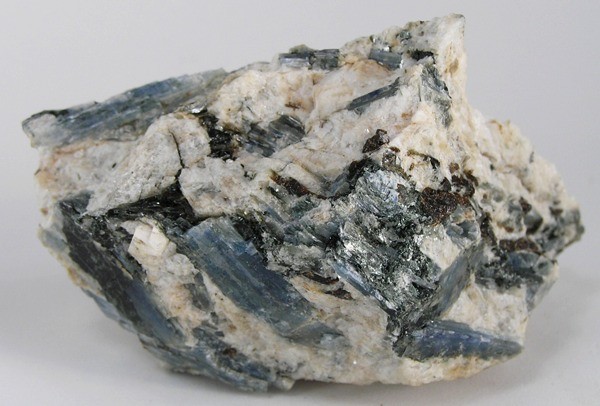
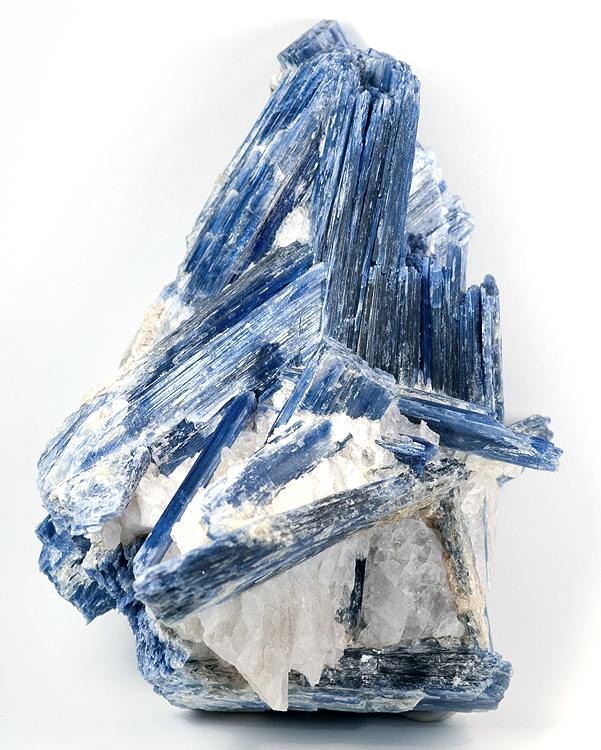
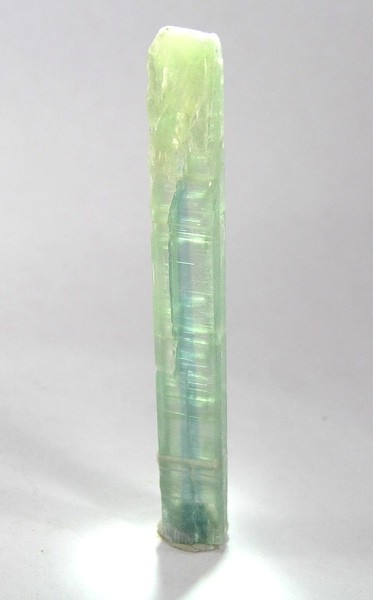
Kyanite is a triclinic aluminum silicate that forms under high pressure in metamorphic rocks, characterized by variable hardness (5–7 on the Mohs scale) depending on crystallographic direction and a color ranging from intense blue to gray, green, or yellow.
Kyanite (from the Greek kyanos, blue) is an aluminum silicate with the formula Al₂SiO₅ that belongs to the triclinic crystal system. It forms predominantly in high-grade metamorphic rocks, particularly in blueschists and eclogites, where elevated pressures and temperatures (typically 400–700 °C and 5–10 kbar) favor its crystallization. It is mineralogically polymorphous with andalusite and sillimanite: all three minerals share the same chemical composition but differ in crystal structure, reflecting different pressure-temperature conditions during formation. Kyanite is frequently associated with garnet, feldspar, quartz, and white mica. Its hardness varies markedly depending on direction: it is harder (7 Mohs) along the c-axis but softer (5 Mohs) perpendicular to it, a property that makes it easily recognizable under the microscope. Crystals are typically tabular or fibrous, often of intense blue-azure color (the most prized variety), but also colorless, gray, green, or yellow. In the gemological market, superior quality blue specimens from Nepal, Myanmar, and Brazil have gained increasing interest over the past two decades.
Crystal system: Triclinic (space group P1̄, Z = 4). Lattice parameters: a ≈ 7.12 Å, b ≈ 7.85 Å, c ≈ 5.57 Å; α ≈ 89.9°, β ≈ 101.0°, γ ≈ 106.0°. Hardness: 5–7 Mohs (anisotropic, maximum along [001]). Density: 3.56–3.67 g/cm³. Cleavage: perfect along ((100)), good along (10). Refractive index: nα ≈ 1.712, nβ ≈ 1.720, nγ ≈ 1.734; birefringence Δn ≈ 0.022. Pleochroism: marked, from intense blue to colorless. UV-Vis spectroscopy: characteristic absorption around 610 nm (d–d transitions of Fe³⁺ as the primary chromophore). Raman spectroscopy: diagnostic peaks at 206, 354, 438, 702, 822 cm⁻¹. Thermodynamic stability: stable at pressures >5 kbar; transition to sillimanite at lower pressures and elevated temperatures. Typical mineralogical associations: garnet (almandine-pyralspit), potassium feldspar, quartz, white mica, rutile, plagioclase feldspar. Genesis: high-grade regional metamorphism (blueschist and eclogite facies), rarely in granitic pegmatites. Gemology: intense blue variety is subjected to thermal treatment (heating at 800–900 °C in air) to enhance color; marked pleochroism permits rapid identification; non-fluorescent under UV.
Mining localities
- Nepal (Himalaya, valle del Kathmandu) — cristalli blu di eccellente qualità gemmologica
- Myanmar (Birmania) — varietà blu intenso, storicamente importante
- Brasile (Minas Gerais, Espírito Santo) — cristalli blu e verdi di buona qualità
- Francia (Alpi, Piemonte) — cristalli in scisti blu metamorfici
- Svizzera (Alpi Penniche, Vallese) — associazioni classiche in eclogiti
- Austria (Salisburghese) — cristalli in rocce metamorfiche
- Stati Uniti (North Carolina, Georgia) — varietà grigia e azzurra
- Russia (Urali, Siberia) — cristalli in complessi metamorfici
- Madagascar — varietà blu e verde di interesse gemmologico
Frequently Asked Questions
What is kyanite and how does it form?
Kyanite is an aluminum silicate (Al₂SiO₅) that forms exclusively under high-pressure conditions within metamorphic rocks, typically at depths exceeding 10 km. Its formation requires moderate temperatures (400-700°C) and elevated pressures, which is why it is considered an indicator mineral of high-pressure, low-temperature metamorphism.
Why does kyanite have variable hardness?
Kyanite exhibits anisotropic hardness that varies from 5 to 7 on the Mohs scale depending on the crystallographic direction along which it is measured. This anomalous behavior depends on the triclinic crystal structure of the mineral, where atomic bonds are weaker along certain crystallographic axes than others.
How to identify kyanite and where is it found?
Kyanite is recognized by its characteristic intense blue color (though it can also be gray, green, or yellow), the elongated crystal form, and its association with other metamorphic minerals such as garnet and sillimanite. The major deposits are found in metamorphic rocks of schists and gneisses, particularly in continental collision zones such as the Alps, Himalayas, and Brazil.
What is kyanite used for and what is its value?
Kyanite has industrial applications mainly in the ceramic and refractory sectors for producing high-temperature materials, thanks to its thermal stability. Samples of gemological quality (intense blue and transparent) have moderate commercial value in the collector's market, generally lower than traditional precious stones, with prices ranging from 10 to 50 euros per carat depending on quality.
Entry generated with Claude API (Anthropic) on data extracted from Mindat, RRUFF and Wikipedia. Not yet reviewed by a human expert. Verify data against original sources before citing in formal work.