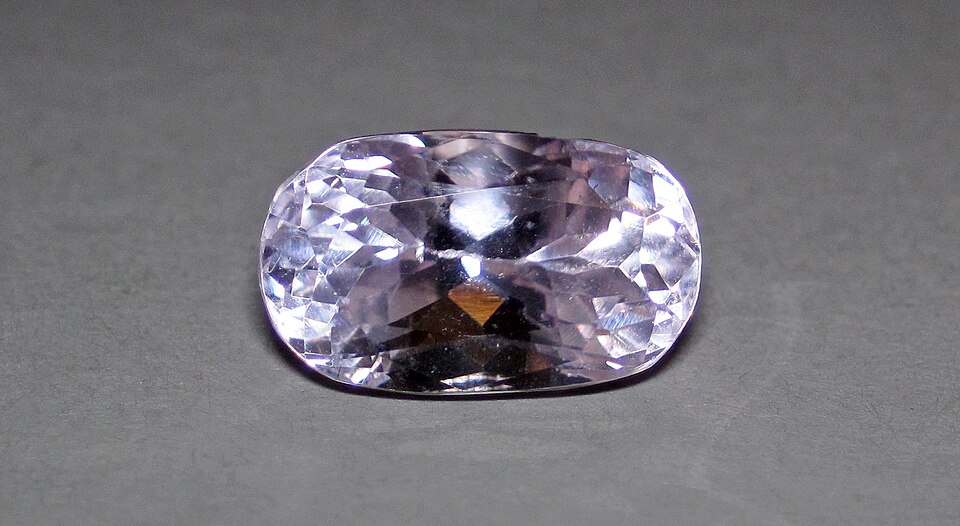
Kunzite
Kunzite
LiAlSi₂O₆ Properties
- Category
- Gem
Kunzite is a lithium and aluminum silicate that forms transparent crystals ranging from colorless to intense pink-violet, prized as a gemstone for jewelry despite its moderate hardness of 6.5-7 on the Mohs scale.
Kunzite is a gem variety of spodumene (LiAlSi₂O₆), a monoclinic pyroxene that owes its pink-violet color to the presence of manganese as a trace element. The name honors German gemologist George Frederick Kunz, who first described it scientifically in 1902. Crystals form in lithium-rich granitic pegmatites, often in association with beryl, quartz, and feldspar. Kunzite exhibits marked pleochroism: when viewed from different angles, it reveals hues ranging from nearly colorless to intense pink—a characteristic that gem cutters exploit to maximize final color. A fascinating peculiarity is its photosensitivity: prolonged exposure to sunlight can fade the color over time, necessitating protected storage. In the gemological market, the finest specimens originate from Afghanistan (Kunar Valley), California (USA), and Brazil, with prices varying significantly based on color intensity and size.
Crystal system: monoclinic, space group P2₁/c. Unit cell parameters: a ≈ 7.64 Å, b ≈ 8.73 Å, c ≈ 5.25 Å, β ≈ 110.1°. Hardness: 6.5–7 Mohs; perfect cleavage along ((110)) (characteristic of pyroxenes). Density: 3.13–3.20 g/cm³. Refractive index: nα ≈ 1.655, nβ ≈ 1.662, nγ ≈ 1.676; birefringence Δn ≈ 0.021 (biaxial positive). Pleochroism: X (nearly colorless), Y (pink-violet), Z (intense violet). UV Fluorescence: blue-violet under long-wave UV (365 nm). Chemical composition: LiAlSi₂O₆ with traces of Mn²⁺ (responsible for color), Fe²⁺, Fe³⁺. Kunzite is polymorphous with jadeite and diopside. Formation: late-stage granitic pegmatites in fractional crystallization environments of magmas enriched in incompatible elements (Li, Be, Nb, Ta). Typical mineral associations: quartz, alkali feldspar, beryl, tourmaline, apatite, topaz. Thermal stability: stable to approximately 1200 °C; above this temperature it undergoes structural transformation. Color photodegradation is attributed to oxidation of Mn²⁺ to Mn³⁺ under UV irradiation, a reversible process via moderate heating.
Mining localities
- Kunar Valley, Afghanistan (esemplari di qualità superiore, colore rosa intenso)
- Pala, California, USA (pegmatiti storiche, kunzite di riferimento)
- Minas Gerais, Brasile (produzioni significative, varietà rosa-violetto)
- Nuristan, Afghanistan (giacimenti recenti ad alta qualità)
- San Diego County, California, USA (pegmatiti di Ramona e Mesa Grande)
- Taquaral, Paraíba, Brasile (kunzite rosa pallido associate a tourmaline)
- Madagascar (produzioni minori, qualità variabile)
Frequently Asked Questions
Why does kunzite change color when exposed to sunlight?
Kunzite undergoes photochemical alterations when exposed to prolonged ultraviolet radiation, causing its characteristic pink-violet color to fade toward paler or colorless tones. This phenomenon is caused by the breaking of atomic bonds in the crystal structure of the lithium aluminum silicate (LiAlSi₂O₆). To preserve the color, it is advisable to store kunzite jewelry away from direct and prolonged light sources.
Is kunzite suitable for engagement rings?
Kunzite has a moderate hardness of 6.5-7 on the Mohs scale, lower than diamond (10) and sapphire (9), making it less resistant to daily scratches and impacts. While a fascinating gemstone for jewelry, harder stones like diamonds, sapphires, or spinels are preferable for engagement rings, or kunzite should be set in a protective mounting to shield it from potential damage. If used for rings, it requires greater care and regular maintenance.
Where is kunzite found and what are the main mining locations?
Kunzite forms primarily in lithium-rich granitic pegmatites and is mainly extracted in Afghanistan (Hunza Valley), Brazil, Madagascar, Pakistan, and California in the United States. The finest gem-quality specimens come from Afghanistan, known for intense violet-colored crystals and high transparency. Pegmatites are igneous rocks formed from slowly cooling magma, which allows the growth of large and well-defined crystals.
How do you recognize authentic kunzite from imitations or glass?
Authentic kunzite has a hardness of 6.5-7 on the Mohs scale, so it resists scratching with a knife but not with a diamond file, while glass is softer (5.5) and synthetic pink quartz has different hardness. A diagnostic characteristic is pleochroism: observing the crystal from different angles shows color variations (from pale pink to intense violet), a property absent in glass. Examination under a gemological microscope also reveals natural inclusions typical of kunzite, mainly rutile needles.
Entry generated with Claude API (Anthropic) on data extracted from Mindat, RRUFF and Wikipedia. Not yet reviewed by a human expert. Verify data against original sources before citing in formal work.