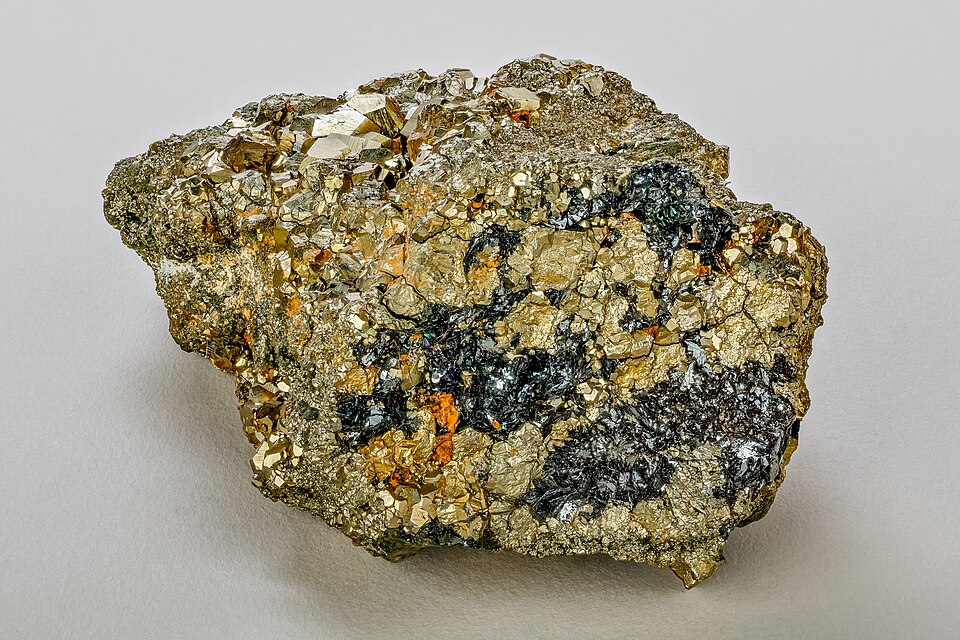
Hematite
Ematite
Fe₂O₃ Properties
- Category
- Mineral
Hematite is an iron oxide (Fe₂O₃) that forms trigonal crystals ranging from metallic gray to black, and is the most important iron mineral from both economic and geological perspectives. It is so hard and dense that the ancients polished it into mirrors and seals, while today it remains the world's primary source of iron for the steel industry.
Hematite is a ferric oxide that crystallizes in the trigonal system, often in well-developed tabular habits or rhombohedra. Its name derives from the Greek haimatites (blood-like), because when finely powdered it produces a characteristic red powder, used in pigments since antiquity. Geologically it forms in highly diverse environments: in chemical sedimentary iron deposits (banded iron formations), in high-temperature metamorphic rocks, in granitic pegmatites, and as a secondary alteration mineral in oxidation zones. Its exceptional density (5.26 g/cm³) and hardness of 5.5–6.5 on the Mohs scale make it easily recognizable. It frequently associates with magnetite, limonite, and quartz. From an economic standpoint, hematite represents approximately 70% of global crude iron production, with major deposits in Australia, Brazil, China, and India.
Chemical formula: Fe₂O₃; Crystal system: trigonal, space group R3̄c; Lattice parameters: a = 5.03 Å, c = 13.75 Å; Density: 5.24–5.29 g/cm³; Mohs hardness: 5.5–6.5; Cleavage: absent (conchoidal fracture); Color: steel gray to black (opaque), red in powder (streak); Luster: metallic to submetallic; Refractive index: n_ω = 3.22, n_ε = 2.94 (negative birefringent); Magnetism: paramagnetic (antiferromagnetic below 260 K, Morin transition); Spectroscopy: visible absorption with characteristic bands in UV-Vis; Curie temperature: ~680 K for magnetite, but hematite is antiferromagnetic. Polymorphs: maghemite (γ-Fe₂O₃) is the metastable cubic form. Common mineral associations: magnetite, limonite, goethite, quartz, feldspar. Genesis: chemical sedimentary (banded iron formations), metamorphic, hydrothermal, supergene alteration.
Mining localities
- Minas Gerais, Brasile (giacimenti di Carajás e Quadrilátero Ferrífero)
- Pilbara, Australia Occidentale (banded iron formations arcaiche)
- Kiruna, Svezia (giacimenti di ferro apatite-magnetite-ematite)
- Isola d'Elba, Italia (ematite speculare storica)
- Lago Superiore, Nord America (giacimenti paleoproterozoici)
- Cina (provincia dello Shandong e dell'Anhui)
- India (Odisha e Chhattisgarh)
Frequently Asked Questions
How do you identify hematite from other minerals?
Hematite is identified by its metallic gray to black color, hardness of 5.5-6.5, and very high specific gravity (5.3 g/cm³). A practical test is the streak test: hematite leaves a characteristic red powder mark on white ceramic, due to its Fe₂O₃ composition. Its metallic luster and crystalline fragility easily distinguish it from other iron oxides like magnetite.
Where are the main hematite deposits found in the world?
The largest hematite deposits are concentrated in Brazil, Australia, China, India, and Venezuela, with Brazil producing about 35% of global supply. In Italy, minor deposits are found in Liguria and the Alps, historically important for local use. Hematite forms in sedimentary and hydrothermal environments, often associated with metamorphic and igneous rocks.
What is the difference between hematite and magnetite?
Magnetite (Fe₃O₄) and hematite (Fe₂O₃) differ in chemical composition and magnetic properties: magnetite is strongly magnetic and attracts a magnet, while hematite is weakly magnetic or paramagnetic. Hematite shows a more reddish streak, slightly lower hardness (5.5-6.5 vs 6-6.5), and was historically used as a polish and seal due to its density and resistance.
What are the main uses of hematite today?
Hematite is the world's primary source of iron (about 70% of extracted iron ore), used in steel and metallic alloy production in the steel industry. Beyond industrial use, it is applied as a natural red pigment in paints and cosmetics, as an abrasive for grinding, and in small quantities in jewelry (especially in polished form). Its Fe₂O₃ formula makes it extremely versatile from a commercial standpoint.
Entry generated with Claude API (Anthropic) on data extracted from Mindat, RRUFF and Wikipedia. Not yet reviewed by a human expert. Verify data against original sources before citing in formal work.