Green Tourmaline
Tormalina Verde
Ca(Li,Al)₃Al₆(BO₃)₃Si₆O₁₈(OH)₄ Properties
- Category
- Gem
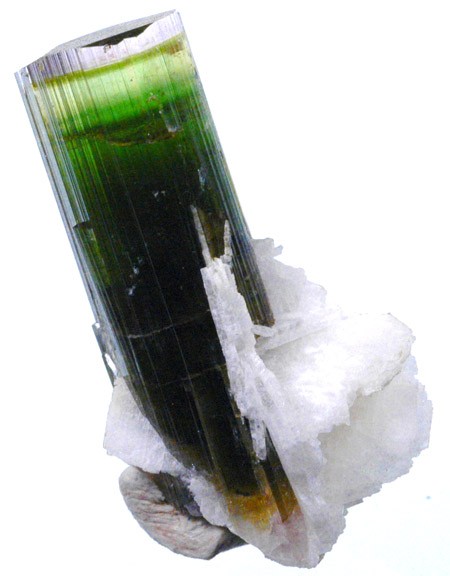
Green tourmaline is a borate silicate with trigonal symmetry that owes its color to the presence of iron and, occasionally, chromium; it is a gem of notable hardness (7–7.5 on the Mohs scale) prized for its transparency and utilized in both jewelry and mineralogical collections.
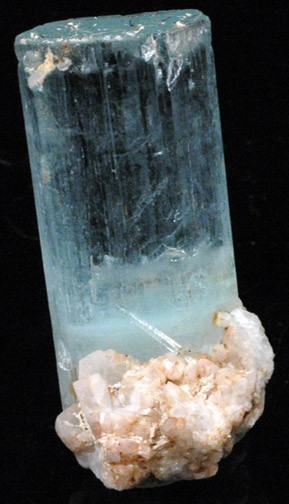
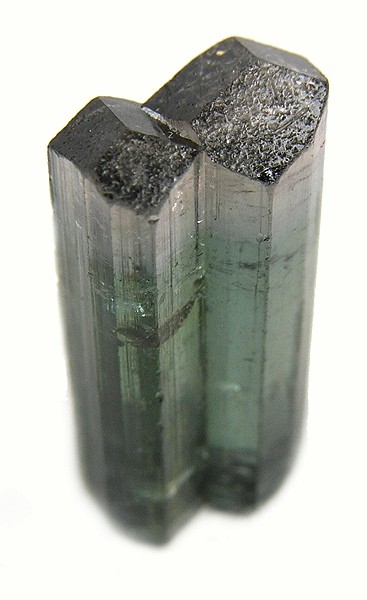
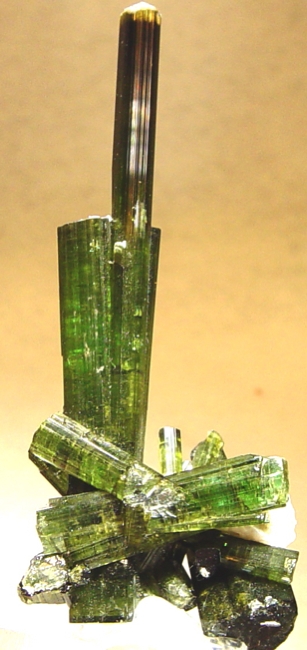
Green tourmaline belongs to the complex tourmaline group, a family of boron silicates characterized by a complex trigonal crystal structure. The green color can vary from very pale, nearly colorless hues to intense, saturated green, depending primarily on the concentration of divalent and trivalent iron; traces of chromium and vanadium may contribute to more vivid tonalities. It crystallizes in elongated prisms with characteristic striations parallel to the c-axis, often terminated by trigonal facets.
From a gemmological perspective, green tourmaline is sought after for its transparency, pronounced pleochroism (displaying different colors depending on viewing angle), and relative abundance compared to other colored varieties. The most prized specimens originate from Brazil, Afghanistan, Nigeria, and Mozambique, where it occurs in granitic pegmatites and boron-rich metamorphic rocks. In the contemporary gemological market, superior-quality specimens (transparent, saturated green color, free from visible inclusions) command significant prices, though typically lower than emerald or red tourmaline (rubellite).
Green tourmaline crystallizes in the trigonal system, space group R3m, with lattice parameters typically a ≈ 15.9 Å and c ≈ 7.1 Å. The complex structural formula reflects isomorphic substitution of cations across three distinct crystallographic positions: X sites (9-fold coordination), Y sites (6-fold coordination), and Z sites (6-fold coordination). In green tourmaline, the X position is occupied by Ca²⁺, the Y position by Li⁺ and Al³⁺ in variable proportions, and the Z position predominantly by Al³⁺. The green coloration is attributed to crystal-field transitions of Fe²⁺ and Fe³⁺, with absorption in the 400–600 nm range.
Refractive indices: nω ≈ 1.624–1.629; nε ≈ 1.644–1.650 (negative birefringence, ~0.020–0.025). Specific gravity: 3.0–3.25 g/cm³. Mohs hardness 7–7.5; cleavage absent (conchoidal fracture). The visible absorption spectrum shows characteristic bands around 500 nm (Fe²⁺) and 620 nm. Pleochroism is marked: ordinary ray (e) saturated green, extraordinary ray (o) paler yellow-green. Under ultraviolet light (365 nm) it may exhibit weak yellow-green fluorescence. Infrared spectroscopic analysis reveals the O–H band around 3600 cm⁻¹. Reflected-light microscopy reveals typical inclusions: rutile needles, hematite, feldspar inclusions, rarely two-phase inclusions.
Mining localities
- Minas Gerais, Brasile
- Kunar, Afghanistan
- Ilesha, Nigeria
- Mozambico
- Paraíba, Brasile
- Val d'Aosta, Italia (pegmatiti minori)
- Ural, Russia
- Elba, Toscana, Italia
Frequently Asked Questions
What is the difference between green tourmaline and emerald?
Green tourmaline and emerald are different gemstones: tourmaline is a boron silicate (hardness 7-7.5) with formula Ca(Li,Al)₃Al₆(BO₃)₃Si₆O₁₈(OH)₄, while emerald is a beryl (hardness 7.5-8) and generally more brittle. Green tourmaline's color comes from iron and sometimes chromium, often resulting in greater transparency and vibrancy than emerald of similar quality.
How do you identify authentic green tourmaline from an imitation?
Authentic green tourmaline has a hardness of 7-7.5 on the Mohs scale, meaning it cannot be scratched by quartz (hardness 7) but can scratch feldspar. Under magnification, genuine tourmaline often shows pleochroism (color changes with viewing angle) and crystals with characteristic vertical striations from its trigonal structure.
Where is green tourmaline found and what is its price?
Jewelry-quality green tourmaline is extracted primarily from Brazil, Afghanistan, Nigeria, and Mozambique. Price varies significantly based on transparency, color, and size, ranging from 20-50 euros per carat for common specimens to 200-500 euros per carat for high-quality stones with saturated color and few inclusions.
Why is green tourmaline green and how is it formed?
Green tourmaline owes its color to the presence of iron (Fe²⁺ and Fe³⁺) in its crystal structure, and sometimes trace amounts of chromium. It forms in hydrothermal environments at moderate to high temperatures, typically in granitic pegmatites and metamorphic rocks, where boron-, lithium-, and aluminum-rich fluids enable crystallization of the boron silicate into trigonal structures.
Entry generated with Claude API (Anthropic) on data extracted from Mindat, RRUFF and Wikipedia. Not yet reviewed by a human expert. Verify data against original sources before citing in formal work.