Galena
Galena
PbS Properties
- Category
- Mineral
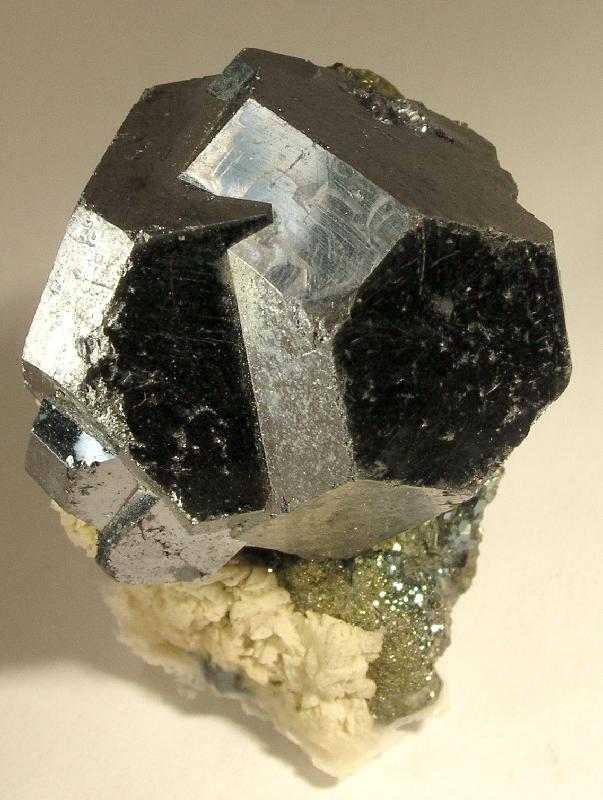
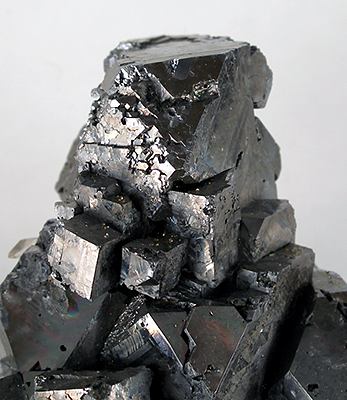
Galena is a lead sulfide (PbS) with a metallic gray color, and the most important mineral for lead extraction. It is easily recognized by its metallic luster, perfect cubic cleavage, and notably high weight.
Galena is a cubic sulfide that has represented the primary source of lead for humanity for millennia. It forms in hydrothermal environments at medium-low temperatures, often in association with sphalerite (ZnS), calcite, and fluorite within veins and stratified deposits. Its cubic crystal structure generates *perfect cleavage* along three orthogonal planes, a property that renders it brittle but diagnostically distinctive. With a hardness of 2.5 on the Mohs scale, it is relatively soft; however, its density of 7.4–7.6 g/cm³ distinguishes it immediately by touch. Historically, galena was exploited as early as the Assyrians (2500 BC) and Romans, who extracted it from mines in Wales and Sardinia. Today it remains essential for lead production, lead-acid batteries, and radiological shielding. Well-formed crystals, though rare, are highly sought after by mineral collectors.
Galena crystallizes in the cubic system, space group Fm3̄m (no. 225), with a *rock salt* (NaCl) structure type. Lattice parameter: a = 5.936 Å. Calculated density: 7.60 g/cm³. Mohs hardness: 2.5 (brittle, cleavable). Luster: metallic. Color: lead gray, opaque. Streak: gray-black. Cleavage: perfect along ((100)). Fracture: conchoidal when not cleaved. Electrical conductivity: good (semiconductor). Refractive index: not applicable (opaque). Raman spectroscopy: characteristic bands at ~138 cm⁻¹ and ~204 cm⁻¹ (Pb-S vibrations). Chemical analysis: Pb 86.6%, S 13.4% (theoretical). Often contains traces of Ag, Cu, Zn, Cd, Bi. Silver content can reach 0.1–1% by weight in some specimens, rendering them economically significant. UV fluorescence: generally non-fluorescent. Typical paragenesis: sphalerite, calcite, fluorite, barite, cerussite (surface alteration).
Mining localities
- Sardegna, Italia (Iglesias, Montevecchio) — depositi stratificati storicamente importanti
- Galles, Regno Unito (Flintshire) — miniere storiche del Pb
- Missouri, USA (Tri-State District) — grandi cristalli cubici
- Perù (Cerro de Pasco) — associazione con sfalerite
- Cina (Yunnan, Guangxi) — produzioni contemporanee
- Australia (Broken Hill, NSW) — cristalli di qualità gemmologica
- Spagna (Linares, Jaén) — miniere storiche
Frequently Asked Questions
How can you identify galena among other minerals?
Galena is easily recognized by its bright metallic gray color, intense metallic luster, and very high weight due to its high lead content. Its most characteristic property is perfect cubic cleavage, meaning it naturally breaks into small regular cubes when fractured. These three combined factors make visual identification immediate even for beginners.
Where is galena found in the world and what are the main deposits?
Galena forms primarily in hydrothermal environments and replacement deposits, and is globally distributed with important deposits in Peru, Mexico, Australia, Kazakhstan, and the United States. Historically, large quantities came from Spain and Great Britain, while today the world's largest producers remain in South America and Central Asia. Its relative abundance and ease of lead extraction make it still the most economically important lead mineral.
What is the chemical composition of galena and how does it form?
Galena is a lead sulfide with chemical formula PbS, containing 86.6% lead and 13.4% sulfur by weight. It forms primarily in hydrothermal veins when mineralized solutions rich in lead and sulfur cool at varying depths in the Earth's crust, or in diagenetic environments where sedimentary rocks undergo chemical transformations. Its cubic crystal structure reflects the ordered arrangement of lead and sulfur atoms in the crystal lattice.
What is the price of galena and where can you buy it as a collection sample?
The price of galena as a collection sample varies significantly based on quality, size, and origin, generally ranging between 10 and 100 euros for small to medium well-formed specimens. Exceptional samples with perfect cubic crystals or from renowned historic deposits can reach much higher prices. It is purchased mainly from specialized mineral dealers, gemology fairs, online mineral shops, and occasionally from mineralogy auction houses.
Entry generated with Claude API (Anthropic) on data extracted from Mindat, RRUFF and Wikipedia. Not yet reviewed by a human expert. Verify data against original sources before citing in formal work.