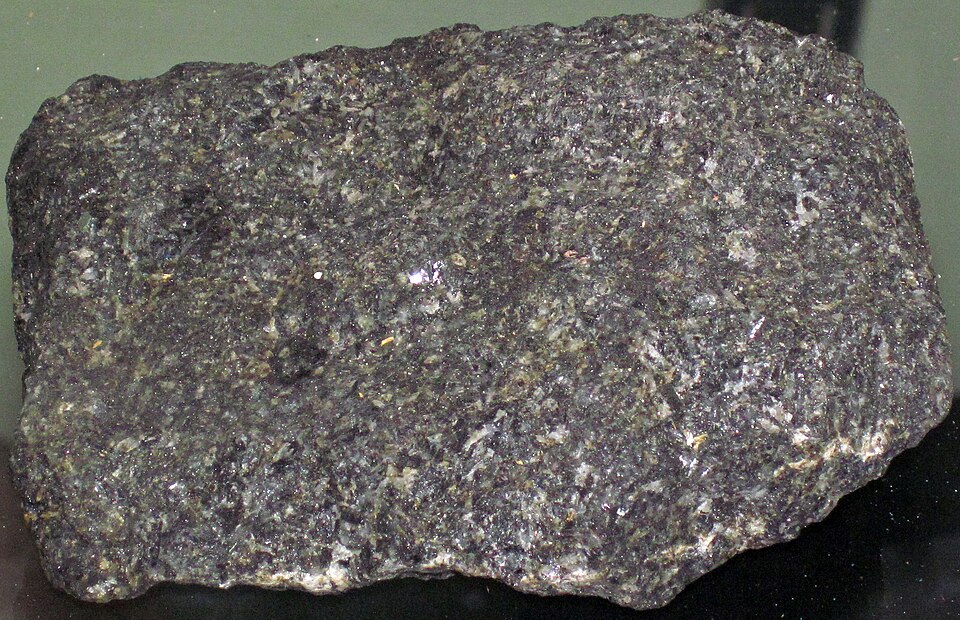
Gabbro
Gabbro
CaAl₂Si₂O₈ + MgSiO₃ Properties
- Category
- Rock
Gabbro is a coarse-grained intrusive igneous rock composed primarily of calcic plagioclase feldspar and pyroxenes, forming from the slow cooling of magma at depth. It is the plutonic equivalent of basalt and represents the most abundant rock of the oceanic crust.
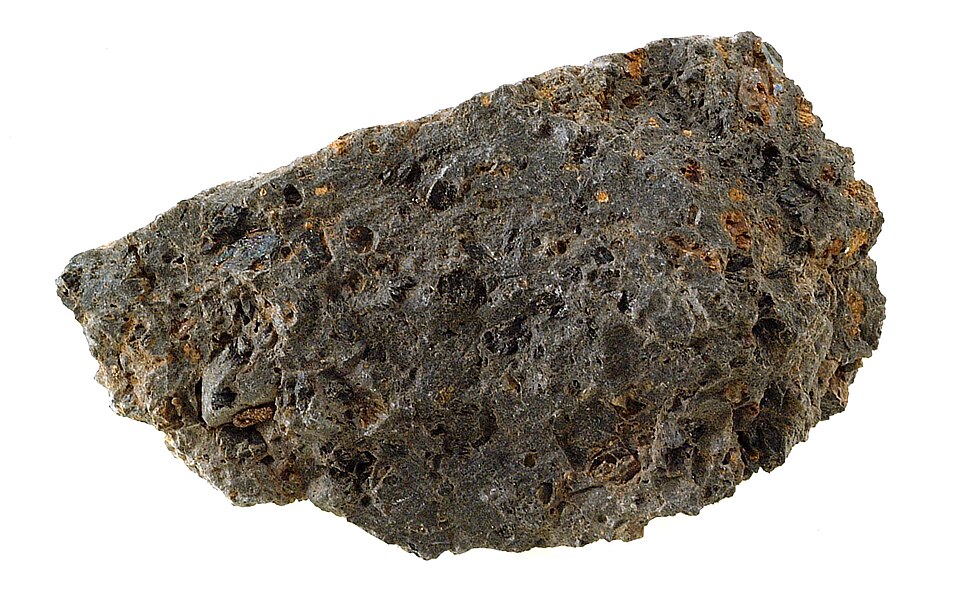
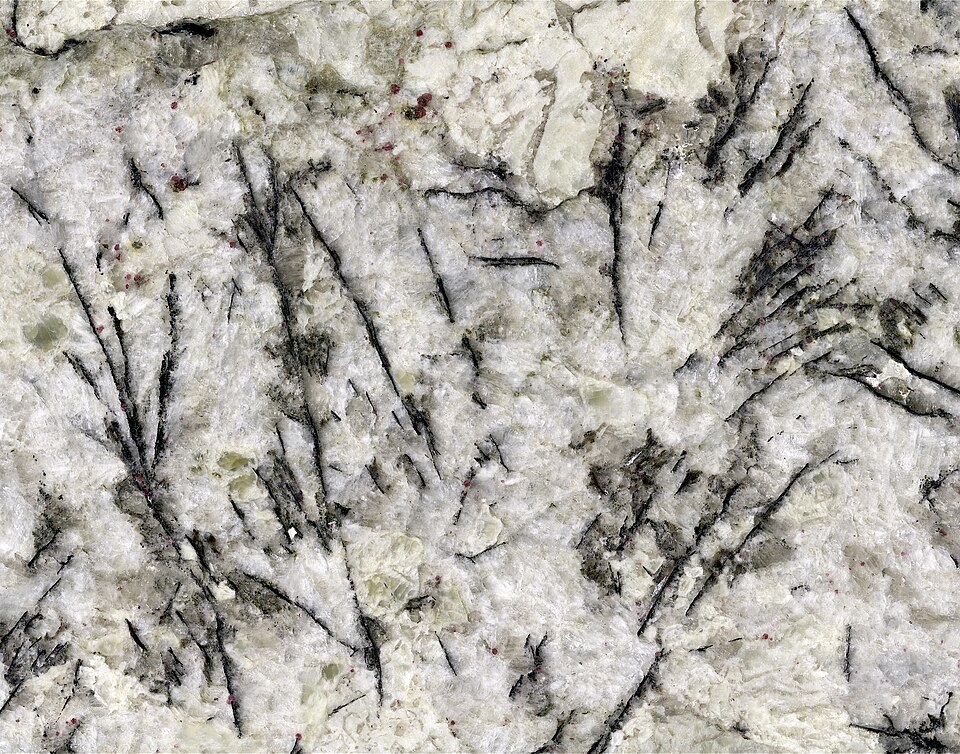
Gabbro is a magmatic rock that forms when basaltic magma cools slowly within the Earth's crust, allowing minerals to crystallize into crystals visible to the naked eye. Its typical mineralogical composition includes plagioclase feldspar (calcium-rich), pyroxenes such as augite, and often olivine; this association gives it a dark color, ranging from gray-black to greenish-black. Unlike basalt, which has fine grain because it cools rapidly at the surface, gabbro develops a characteristic phaneritic texture, with well-defined crystals.
Geologically, gabbro is the dominant rock in ophiolites and the lower section of oceanic crust, where it forms along mid-ocean ridges. It is frequently associated with ultramafic rocks such as peridotite and may contain significant deposits of economically important minerals, including chromite, magnetite, and nickel and copper sulfides. From an applied perspective, gabbro is quarried as an ornamental and construction stone (commercially known as "absolute black" or "Gabbro black"), and is used as road aggregate and refractory material.
Gabbro is classified as a mesocratic intrusive igneous rock with basaltic composition. Its primary mineral assemblage comprises plagioclase (anorthite series, typically An₅₀₋₉₀), pyroxenes (magnesium-rich augite, composition Ca(Mg,Fe)Si₂O₆), and frequently olivine (Mg₂SiO₄ to Fa₃₀). Average density ranges between 2.8 and 3.0 g/cm³. Hardness varies from 6 to 7 on the Mohs scale depending on the relative percentage of feldspar and pyroxene.
Crystallographically, the constituents belong to different crystal systems: plagioclase is triclinic, augite is monoclinic. The characteristic phaneritic texture results from slow magmatic cooling (rate < 1 °C per year), permitting extended crystal nucleation and growth. Compositional variations produce subtypes: troctolite (plagioclase + olivine without significant pyroxene), norite (plagioclase + orthopyroxene), and anorthosite (plagioclase > 90%). Modal petrographic analysis and Raman spectroscopy confirm mineralogical phases; X-ray fluorescence spectroscopy (XRF) provides bulk chemical composition. Gabbro is frequently affected by metamorphic alteration in the greenschist facies due to interaction with hydrothermal fluids and low-grade metamorphism, producing secondary assemblages of chlorite, epidote, and actinolite.
Mining localities
- Gabbro, Toscana, Italia
- Skaergaard, Groenlandia
- Stillwater Complex, Montana, USA
- Bushveld Complex, Sudafrica
- Layered intrusions, Norvegia
- Ophioliti di Liguoria, Italia
- Troodos, Cipro
- Sudbury Basin, Ontario, Canada
Frequently Asked Questions
How do you identify gabbro from other igneous rocks?
Gabbro is recognized by its coarse grain size visible to the naked eye, with white-gray plagioclase feldspars and dark pyroxene crystals (augite) clearly distinguishable. Unlike basalt, its volcanic equivalent with fine grain, gabbro cooled slowly at depth allowing larger crystal formation. Its high density (about 3.0 g/cm³) and hardness also distinguish it from sedimentary or metamorphic rocks.
Where is gabbro found and what are the main global reserves?
Gabbro is the most abundant rock in the oceanic crust, forming most of the seafloor through slow crystallization of basaltic magma at depth. Significant reserves are found in Norway, Russia, South Africa, China, and the United States, where it is commercially extracted for use as gravel, aggregates, and building material. In Italy it is mainly present in the Alps and Apennines.
What is the difference between gabbro and basalt?
Gabbro and basalt have the same chemical composition (calcium plagioclase feldspar and pyroxenes) but differ in cooling rate: gabbro forms from magma cooling slowly at depth creating large crystals (plutonic rock), while basalt forms from magma cooling rapidly at the surface creating microscopic crystals (volcanic rock). Basalt is therefore fine-grained and gabbro is coarse-grained.
What are the commercial uses of gabbro?
Gabbro is extracted and used primarily as concrete aggregate, road gravel, railway ballast, and as a building stone thanks to its hardness and wear resistance. It is also used as facing material for facades and floors, as well as ballast in civil engineering projects. Its price ranges from 30 to 100 euros per ton depending on quality and location.
Entry generated with Claude API (Anthropic) on data extracted from Mindat, RRUFF and Wikipedia. Not yet reviewed by a human expert. Verify data against original sources before citing in formal work.