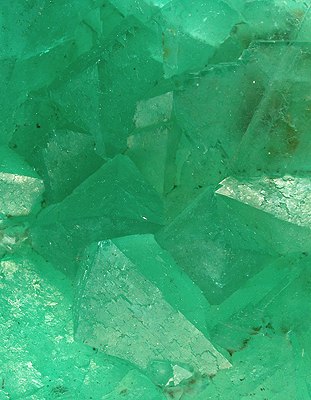
Fluorite
Fluorite
CaF₂ Properties
- Category
- Mineral
Fluorite is a calcium fluoride mineral (CaF₂) that crystallizes in perfect cubic forms, renowned for its vivid colors ranging from violet to green, blue to yellow. It is the mineral from which the phenomenon of *fluorescence* takes its name, and it is so friable that it was historically used as a flux in metallurgy.
Fluorite (or *fluorspar* in mining vernacular) is a common accessory mineral in magmatic and hydrothermal rocks, where it forms at moderate to high temperatures in association with quartz, calcite, and tungsten minerals. Its cubic structure (space group Fm3̄m) permits perfect cleavage along {111} planes, generating naturally formed octahedra of extraordinary beauty. The colors—from intense violet to blue, green to yellow—derive from lattice defects and traces of elements such as cerium and yttrium; fluorescence under ultraviolet rays (often blue or violet) is caused by these same color centers. Historically, fluorite has been mined as a flux for steel smelting and in the production of hydrofluoric acid; today it remains a highly prized collector's mineral, with the finest specimens coming from China (Yunnan Province), Spain (Asturias), and the United Kingdom (Derbyshire).
Crystallographic and physical data: Cubic system, space group Fm3̄m, lattice parameter a = 5.463 Å. Density 3.18 g/cm³. Hardness 4 Mohs; perfect cleavage along {111} generating octahedra. Refractive index n ≈ 1.434 (isotropic). Birefringence absent (isotropic mineral). Optical properties: Transparent to translucent; fluorescence under UV-A and UV-C (blue, violet, occasionally red). Characteristic spectroscopic absorption in the visible range due to F centers and color defects. Composition: Pure CaF₂; common traces of Ce³⁺, Yb³⁺, Sm³⁺ (responsible for coloration). Genesis: Precipitation from hydrothermal fluids at T = 200–400 °C; typical associations: quartz, calcite, barite, galena, sphalerite, yttrium fluoride (yttrofluorite). Industrial uses: Metallurgical flux (60–70% of world production), hydrofluoric acid synthesis (HF), optics (low-dispersion lenses for IR spectroscopy). Gemological market: Gem-quality specimens (transparent, >2 ct) from Yunnan (China) and Derbyshire (UK) reach 5–20 USD/carat; the *Blue John* varieties (blue-violet stratified) are particularly sought after by collectors.
Mining localities
- Yunnan, Cina — esemplari trasparenti di qualità gemmologica, colori blu-viola intensi
- Derbyshire, Regno Unito — giacimenti storici di 'Blue John', varietà stratificata blu-viola
- Asturie, Spagna — fluorite industriale di alta purezza e cristalli collezionistici
- Svizzera (Uri, Gottardo) — cristalli ottaedrici perfetti in associazione con quarzo
- Illinois, USA — fluorite di qualità industriale in associazioni con galena e sfalerita
- Namibia (Erongo) — cristalli blu di eccezionale trasparenza
Frequently Asked Questions
Why is fluorite called that and what does it have to do with fluorescence?
Fluorite is the mineral from which the phenomenon of fluorescence takes its name, discovered precisely by studying this crystal. When exposed to ultraviolet light, fluorite emits visible light in various colors (blue, violet, red) thanks to rare earth ions present in its impurities, an effect that has fascinated mineralogists for centuries.
How can you identify real fluorite and what are its most common colors?
Authentic fluorite crystallizes in perfect cubic forms (CaF₂) and displays vivid colors ranging from deep violet to emerald green, from blue to yellow and pink. You can identify it by its characteristic cubic structure, its brittleness (friability), and the fact that it fluoresces under UV light, while fakes do not show this property.
Where is fluorite found in the world and how much does a specimen cost?
The main fluorite deposits are found in China, Mexico, South Africa, and Mongolia, with China being the world's largest producer. Prices vary considerably: small and common specimens cost 5-20 euros, while higher quality examples with intense fluorescence can exceed 100-300 euros depending on size and purity.
What is the hardness of fluorite and why is it so brittle?
Fluorite has a hardness of 4 on the Mohs scale, making it quite soft and brittle compared to other minerals. This friability is due to its simple cubic crystal structure, which features perfect cleavage planes along the four diagonal directions of the cube, causing it to break easily when subjected to pressure.
Entry generated with Claude API (Anthropic) on data extracted from Mindat, RRUFF and Wikipedia. Not yet reviewed by a human expert. Verify data against original sources before citing in formal work.