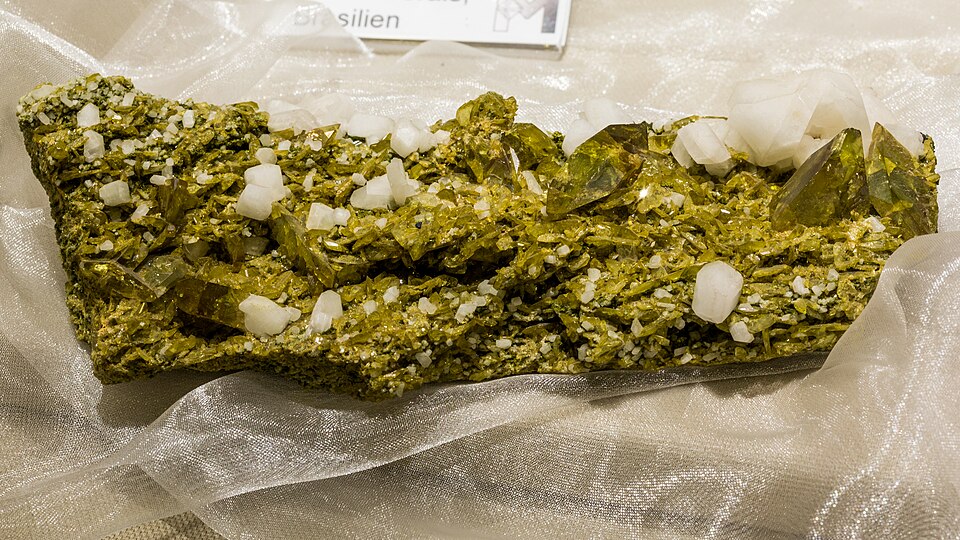
Epidote
Epidoto
Ca₂Al₂(Al,Fe)(SiO₄)(Si₂O₇)O(OH) Properties
- Category
- Mineral
Epidote is a calcium and aluminum silicate that forms greenish or yellowish crystals, very common in metamorphic and hydrothermal rocks. Its hardness (6-7 on the Mohs scale) makes it resistant to abrasion, while the characteristic color depends on the iron content in the crystal structure.
Epidote is a sorosilicate (containing both isolated SiO₄ tetrahedra and Si₂O₇ groups) that crystallizes in the monoclinic system. Its name derives from the Greek *epidosis* (growth), as it often occurs in well-developed crystals. It forms primarily in low to medium pressure metamorphic environments, where feldspar-rich rocks undergo hydrothermal alteration, and represents an index mineral of the greenschist facies. Color varies from yellowish-green to intense green depending on the isomorphic substitution Fe³⁺↔Al at the M3 position in the crystal structure. Typical mineral associations include quartz, feldspar, chlorite, and albite. Despite its relative abundance, epidote has little commercial gemological interest, although extremely rare transparent gem-quality crystals have been cut for collectors.
Crystal system: monoclinic, space group P21/m. Lattice parameters: a ≈ 8.89 Å, b ≈ 5.63 Å, c ≈ 10.19 Å, β ≈ 115.4°. Hardness: 6-7 Mohs. Density: 3.35-3.45 g/cm³ (increases with Fe content). Cleavage: perfect on ((100)), good on (01). Fracture: subconchoid. Luster: vitreous. Transparency: transparent to translucent. Refractive indices: nα ≈ 1.715, nβ ≈ 1.725, nγ ≈ 1.734; birefringence Δn ≈ 0.019 (positive). Axial angle 2V ≈ 64-90° (composition-dependent). Pleochroism: weak to moderate (yellow-green → yellow-brown → green). UV Fluorescence: weak or absent. Absorption: characteristic band in visible spectrum around 460 nm (Fe³⁺). Composition: solid solution series with pistacinite (Fe-epidote) and clinozoisite (Al-epidote); isomorphic substitution Fe³⁺ ↔ Al governs optical properties. Thermal stability: stable to ~500 °C, dehydrates above this temperature. Solubility: insoluble in dilute cold acids.
Mining localities
- Alpi Orobie (Lombardia, Italia) — cristalli eccellenti in scisti metamorfici
- Val d'Aosta (Italia) — epidoto in paragneiss e marmi
- Trentino-Alto Adige (Italia) — associato a rocce metamorfiche alpine
- Isola d'Elba (Toscana, Italia) — minerale accessorio in graniti alterati
- Passo del Brennero (Alpi, Italia-Austria) — zone di alterazione idrotermale
- Austria — Zillertal e altre valli alpine
- Svizzera — cristalli in rocce metamorfiche del Gottardo
- Francia — Alpi francesi, Pirenei
- California (USA) — rocce metamorfiche della Sierra Nevada
- Giappone — Oku-Hotaka (cristalli eccellenti)
- Messico — Sonora e altre regioni minerifere
- Norvegia — rocce metamorfiche scandinave
Frequently Asked Questions
How can you identify epidote from other green minerals?
Epidote is recognized by its characteristic green color (sometimes yellowish), hardness of 6-7 on the Mohs scale, and imperfect cleavage with elongated crystals. Unlike malachite or aventurine, epidote displays a well-defined monoclinic crystal structure and shows no effervescence with dilute acids.
In which rocks is epidote found and how does it form?
Epidote forms primarily in metamorphic rocks at low to medium metamorphic grades and in hydrothermal rocks altered by calcium and aluminum-rich fluids. Its chemical formula Ca₂Al₂(Al,Fe)(SiO₄)(Si₂O₇)O(OH) stabilizes during moderate heating and pressure, or during hydrothermal alteration processes of plagioclase and ferromagnetic minerals.
What is the price and where can I buy epidote crystals?
Raw epidote typically costs between €5-20 per kg, while well-formed crystals can reach €30-100 depending on quality and size. It is available from online mineral suppliers, crystal shops, mineral fairs, and specialized sites such as eBay, Etsy, and professional mineral distribution companies.
Why is epidote green and what is the role of iron in its color?
The green-yellowish color of epidote depends directly on iron content (Fe³⁺) that substitutes part of the aluminum in its crystal structure. The higher the iron concentration, the more intense the green color; conversely, epidotes with low iron appear paler or yellowish, as iron selectively absorbs specific wavelengths of visible light.
Entry generated with Claude API (Anthropic) on data extracted from Mindat, RRUFF and Wikipedia. Not yet reviewed by a human expert. Verify data against original sources before citing in formal work.