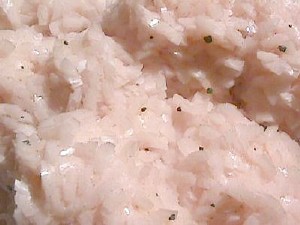
Dolomite
Dolomite
CaMg(CO₃)₂ Properties
- Category
- Mineral
Dolomite is a calcium and magnesium carbonate (CaMg(CO₃)₂) that forms trigonal crystals that are colorless or pinkish, less soluble in acid than calcite, and characteristic of the Alpine dolomites.
Dolomite is a double carbonate that crystallizes in the trigonal system, distinguished from calcite by its stoichiometric 1:1 composition of Ca²⁺ and Mg²⁺. It is named after French naturalist Déodat Gratet de Dolomieu, who in 1791 described the dolomitic rocks of the Alps. It forms predominantly in marine diagenetic environments, where magnesium-rich fluids alter preexisting calcite, or directly from precipitation in lagoons and salt basins. Its hardness of 3.5–4 on the Mohs scale makes it fragile compared to feldspars. A crucial diagnostic feature is its slow, weak reaction with dilute hydrochloric acid at room temperature, whereas calcite reacts vigorously: this property is fundamental for field identification. Dolomite frequently associates with calcite, siderite, barite, and quartz in sedimentary rocks.
Crystal system: trigonal (space group R3̄). Unit cell parameters: a = 4.804 Å, c = 15.95 Å (at 25 °C). Density: 2.86 g/cm³. Hardness: 3.5–4 Mohs; perfect cleavage along 1011. Refractive index: nω = 1.503, nε = 1.679 (negative birefringent, δ ≈ 0.176). Luster: vitreous. Color: colorless, white, pink, yellow; variable UV fluorescence (often absent). Chemical composition: CaMg(CO₃)₂; Ca 21.7%, Mg 13.4%, C 5.0%, O 58.9% (wt%). Solubility: insoluble in cold dilute HCl (diagnostic test), slowly soluble in hot HCl. IR spectroscopy: characteristic absorptions at 2515, 2605 cm⁻¹ (C–O stretching), 1430 cm⁻¹ (CO₃²⁻ bending). Genesis: marine diagenesis, precipitation from supersaturated solutions, metasomatic replacement of calcite. Mineral associations: calcite, siderite, barite, ankerite, fluorite, quartz. Varieties: ferriferous dolomite (with Fe²⁺), manganiferous dolomite (with Mn²⁺).
Mining localities
- Dolomiti, Trentino-Alto Adige, Italia (località tipo)
- Bergamasche, Lombardia, Italia
- Appennini, Emilia-Romagna, Italia
- Cantabria, Spagna
- Voralberg, Austria
- Bacino di Paradox, Utah, USA
- Minerva, Ohio, USA
- Bacino del Permiano, Texas, USA
- Bacino del Golfo, Messico
- Bacino di Carpazi, Romania
Frequently Asked Questions
How do you distinguish dolomite from calcite?
Dolomite reacts much more slowly to dilute acids compared to calcite: while calcite effervesces immediately, dolomite requires hot or powdered acid to react noticeably. Furthermore, dolomite has the formula CaMg(CO₃)₂ with a more ordered trigonal crystal structure, while calcite is CaCO₃.
Where is dolomite found in Italy?
Dolomite is abundant in the Dolomites of Northern Italy, particularly in Veneto, Trentino-Alto Adige, and Friuli-Venezia Giulia, where it forms spectacular rock formations. These deposits originated from ancient marine environments during the Mesozoic, making them a major source for both scientific and tourism purposes.
What is the difference between dolomite and dolomitic rock?
Dolomite is a single mineral with the formula CaMg(CO₃)₂, while dolomitic rock (or dolomite rock) is a rock composed mainly of dolomite crystals, often with varying percentages of calcite and other impurities. A pure dolomitic rock contains at least 50% dolomite mineral.
What are the industrial uses of dolomite?
Dolomite is extracted primarily for the production of cement, dolomitic lime, construction materials, and as an agricultural soil amendment to increase magnesium content. It is also used in steelmaking as a flux and in glass production, as well as a road aggregate.
Entry generated with Claude API (Anthropic) on data extracted from Mindat, RRUFF and Wikipedia. Not yet reviewed by a human expert. Verify data against original sources before citing in formal work.
Sources
- Mindat.org — Dolomite
- IMA — International Mineralogical Association
- Webmineral — Dolomite
- USGS — Dolomite (Mineral)
- Deer, Howie & Zussman — Rock-Forming Minerals Vol. 5