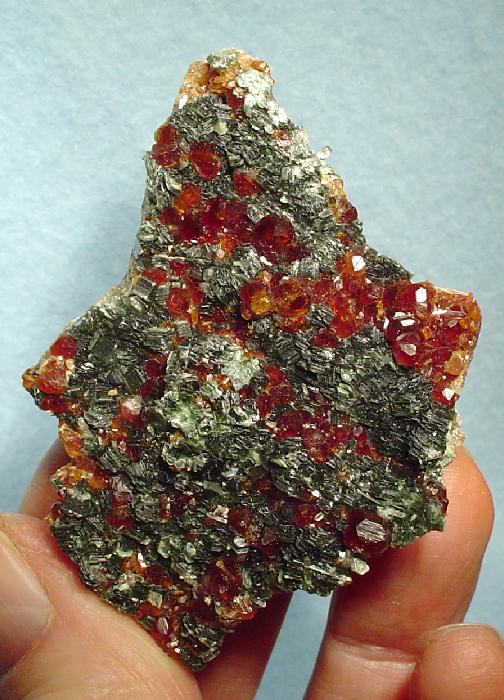
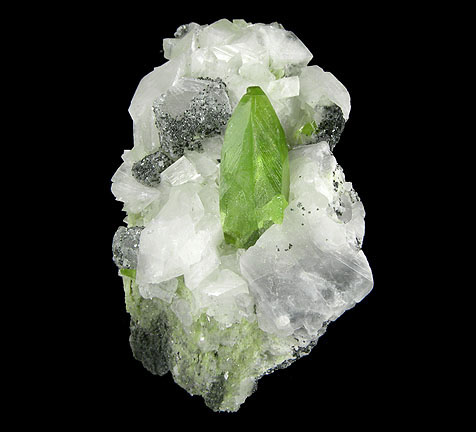
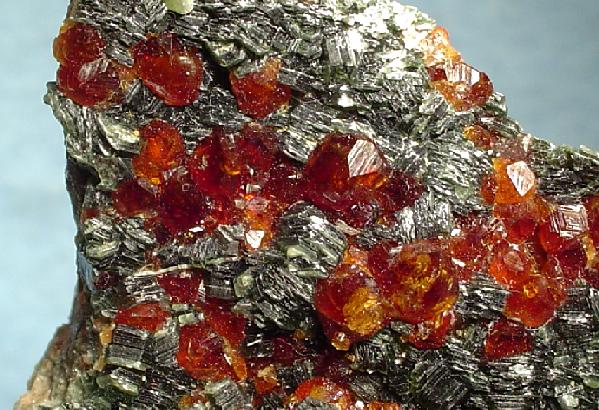
Clinochlore
Clinocloro
Mg₅Al(Si₃Al)O₁₀(OH)₈ Properties
- Category
- Mineral
Clinochlore is a hydrated magnesium and aluminum silicate belonging to the chlorite group, characterized by a layered structure that makes it extremely friable and soft (hardness 2-2.5 on the Mohs scale). It typically occurs as green, yellow, or colorless tabular crystals, forming in low-temperature metamorphic environments.
Clinochlore is one of the most common members of the chlorite family, layered 2:1 silicates in which layers of silicon tetrahedra alternate with octahedral layers rich in magnesium and aluminum. Its general formula Mg₅Al(Si₃Al)O₁₀(OH)₈ highlights the isomorphic substitution between magnesium and aluminum in octahedral positions, responsible for the color variability observed in nature. It forms predominantly in low-temperature metamorphic contexts (greenschist facies), associated with phyllosilicates such as muscovite, chlorite, and talc, as well as in hydrothermally altered igneous rocks. The monoclinic structure with angle β ≈ 97° confers on the mineral perfect cleavage along the (001) plane, from which derive the characteristic flexible yet brittle laminae. Significant deposits are found in the Alps (Switzerland, Austria), the Apennines, Scotland, and the metamorphic regions of central Asia.
Clinochlore — Mg₅Al(Si₃Al)O₁₀(OH)₈. Crystal system: monoclinic, space group C2/m. Lattice parameters: a ≈ 5.3 Å, b ≈ 9.2 Å, c ≈ 14.2 Å, β ≈ 97°. Mohs hardness: 2–2.5. Density: 2.65–2.78 g/cm³. Cleavage: perfect along (001). Color: pale green, yellow, colorless; white streak. Luster: vitreous to pearly on cleavage surfaces. Transparency: transparent to translucent. Refractive index: nα ≈ 1.57, nβ ≈ 1.60, nγ ≈ 1.61; birefringence Δn ≈ 0.04 (positive). Optic angle 2V ≈ 0–40° (variable with composition). IR spectroscopy: characteristic absorption bands at 3,620 cm⁻¹ (O–H stretch), 1,000–1,200 cm⁻¹ (Si–O stretch). Raman spectroscopy: diagnostic peaks at ~280, ~350, ~680 cm⁻¹. UV fluorescence: generally inert. Mineral associations: muscovite, quartz, feldspar, epidote, magnetite. Formation environment: regional metamorphism in greenschist facies; hydrothermal alteration of mafic igneous rocks.
Mining localities
- Alpi Svizzere (Canton Grigioni, Vallese) — cristalli verdi in marmi metamorfici
- Alpi Austriache (Tirolo) — associato a feldspato e quarzo in micascisti
- Appennini (Liguria, Toscana) — in rocce metamorfiche della facies degli scisti verdi
- Scozia (Highlands) — in metabasiti e scisti verdi
- Corsica — in marmi e micascisti
- Pirenei (Francia, Spagna) — in zone metamorfiche a bassa temperatura
- Alpi Marittime — in associazione con clorite e talco
Frequently Asked Questions
How do you identify clinochlore and what are its main characteristics?
Clinochlore is easily recognizable by its green, yellow, or colorless hue and its lamellary structure with very friable tabular crystals. Its extremely low hardness (2-2.5 on the Mohs scale) makes it distinctive because it can be scratched easily with a knife and leaves visible marks on a white surface. It belongs to the chlorite group and is a hydrated magnesium and aluminum silicate with the formula Mg₅Al(Si₃Al)O₁₀(OH)₈.
In what geological environments does clinochlore form and where can it be found?
Clinochlore forms primarily in low-grade metamorphic rocks, such as greenschists and phyllites, and is also common in hydrothermal deposits associated with altered igneous rocks. Major deposits are found in Switzerland, Brazil, Madagascar, China, and the United States, frequently in association with other low-pressure and temperature metamorphic rocks.
What are the physical and chemical properties of clinochlore and how do they influence its use?
Clinochlore has a lamellar structure that makes it very friable and easily exfoliable, with a density of approximately 2.6-2.8 g/cm³ and a low refractive index. These properties make it unsuitable for major industrial applications, but make it valued by mineral collectors and useful for petrological and metamorphic studies as an indicator of low-grade conditions.
What is the price of clinochlore and where can you buy it as a mineral specimen?
Clinochlore has no significant commercial value as raw material, but well-formed crystalline specimens typically cost between 5 and 50 euros depending on quality, size, and geographical origin. It can be purchased from specialized mineral dealers, international mineral fairs, and online platforms dedicated to collectors, as its main value lies in scientific and collecting interest rather than industrial applications.
Entry generated with Claude API (Anthropic) on data extracted from Mindat, RRUFF and Wikipedia. Not yet reviewed by a human expert. Verify data against original sources before citing in formal work.