Black Tourmaline
Tormalina Nera
NaFe₃Al₆(BO₃)₃Si₆O₁₈(OH)₄ Properties
- Category
- Mineral
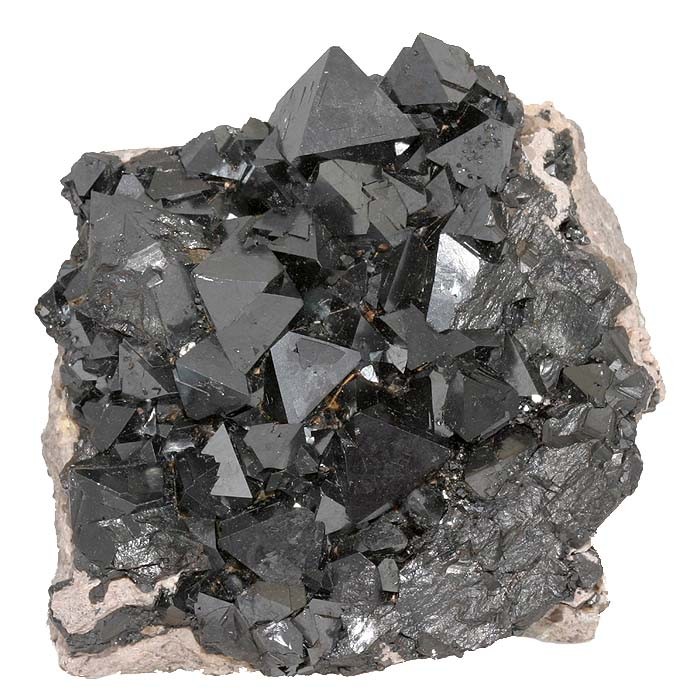
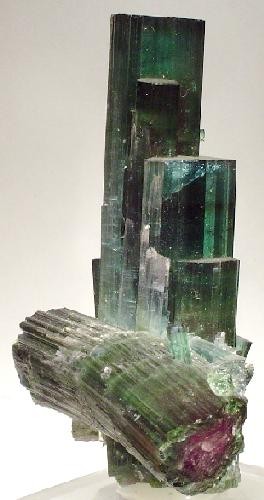
Black tourmaline is a complex borosilicate of boron and iron that forms black prismatic crystals, often striated longitudinally, with hardness 7-7.5 on the Mohs scale. It is the most common member of the tourmaline group and is found in granitic pegmatites and metamorphic rocks worldwide.
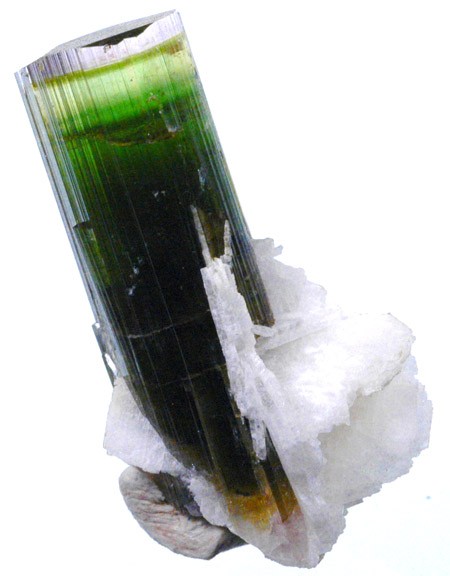
Black tourmaline, the *schorl* variety of the tourmaline group, is a trigonal cyclosilicate that crystallizes in vertically striated prisms, sometimes highly elongated. Its structural formula [Na(Fe₃²⁺)Al₆(BO₃)₃Si₆O₁₈(OH)₄] reveals a composition rich in ferrous iron, responsible for its intense black and opaque color. It forms predominantly in *granitic pegmatite* environments and in high-pressure metamorphic rocks, often in association with feldspars, quartz, and micas. Black tourmaline is piezoelectric: when subjected to mechanical pressure it generates an electric potential difference, a property that made it of interest for technological applications in the twentieth century. Exceptional crystals come from pegmatites in Brazil (Minas Gerais), Namibia, and Afghanistan, while economically significant deposits are found in Sri Lanka and California. In the gemological market, it is valued for crystalline specimens and, rarely, for cabochons when sufficiently transparent.
Crystal system: trigonal, space group *R3m*. Lattice parameters: *a* ≈ 15.84 Å, *c* ≈ 10.35 Å. Mohs hardness: 7-7.5. Density: 3.10-3.25 g/cm³ (variable with iron content). Refractive index: *n_ω* ≈ 1.635-1.675, *n_ε* ≈ 1.610-1.650 (negative birefringence, Δ ≈ 0.015-0.025). Marked pleochroism: very dark color along the *c* axis, paler perpendicularly. UV-Vis spectroscopy: absorption in the visible spectrum with characteristic bands around 400-500 nm due to *d-d* transitions of Fe²⁺. Magnetism: paramagnetic (χ ≈ 10⁻⁵ cgs). Piezoelectricity: present, with piezoelectric coefficient *d₃₃* ≈ 2-4 pC/N. Fluorescence: generally absent. Cleavage: none; conchoidal fracture. Loessity: sometimes present on prismatic faces. Common inclusions: apatite, quartz, feldspar. Distinction from *blue tourmaline* (indicolite) and *brown tourmaline* (dravite) is based on chemical analysis (EDS, EPMA) and Raman spectroscopy, which shows characteristic peaks at 158, 204, and 356 cm⁻¹ for pure schorl.
Mining localities
- Minas Gerais, Brasile — pegmatiti con cristalli eccezionali fino a 30 cm
- Namibia (Erongo Region) — pegmatiti con cristalli di qualità gemmologo
- Afghanistan (Kunar Province) — cristalli trasparenti e ben formati
- Sri Lanka (Matara District) — giacimenti alluvionali storici
- California, USA (San Diego County) — pegmatiti con associazioni mineralogiche ricche
- Baviera, Germania (Waldviertel) — pegmatiti paleozoiche
- Madagascar — pegmatiti con varietà colorate associate
Entry generated with Claude API (Anthropic) on data extracted from Mindat, RRUFF and Wikipedia. Not yet reviewed by a human expert. Verify data against original sources before citing in formal work.