Basalt
Basalto
SiO₂ + MgO + FeO Properties
- Category
- Rock
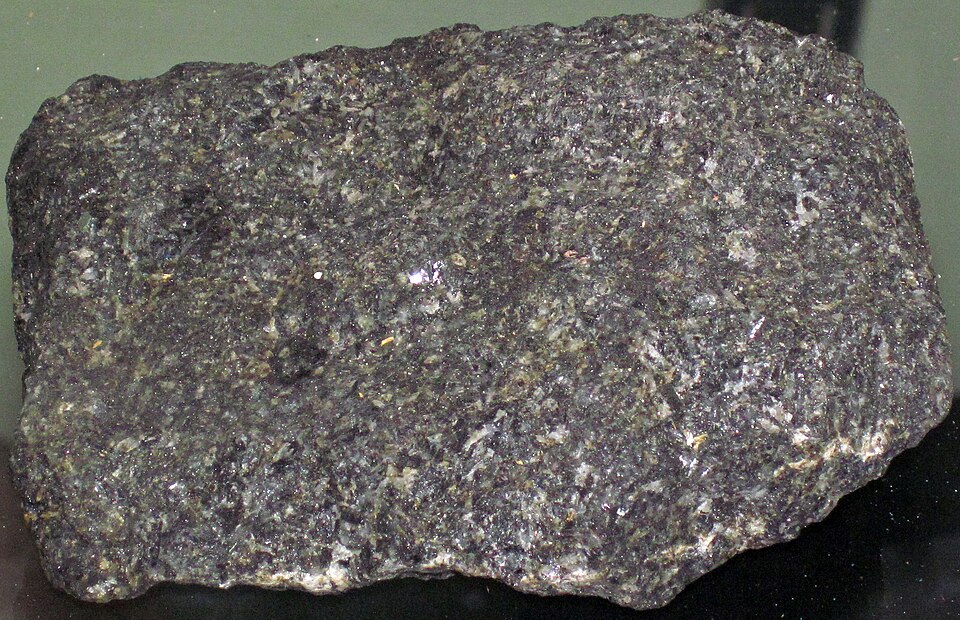
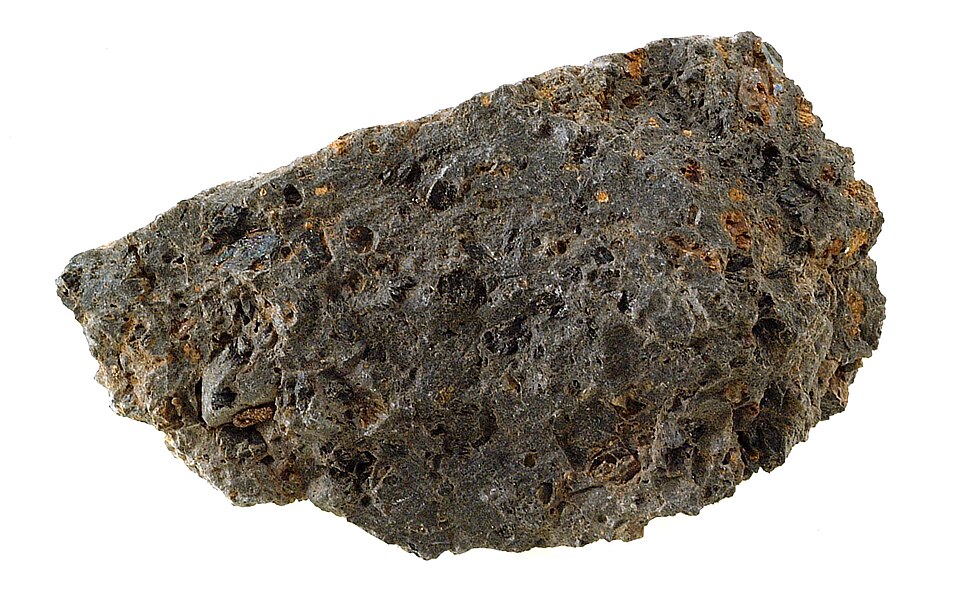
Basalt is a dark and dense volcanic rock formed by the rapid cooling of lava rich in iron and magnesium, composed primarily of silicates such as plagioclase and pyroxene. It is the most abundant rock in Earth's crust and constitutes oceanic floors, characterized by its aphanitic structure (microscopic crystals invisible to the naked eye).
Basalt is an extrusive volcanic rock representing the solidified product of magma eruptions with basic composition, characterized by low silica content (approximately 45-52% SiO₂) and high concentration of iron and magnesium. Its formation occurs when lava, rich in olivine, pyroxene (augite), and calcic plagioclase, cools rapidly at the surface, preventing the growth of visible crystals. This process generates an aphanitic or glassy structure, depending on cooling rate: classic basalt exhibits a fine-grained texture, while glassy basalt (obsidian) results from extremely rapid cooling.
Geologically, basalt is the dominant rock of volcanic plateaus, oceanic hot spots (such as Hawaii), and mid-ocean ridges, where plate tectonics continuously generates new basaltic crust. On Earth, basalt covers approximately 70% of oceanic floors and constitutes layers hundreds of meters thick in regions such as Iceland, the Deccan plateau in India, and the Columbia River Plateau. Its density (2.7-3.0 g/cm³) exceeds that of granite, reflecting the abundance of heavy iron-magnesium minerals. Historically, basalt has been used as building stone since antiquity: ancient Egyptians employed it for statues and vessels, while in modern architecture it is valued for its resistance to erosion.
Mineralogical composition: basalt is a polymineralic rock composed primarily of plagioclase (anorthite An₅₀₋₇₀, 40–60% by volume), pyroxene (augite, 20–40%), and often olivine (Mg₂SiO₄–Fe₂SiO₄, 0–30%). Accessory minerals include magnetite (Fe₃O₄) and ilmenite (FeTiO₃), responsible for the black coloration.
Physical properties: density 2.7–3.0 g/cm³; hardness 5–6 Mohs (plagioclase 6, pyroxene 5–6); irregular to conchoidal fracture; vitreous to opaque luster; color ranging from dark gray to black. The refractive index varies from 1.55 to 1.70 depending on mineralogical composition.
Crystal structure: basalt is amorphous or microcrystalline with crystals < 1 mm. The texture is ophitic (pyroxene intergranular to plagioclase) or intersertal (volcanic glass among crystals). In more slowly cooled basalts, phenocrysts of olivine or plagioclase may develop embedded in an aphanitic matrix.
Average chemical composition: SiO₂ 48–52%, Al₂O₃ 14–18%, FeO + Fe₂O₃ 10–14%, MgO 7–11%, CaO 10–12%, Na₂O + K₂O 1–3%. The Mg# ratio (MgO/(MgO+FeO)) varies from 0.5 to 0.7.
Genetic origins: basalt derives from partial melting of the mantle (peridotite) at depths of 30–100 km, with crystallization temperatures between 1100–1200 °C. The degree of melting is typically 10–20%. IUGS classification: tholeiitic basalt (subalkaline, iron-rich) vs. alkaline basalt (enriched in K, Na, and incompatible elements). Raman spectroscopy and XRD confirm the presence of plagioclase, pyroxene, and iron oxides.
Mining localities
- Islanda (Eyjafjallajökull, Hekla)
- Hawai, USA (Kilauea, Mauna Loa)
- Deccan Plateau, India
- Columbia River Plateau, Oregon-Washington, USA
- Etna, Sicilia, Italia
- Stromboli, Isole Eolie, Italia
- Craters of the Moon, Idaho, USA
- Giant's Causeway, Irlanda del Nord
- Basalti del Karoo, Sudafrica
- Altopiano vulcanico del Rif, Marocco
Frequently Asked Questions
How do you recognize basalt and what are its main characteristics?
Basalt is a dark, almost black volcanic rock that is very dense and heavy to touch, with a fine crystalline structure due to rapid lava cooling. It is composed mainly of plagioclase and pyroxene minerals, which give it a glossy and granular appearance under magnification, and often displays characteristic hexagonal columnar structures when cooled in large masses.
Where is basalt found and how is it formed?
Basalt forms from the rapid cooling of iron and magnesium-rich lava (approximate formula: SiO₂ + MgO + FeO) during volcanic eruptions, and is the most abundant rock in Earth's crust, primarily composing ocean floors. It is found in large quantities in volcanically active zones, lava plains, and oceanic basements throughout the world.
What are the practical uses of basalt and what does it cost?
Basalt is widely used as a building material for paving, pavements, and road aggregates thanks to its high wear resistance, as well as for the production of basalt fibers used in technical applications and thermal insulation. Prices typically range from 15 to 50 euros per cubic meter depending on quality and source, making it economical compared to other natural stones.
What is the difference between basalt and granite?
Basalt is a dark volcanic rock with fine crystals formed from rapid lava cooling, while granite is a light plutonic rock with large crystals formed from slow magma cooling at depth. Basalt is significantly denser and harder than granite, with a chemical composition rich in iron and magnesium, whereas granite is rich in quartz and potassium feldspar.
Entry generated with Claude API (Anthropic) on data extracted from Mindat, RRUFF and Wikipedia. Not yet reviewed by a human expert. Verify data against original sources before citing in formal work.