Azurite
Azzurrite
Cu₃(CO₃)₂(OH)₂ Properties
- Category
- Mineral
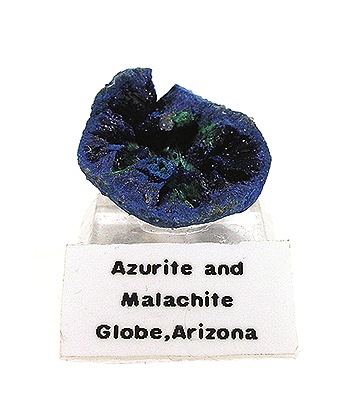
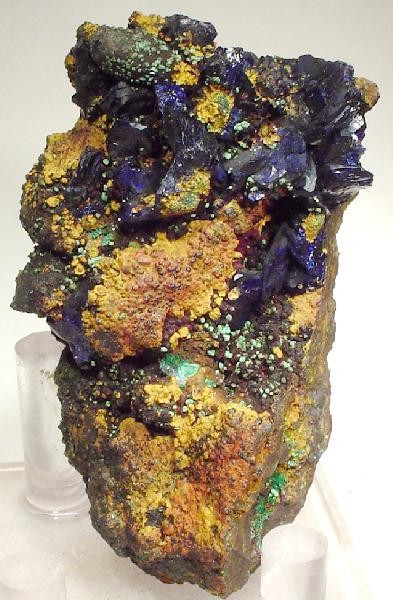
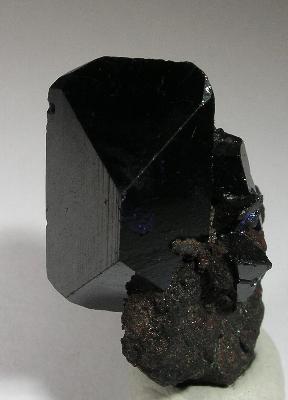
Azurite is a basic copper carbonate that forms splendid intensely blue crystals, often associated with oxidation zones in copper deposits. Its characteristic color and relative fragility make it more valued by collectors than as a gemstone for jewelry.
Azurite (Cu₃(CO₃)₂(OH)₂) is a secondary mineral that forms in the superficial oxidizing environment of copper deposits, where acidic solutions percolate through rocks containing primary copper minerals such as chalcocine and chalcocite. Its intense blue color, due to the presence of Cu²⁺ ions, has made it famous since antiquity: the Greeks and Romans pulverized it to obtain the precious blue pigment for frescoes and manuscripts. It crystallizes in the monoclinic system, developing prismatic or tabular habits, sometimes accompanied by malachite (Cu₂(CO₃)(OH)₂), its green mineral twin, with which it forms characteristic mineralogical associations. Its modest hardness (3.5–4 on the Mohs scale) and fragility due to perfect cleavage make it delicate: specimens of gemmological quality are rare and highly sought after by international mineral collectors.
Crystal system: monoclinic, space group P2₁/c. Unit cell parameters: a = 4.98 Å, b = 5.95 Å, c = 9.97 Å, β = 92.4°. Hardness: 3.5–4 Mohs; relative density: 3.77–3.89 g/cm³. Refractive index: nα = 1.730, nβ = 1.758, nγ = 1.838 (birefringence Δn ≈ 0.108, strong). Pleochroism: intense blue to light blue. Perfect cleavage along (11), high fragility. Soluble in dilute acids with effervescence (carbonate test). UV spectroscopy: weak fluorescence. Typical mineral associations: malachite, limonite, calcite, quartz. Formation: supergene alteration in oxidation zones of copper deposits (copper porphyries, veins). Decomposition temperature: ~220 °C (loss of H₂O), ~350 °C (conversion to malachite).
Mining localities
- Morenci, Arizona (USA) — esemplari di eccezionale qualità
- Chessy, Lione (Francia) — località classica storica, sinonimo 'chessylite'
- Tsumeb, Namibia — cristalli blu intensi di notevoli dimensioni
- Bisbee, Arizona (USA) — giacimenti cupriferi storici
- Lavrion, Grecia — siti di estrazione antichi
- Codelco, Atacama (Cile) — giacimenti moderni di rame
- Malachite Belt, Congo Democratico — associazioni con malachite
Frequently Asked Questions
How is azurite formed and where is it found?
Azurite forms in oxidation zones of copper deposits, where meteoric waters alter primary copper minerals. It is found primarily in deposits such as Chessy in France, Tsumeb in Namibia, and US mines, often associated with green malachite.
Why is azurite fragile and how should it be stored?
Azurite is fragile due to its delicate crystal structure and low hardness (3.5-4 on Mohs scale), and it is sensitive to moisture, tending to alter to malachite over time. To preserve it, avoid impacts, excessive humidity, and prolonged direct sunlight.
What is the chemical formula of azurite and what are its main properties?
Azurite is a basic copper carbonate with formula Cu₃(CO₃)₂(OH)₂, characterized by intense blue color, vitreous luster, and perfect cleavage. It effervesces in dilute acids, releasing carbon dioxide, a diagnostic property fundamental for identification.
What is the price and value of an azurite crystal?
The price of azurite varies significantly based on size, crystal quality, and origin: small raw crystals cost €5-20, while rare collector specimens can reach €100-500. The most valued specimens come from Tsumeb and Chessy.
Entry generated with Claude API (Anthropic) on data extracted from Mindat, RRUFF and Wikipedia. Not yet reviewed by a human expert. Verify data against original sources before citing in formal work.