Aragonite
Aragonite
CaCO₃ Properties
- Category
- Mineral
Aragonite is a calcium carbonate (CaCO₃) that crystallizes in delicate, needle-like forms, often grouped in flower-like or star-shaped structures. It is the most unstable mineral among the polymorphs of calcium carbonate and slowly transforms into calcite over millions of years.
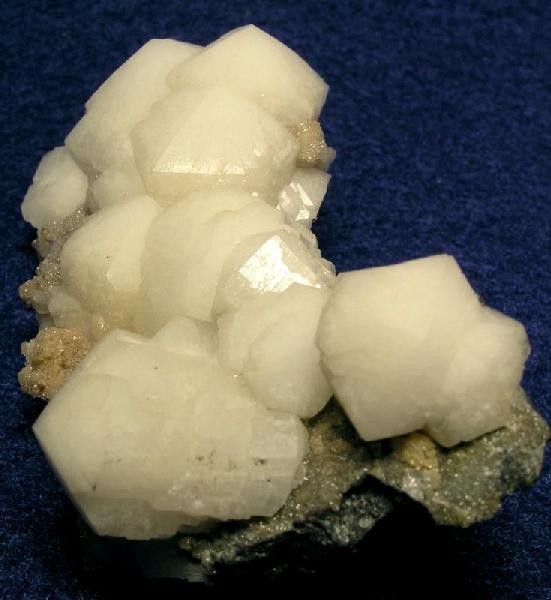
Aragonite represents one of three principal polymorphs of calcium carbonate, alongside calcite and vaterite. Unlike calcite, which crystallizes in the trigonal crystal system, aragonite adopts the orthorhombic crystal system, with space group *Pmcn*. This different crystal structure renders it thermodynamically unstable at ordinary temperatures and pressures: over geological time, aragonite gradually transforms into calcite, the most stable polymorph. It forms characteristic acicular crystals (thin needles) or pseudohexagonal habits, often grouped in radiated aggregates reminiscent of cactus flowers. It is commonly found in coastal sedimentary environments, in mollusk shells, coral skeletons, and shallow marine sediments. It is also an important component of nacre (mother-of-pearl) and forms in cave deposits of stalactites and stalagmites where waters are rich in calcium. Its hardness of 3.5–4 on the Mohs scale makes it fragile and easily soluble in dilute acids.
Crystal system: orthorhombic, space group *Pmcn* (Z = 4). Lattice parameters: a = 5.741 Å, b = 7.975 Å, c = 4.959 Å. Density: 2.93–2.95 g/cm³. Mohs hardness: 3.5–4. Cleavage: perfect along (10), good along (110). Crystal habit: acicular, pseudohexagonal, often in radiated or fibrous aggregates. Color: colorless, white, yellowish, pink, brown; transparent to translucent. Refractive index: α = 1.530, β = 1.682, γ = 1.685; positive birefringent. Pleochroism: weak. Solubility: vigorous effervescence in dilute HCl (10%). IR spectroscopy: characteristic carbonate absorptions at ~1500 cm⁻¹ and ~875 cm⁻¹. UV fluorescence: generally inert, occasionally weakly fluorescent (blue or orange). Thermal stability: progressive transformation toward calcite at ordinary temperatures; inversion is accelerated by pressure and the presence of impurities. Mineral associations: calcite, gypsum, halite, celestine, barite; frequent in marine sediments, shells, corals, pearls. Genesis: direct precipitation from seawater, biogenic formation (skeletons), diagenesis of coastal sediments, cave deposits.
Mining localities
- Molini di Trieste (Friuli-Venezia Giulia, Italia) — cristalli pseudoesagonali in sedimenti marini
- Grotta di Castellana (Puglia, Italia) — aragonite in stalattiti e stalagmiti
- Flos Ferri, Sardegna (Italia) — forme aciculari in cavità
- Spagna — giacimenti costieri e depositi di grotta
- Messico — aragonite biogenica in conchiglie e sedimenti marini
- Giappone — forme pseudoesagonali in ambienti marini
- Namibia — aragonite in depositi sedimentari costieri
- Marocco — cristalli aciculari in cavità
- Perù — aragonite in sedimenti marini e depositi di grotta
Frequently Asked Questions
How do you recognize aragonite and what is the difference from calcite?
Aragonite is distinguished from calcite by its characteristic crystal form: it crystallizes in needle-like structures, often grouped in flower or star patterns, while calcite forms rhombohedral crystals. Both have the formula CaCO₃ but different crystal structures; aragonite is metastable and over time (millions of years) slowly transforms into calcite, the most stable form.
Where is aragonite found in nature and what are the main deposits?
Aragonite forms primarily in warm, shallow marine environments, in mollusk shells, coral skeletons, and underground aragonite caves. The main deposits are found in Spain (Molina de Aragón), Austria, Mexico, and in some tropical coastal environments where physico-chemical conditions favor its precipitation.
What is the price of aragonite and where can you buy it?
Aragonite prices vary considerably based on quality, size, and origin: small specimens (2-5 cm) average 5-15 euros, while museum-grade pieces can reach 50-200 euros. It is available from specialized mineral shops, international gem markets, and online platforms dedicated to mineral and crystal sales.
Why does aragonite transform into calcite and how long does it take?
Aragonite is thermodynamically unstable at ordinary temperatures and pressures; it tends to transform into calcite because this is the most stable crystalline form of CaCO₃ under normal terrestrial conditions. This transformation is very slow and requires millions of years, depending on factors such as temperature, humidity, and the presence of groundwater that facilitates recrystallization.
Entry generated with Claude API (Anthropic) on data extracted from Mindat, RRUFF and Wikipedia. Not yet reviewed by a human expert. Verify data against original sources before citing in formal work.